


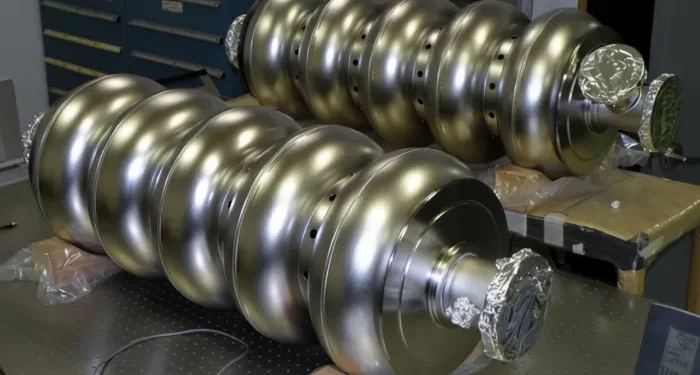
Scientists at the U.S. Department of Energy’s Thomas Jefferson National Accelerator Facility are utilizing advanced artificial intelligence to keep their high-powered particle accelerator running smoothly. The machine, known as the Continuous Electron Beam Accelerator Facility (CEBAF), relies on hundreds of carefully tuned superconducting cavities that push electrons to nearly the speed of light. Each cavity acts as a resonant structure powered by radiofrequency waves and becomes superconducting at extremely low temperatures, colder than deep space. These cavities are essential for CEBAF’s performance, making the accelerator one of the world’s first to use superconducting radiofrequency technology on a large scale.
CEBAF supports research for more than 1,650 nuclear physicists worldwide, but maintaining stable conditions inside its 418 cavities is challenging. Occasionally, changes within a cavity can cause the system to lose its superconducting state, resulting in abrupt shutdowns called “system trips.” These interruptions delay important experiments. To address this issue, a team of researchers, including data scientists and experts from Jefferson Lab and several universities and national laboratories, has developed machine learning techniques that help predict and monitor the accelerator’s behavior.
The team focused on reinforcement learning, a type of AI that learns by playing repeated high-speed simulations, similar to how a computer teaches itself chess. By providing the computer with the rules of physics instead of just example data, the model can learn faster and more transparently. Deep differentiable reinforcement learning, an advanced version, quickly adapts its neural networks by correcting errors, speeding up problem-solving in the complex environment of the accelerator.
Constructing accurate models is difficult because each cavity exhibits unique thermal behaviors and susceptibilities. Researchers evaluated different machine learning approaches on a section with approximately 200 superconducting cavities, striving to ensure the models reflected real physics and remained explainable. With these advancements, operators can better foresee system trips and optimize the balance between cooling load and experiment delays, visualizing solutions on a Pareto front—a graph showing the best possible trade-offs.
The cavities themselves are made from ultrapure niobium, housed in steel cryomodules, immersed in liquid helium, and kept just above absolute zero. These extreme conditions make them highly sensitive to temperature shifts. The new AI models, supported by mathematical equations paired with known physics, allow scientists to see and trust how machine learning makes predictions. This transparency helps improve control, minimize disruptions, and could lead to even more efficient operation of CEBAF in the future. Funding for this research came from various DOE programs and partnerships with other labs and institutes, marking a significant step forward in combining physics with artificial intelligence.
Read More