


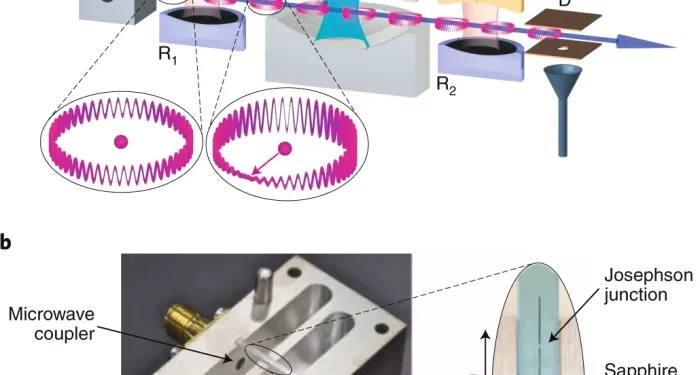
Researchers have made significant progress in understanding how light and matter interact within specialized environments known as cavities, offering new insights into quantum electrodynamics (QED) systems. Through careful experiments and theoretical work, scientists have clarified how photons — particles of light — behave differently when described under quantum versus semi-classical models, particularly as it relates to thermodynamics.
The team, including Marcelo Janovitch of the University of Basel and collaborators from Universität Siegen and Collège de France, studied a system where a three-level atom is connected to a cavity and driven by an external light source. Their investigation focused on bridging the gap between purely quantum mechanical models and simpler, semi-classical approaches often used to describe light-matter interactions.
By formulating a rigorous semi-classical limit, the researchers showed that many traditional thermodynamic approaches break down in this context. One key discovery was that these standard models can overestimate entropy, or disorder, in the system by failing to recognize when photons are being reused as a genuine power source. In contrast, the input-output thermodynamic framework properly captures the power contribution made by the coherent part of the photon field, ensuring a more accurate match with the semi-classical predictions.
To illustrate these findings, the study used a three-level maser — a type of quantum heat engine — coupled to a cavity. The researchers’ results indicate that the way photons are managed by the cavity creates two valid, but different, ways to interpret the system’s thermodynamic behavior. In one approach, photons are seen as lost energy, while in another, they can be repurposed and counted as work performed by the system.
Importantly, the work also highlighted how these differences affect established thermodynamic uncertainty relations, which impose fundamental limits on the performance and fluctuations of energy flows in these systems. Only by using the input-output framework do the semi-classical models preserve expected violations of these uncertainty relations. This new understanding could help improve the design and efficiency of future quantum machines and thermal devices that rely on cavity QED.
Read More