

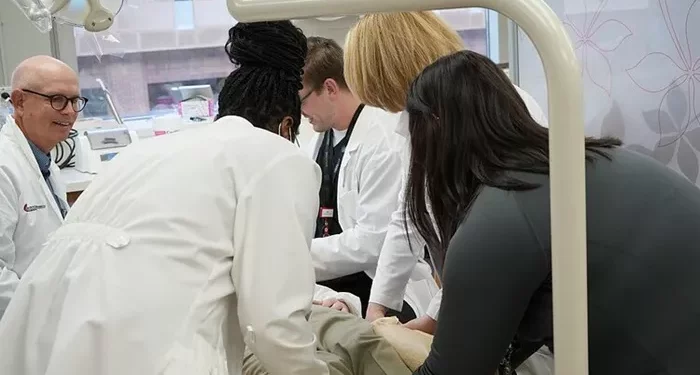
In recent years, Ohio State University’s Nissonger Center has attracted patients with disabilities from all over the country, many of whom travel hundreds of miles to seek dental care at the Columbus campus.
Dr. Stephen Beetstra, director of the center’s dental program, said this reflects the serious shortage of accessible dental services.
“We have patients from all counties in Ohio, even from neighboring states such as Kentucky and West Virginia, and some patients come from as far away as Arkansas,” Beetstra said. “Many people can only get appropriate treatment here with specialized training and equipment.”
Inclusive dentistry is gradually improving the medical experience for people with disabilities, dental anxiety patients and other special needs groups.
Delta Dental Foundation in Okemos, Michigan, actively supports the development of this field, providing training, sensory-friendly equipment and resources to help clinics in Michigan, Ohio and Indiana establish inclusive dental centers.
As pioneers in this field, Ohio State University’s Nissonger Center, Fort Wayne Community Health Center in Indiana and Jackson Family Health Center in Michigan are committed to creating a warm treatment environment, providing personalized care, and helping patients overcome barriers to medical care.
Founded in 1971, the Nisonger Center is affiliated with the Ohio State University College of Medicine and uses an interdisciplinary team model, including doctors, psychologists and rehabilitation therapists, to provide comprehensive care for patients with intellectual and developmental disabilities.
Beetstra revealed that the center will soon provide immersive training for community clinics of other registered inclusive dental centers to ensure that treatment not only solves oral problems, but also focuses on the overall health and comfort of patients.
Through innovative tools and training, the center has successfully avoided the use of sedatives for 85% of patients, which not only ensures patient safety but also significantly reduces medical costs.
“Operating room treatment costs can be as high as $12,000 to $15,000, and we can provide safer and more economical care in the clinic,” he said.
One of the innovative devices, the “vacuum backpack”, stabilizes the patient’s body by shaping, which is particularly suitable for patients with cerebral palsy, greatly improving the comfort and safety of treatment.
At the same time, cultivating a new generation of inclusive dentists has also become an important measure to narrow the gap in care for people with disabilities.
People with disabilities face multiple obstacles such as inconvenient transportation, complex diseases, multiple drug interactions, limited fine motor skills, extreme anxiety and even inability to open their mouths, which leads to a much higher incidence of oral diseases than the general population.
According to a survey by the Indiana University Center for Health Equity, nearly half of people with disabilities have experienced gum pain or bleeding, and two-thirds of them have lost teeth due to untimely treatment of oral problems.
Beetstra emphasized: “Oral health is crucial for people with disabilities. Aspiration pneumonia is one of their main causes of death, often caused by oral bacteria. Maintaining oral hygiene not only protects teeth, but also prevents serious or even fatal infections.”
In Fort Wayne, Indiana, community health centers are also actively responding to the shortage of dental care. Chief Dental Officer Dr. Tyler Kimmel said that the support of the Delta Dental Foundation has provided important support for the clinic to promote inclusive care.
By providing training and consultation, the foundation helped the clinic introduce dimmable LED lights, weighted blankets and sensory tools, significantly improving the patient experience.
Staff training at the New York University Center for People with Disabilities has also promoted the popularization of practical methods to provide caring services for patients with special needs.
Kimmel added, “Our inclusive approach not only benefits people with disabilities, but also those with anxiety, those with a history of trauma, and nervous children. We are committed to providing trauma-informed care for all.”
Fort Wayne Neighborhood Health Center serves about 20,000 patients each year, integrating dental care into primary care and embedding dental hygienists to break down the barriers between dentistry and overall care.
“Oral health is closely linked to chronic conditions such as diabetes and heart disease. By working as a team, we are making dental care more accessible to patients,” Kimmel said.
The clinic plans to open a new clinic next summer with disability-friendly amenities, including frosted sliding glass doors for a personalized environment and portable dental equipment.
“The foundation grant will allow us to expand this environment to all 15 offices, which not only improves the patient experience, but also creates a quiet and comfortable workspace for our staff, which is a win-win for everyone,” Kimmel said.
In Jackson, Michigan, Dr. Katherine Thornton, dental director at Family Health Center, also spoke highly of the support of the Delta Dental Foundation.
“We sent teams to the University of Pennsylvania and New York University for training, and the foundation funded us to build a sensory room and remodel the operating room,” she said.
The sensory room, equipped with custom lighting, soundproofing and a comfortable sofa bed, serves as both a waiting area and a decompression area, as well as patient-adjustable LED lighting and star projection, which significantly enhances the patient and staff experience.
Thornton shared the treatment experience of a teenager who previously could only receive dental treatment under general anesthesia, but now can receive treatment without sedation in the office with the help of a sensory-friendly environment and nitrous oxide.
Despite these achievements, inclusive dentistry still faces systemic challenges. For example, desensitization treatment (to help patients adjust to the office environment) is often not covered by insurance, which puts financial pressure on the office and patients, and special patients often require longer visits.
According to the Centers for Disease Control and Prevention, approximately 8.2% of Michigan residents with disabilities have difficulty living independently, and 4.7% have difficulties with self-care (including brushing their teeth), which leads to higher rates of tooth decay and oral health disparities.
Thornton concluded: “Every little progress counts, and consolidating these gains is key to our progress.”