


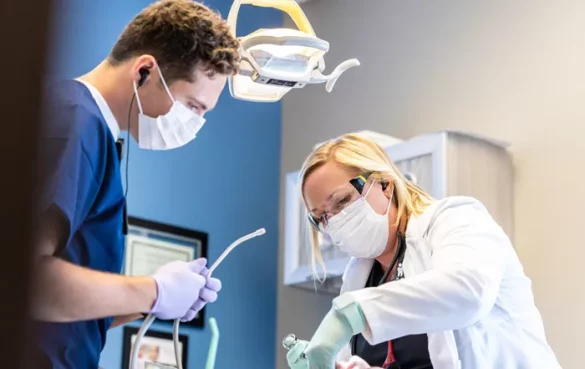
NEW DELHI — India has inaugurated a state-of-the-art Dental Technology Innovation Hub at the Maulana Azad Institute of Dental Sciences, aiming to strengthen the country’s dental technology ecosystem and reduce reliance on imported implants. Union Minister Dr. Jitendra Singh led the launch, underscoring the government’s focus on innovation, accessibility, and affordability in healthcare.
Supported by the Department of Science and Technology (DST) and the Indian Council of Medical Research (ICMR), the Hub will promote collaboration among startups, micro, small, and medium enterprises (MSMEs), and public-private stakeholders. It is designed as a platform for research, development, and commercialization of advanced dental technologies, including AI-assisted tools and interdisciplinary solutions.
The Hub will host workshops, innovation challenges, and training programs to engage students, researchers, and industry professionals nationwide. By bringing together innovators and entrepreneurs, it aims to translate cutting-edge research into practical dental solutions, enhancing patient care and boosting domestic manufacturing capabilities.
Dr. Singh highlighted the government’s commitment to expanding healthcare education, announcing the addition of more than 1,000 undergraduate and 5,000 postgraduate medical and dental seats. This expansion seeks to cultivate a new generation of practitioners skilled in integrating advanced technologies into clinical practice, improving treatment outcomes and operational efficiency.
The Hub will also facilitate access to modern laboratory infrastructure and encourage interdisciplinary research collaborations. Integrating AI and other innovations in dental science, Dr. Singh noted, will enhance patient care and treatment quality while promoting affordability.
The initiative is part of a broader strategy to foster self-reliance in medical technologies and create a culture of innovation and entrepreneurship in healthcare. By supporting startups, MSMEs, and research hubs, India aims to develop a skilled workforce capable of producing cutting-edge solutions and accelerating indigenous innovations.
Complementing this effort, the government approved the DSIR/CSIR “Capacity Building and Human Resource Development” scheme with an outlay of Rs. 2,277.397 crore (approximately US$276 million). The scheme targets universities, national laboratories, and R&D institutions, providing fellowships, awards, and grants to young researchers across Science, Technology, Engineering, Medical, and Mathematical (STEMM) fields.
These initiatives are expected to benefit thousands of students and early-career researchers, enhancing India’s innovation pipeline and strengthening its global standing in science and technology. By integrating talent development, technological advancement, and industry collaboration, India is positioning itself as a leader in healthcare and scientific innovation, fostering a research-driven, innovation-ready future.