

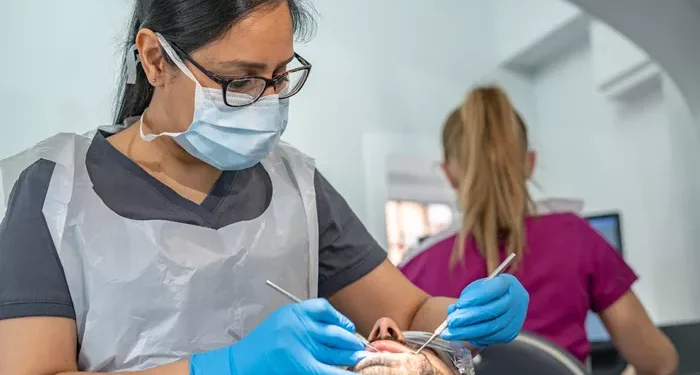
Barking and Dagenham Council and Queen Mary University of London have announced a £4.1 million investment to create a new academic dental centre in central Barking. The facility, on two floors of Maritime House, is scheduled to open to students and patients in September 2026.
The centre will train about 130 dental students each year and provide NHS care to more than 5,000 patients annually. Council leaders say the move comes as the UK faces a national shortage of dentists, with roughly 3,500 NHS posts currently vacant and one in eight dentists approaching retirement within five years.
Local need is acute. In parts of East London, 65% of three- to five-year-olds and almost 80% of 18- to 34-year-olds currently lack access to NHS dental services.
Two in five children in the area suffer from tooth decay. Officials warn that poor oral health is linked to wider conditions such as obesity, smoking-related illness, cardiovascular disease and diabetes.
Funded through the council’s Strategic Community Infrastructure Levy programme, the centre will operate as a community-facing training hub.
Undergraduate and postgraduate students from Queen Mary’s Institute of Dentistry—ranked top in London and 15th globally—will deliver care through outreach and primary service clinics, treating complex oral health needs while gaining practical experience.
The project is positioned as a contribution to national and regional health priorities, including the Government’s 10 Year Health Plan for England and the North East London Integrated Care Board’s efforts to reduce entrenched health inequalities.
Barking and Dagenham is also part of the NHS’s National Neighbourhood Health Programme, one of 43 areas piloting prevention-focused models of care.
Council leaders highlighted wider benefits beyond healthcare. The centre is expected to create around 44 local jobs spanning apprenticeships and roles in reception, sterilisation, security, cleaning and dental nursing. Officials say it will also support local skills development, research and town-centre regeneration.
The investment builds on a deeper partnership between the council and Queen Mary. Last month they signed a 10-year Memorandum of Understanding via the university’s SHAPE Institute—the first UK societal partnership between a local authority and a Russell Group university aimed at tackling health inequalities through research-led, community-driven initiatives.
“Access to good healthcare should not be a postcode lottery,” said Councillor Dominic Twomey, Leader of Barking & Dagenham. He described the centre as a “world-class” facility that will bring training, jobs and improved health to the borough.
Queen Mary officials framed the scheme as part of the university’s long-running commitment to East London. Professor Colin Bailey said the centre will help “train the next generation of much-needed dentists” and reduce dental inequalities.
Professor Sir Mark Caulfield added that the facility represents a “once-in-a-generation opportunity” to improve oral health and remove barriers to care.
The council’s chief executive, Fiona Taylor, said the authority aims to support the NHS 10-year plan and to innovate in public service provision. Councillor Maureen Worby, Cabinet Member for Adult Social Care, Health and Housing, welcomed the growing partnership and its role in embedding health and wellbeing in neighbourhood services.