


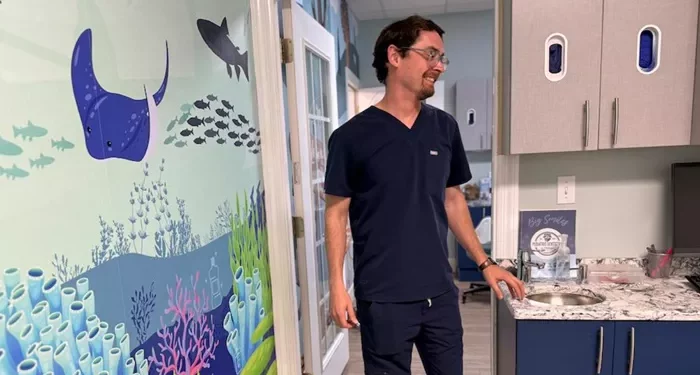
FLORENCE, Ala. — In rare quiet moments between appointments, pediatric dentist Dr. Carson Cruise sometimes does the math in his head. The numbers tell a hard truth: if he stopped accepting Medicaid patients, he could earn the same income while working far fewer hours.
Cruise, 36, owns a pediatric dental clinic in Florence, Alabama, a picturesque town home to the University of North Alabama. All of his patients are children, and about half of them have their dental care covered by Medicaid, the federal–state program for low-income families. Some families drive more than an hour from rural areas to see him. His waitlist stretches four to five months.
“I’ve built great relationships with many of these families,” he said. “I don’t want to abandon them, but it’s getting really difficult to maintain this pace.”
Even though more than half of Alabama’s children are enrolled in Medicaid, Cruise says he is now the only board-certified pediatric dentist in the area who still accepts it.
Alabama illustrates a growing national crisis. Most state Medicaid programs pay dentists significantly less than private insurers do for the same procedures. As a result, fewer dentists accept Medicaid patients, leaving low-income families with limited options and long waits.
According to the American Dental Association, Alabama has fewer dentists per capita than any state except Arkansas. Several counties have no dentists at all, while others — including parts of Lauderdale County, where Cruise practices — are considered “dental deserts,” areas where patients must drive at least 30 minutes for care.
The situation could worsen as the dental workforce ages. In some Alabama counties, more than half of dentists are over 60, and nearly half have no dentists under 40.
Alabama’s Medicaid program reimburses dentists about 46% of their usual charges, on average. For some procedures, Cruise says, reimbursement doesn’t even cover the costs. “You end up losing money on certain treatments,” he said. “That’s why so many dentists stop taking Medicaid altogether.”
Dental care in the U.S. has long been separated from general health care, with inferior coverage and higher out-of-pocket costs. Medicaid dental benefits vary widely from state to state. Only about half of states and Washington, D.C., cover comprehensive dental services for adults. The rest offer limited or emergency-only coverage.
Medicare, the federal health insurance for seniors, does not cover most dental care. Even private dental insurance often leaves patients paying more than they would for medical procedures — typically covering 100% of preventive care but only about 50% of major treatments.
Poor oral health can lead to severe consequences, including heart disease, stroke, pregnancy complications, dementia, and even cancer. It can also impact a person’s mental health and employability.
Zachary Schulz, a public health historian at Auburn University, said he’s seen people denied jobs simply because they were missing teeth. “We view a healthy mouth as a sign of money,” he said.
Recently, Cruise treated a 5-year-old patient with cavities in all 20 baby teeth, several of which were infected. Cases like that require complex dental work under anesthesia in a hospital — but Cruise’s hospital waitlist is about six months long.
Sometimes, parents call in desperation, asking for help before their child’s scheduled procedure. “All we can do is prescribe antibiotics to keep the infection under control,” Cruise said. “It feels like doing Third World care in a First World country.”
Until recently, many Alabama hospitals stopped accepting Medicaid dental patients because reimbursement didn’t cover the costs of operating rooms, anesthesia, or supplies. After advocacy from dentists, one local hospital granted Cruise operating privileges, allowing him to treat patients locally instead of referring them to Birmingham, two hours away.
“It shows that if we try, we can fix things,” he said. “But at the end of the day, it takes money.”
A 2022 Alabama health report found that nearly one in four third graders had untreated tooth decay — higher than the national average. The rates were far worse among children attending lower-income schools, and among Black and Hispanic children compared to white children.
Dr. Stephen Mitchell, a professor at the University of Alabama at Birmingham School of Dentistry, said that while the state’s Medicaid program provides strong eligibility for children under 21, reimbursement remains the biggest obstacle.
The Alabama legislature recently approved a 19% Medicaid funding increase, and dental reimbursement rates have been raised three times since 2021 — yet they remain too low for many dentists. “We’re not the wealthiest state,” Mitchell said. “A dollar of prevention saves a hundred dollars in treatment.”
Cruise says a friend of his, a pediatric dentist just across the border in Mississippi, earns about 25% more for the same Medicaid procedures. For example, Alabama Medicaid reimburses $64 for a child’s tooth extraction, while Mississippi pays $83.
Alabama has recently added a $10-per-visit bonus for dentists treating Medicaid patients — a welcome step, Cruise said, but not enough to close the gap.
Dentists fear that further federal cuts to Medicaid could make matters worse. Former President Donald Trump’s tax and spending law is expected to cut more than $1 trillion from Medicaid over the next decade.
“If that happens, it could turn already thin profit margins into losses,” Cruise said. “We’re doing this with tight budgets already — a cut would be devastating.”
Despite the strain, Cruise remains devoted to his mission. “Most of us have a heart for helping these kids,” he said. “But you can’t keep subsidizing care for the state forever. Something has to give.”
His dilemma reflects a broader truth: without stronger dental insurance coverage and fairer reimbursement, low-income children in Alabama — and across America — will continue to struggle to get the care they need.