


Written by: Sarah Winter, DMD
Introduction
Restoring anterior teeth following trauma presents both functional and aesthetic challenges. In this case, a patient suffered a fall that resulted in the fracture of her maxillary central incisor, requiring a comprehensive restorative approach. The following details our treatment plan, materials used, and the final outcome.
Case Presentation

A female patient presented with a fractured maxillary anterior tooth (No. 9) following a fall (Figure 1). Tooth No. 9 was deemed nonrestorable and required extraction (Figure 2). Our treatment plan included implant placement at site No. 9 and restoration of teeth Nos. 7 through 10 for optimal aesthetics and function.


Treatment Plan and Execution
To achieve a natural and harmonious result, we restored the patient with:
- Implant restoration at site No. 9
- Veneers on Nos. 7, 8, and 10
Given the patient’s naturally bright teeth, we selected a bleach shade for the restorations, ensuring they blended seamlessly while enhancing overall aesthetics, and providing her with strength during the integration and healing phase of her implant placement. Making sure the patient feels confident and cared for during the temporary phase of treatment leads to a better patient experience and greater confidence in the doctor’s ability. Ultimately, making aesthetic temporaries should be seamless and straightforward so that we as clinicians can simply and reliably deliver beautiful results for these aesthetically driven patients and cases.
Provisionalization
Throughout the treatment, we fabricated and modified long-term provisionals using Luxatemp BL (DMG) (Figure 3). Due to the staged nature of her treatment—implant placement followed by gingival augmentation—her provisionals required multiple adjustments.

To facilitate these changes, we were pleased to incorporate DMG’s new LuxaFlow Ultra Bleach Shade, which allowed us to refine the provisional restorations efficiently and aesthetically (Figure 4).

Wax-Up and Impression Technique
A wax-up was created to guide our preparation and provisionalization. We used Genie Putty (Sultan Healthcare) to take an over impression of the wax-up model and lined it with Honigim Light Quad Fast impression material (DMG), ensuring accurate temporization.
Once the teeth were prepped, we used the over impression to create a temporary. We made adjustments to the temporary outside the mouth, using LuxaFlow Ultra to help create an ovate pontic and fill in any bubbles. We used Palaseal (Kulzer) to give it a high shine. We bonded the restoration in place by using a 2 mm area of All-Bond Universal (BISCO) in the center of the prepared teeth and Luxaflow BL on the intaglio surface of the temporary, followed by a 30 s light cure.
Final Provisionalization
Once the implant and the gingival tissue had healed, we went ahead with final preparations of the teeth and the implant was ready for restoration. Again, we fabricated a temporary restoration spanning Nos. 7 through 10 using:
- Genie Putty over impression
- Luxatemp BL
After initial placement and removal from the mouth, we refined the temporaries (Figure 5) by:

- Adjusting for proper contours and length
- Filling air bubbles
- Enhancing the aesthetic profile by slenderizing and reshaping
Conclusion
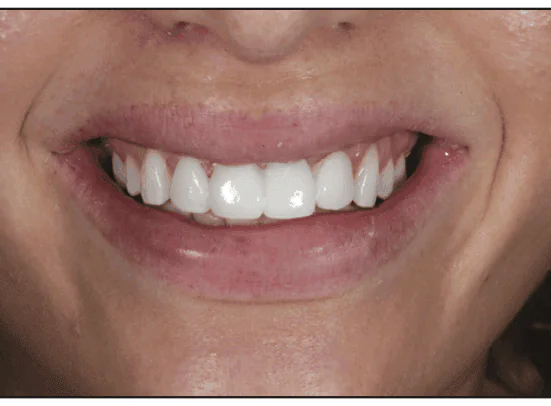
This case demonstrates the importance of meticulous provisionalization in anterior implant and veneer cases. The availability of bleach shades in materials like LuxaFlow Ultra allows for enhanced provisional customization, ensuring seamless transitions throughout the treatment process. Ultimately, our patient achieved a natural, aesthetic outcome with restored function and confidence in her smile (Figure 6).

For more information, visit dmg-america.com.