


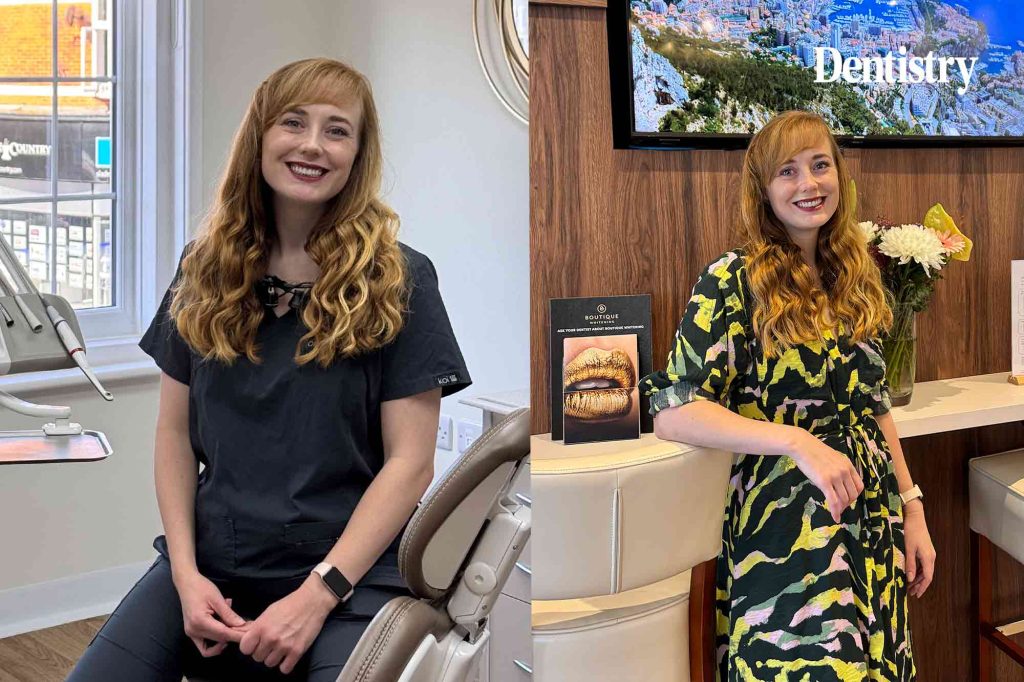
In an honest account of postnatal depression, Amy Baers discusses the silent struggles faced behind closed doors by many new mothers in dentistry.
After days of labour, they finally pass you your baby, and you feel… nothing. Just exhaustion. They tell you that you need to wake every two hours to feed the baby. You’ve already not slept in days. Your body is broken; you don’t recognise it.
Life feels like Groundhog Day. Nappies, feeds, the torture of being woken each time you drift off. The day is spent looking forward to bedtime, only to feel anxiety at the reality that it will be spent in a lonely half-lucid daze of lifting baby up and down out of the cot, panicking you’ll fall asleep feeding and she’ll suffocate in the sheets. You think your baby is in your arms. You hear a cry from across the room. You’re hallucinating. She’s still in her cot. You want to ask for help at night, but ‘breast is best’ so you let your husband sleep.
Eighteen months in and she’s still waking every couple hours. Your mind has forgotten how to rest, you’re in constant fight or flight. You flinch at loud noises and a cry sets off a panic attack. Your chest feels tight all the time. Love has grown but you’re forgetting what it is to feel joy. Everyone tells you to savour the time, but you fantasise about just leaving. You are not built for this; they’d be better off without you.
This was my experience of postpartum and the more I have honest conversations with other mothers, the more I find that so many of us have our own unique but similar stories to tell. Extreme isolation, no village, and social media confounding the guilt. You feel you’re the only one who hasn’t got it together.
At four months postpartum I reached out to my GP about potential postnatal depression (PND) and was met with month’s long waiting lists for any help for myself, and a referral to social services to ensure my baby’s safety. I felt betrayed. As a health professional it is a big step to reach out for mental health support, due to fears it could affect your registration or perceived fitness to work.
Preconceived notions of motherhood
When I was finally allocated someone to come to my house, it was a very young woman, who had never had children. She talked through box breathing while I tried to play with or console my daughter – it was more stressful than helpful. I was lucky that my family noticed my struggles and planned childcare so that I could attend private therapy sessions. This is where I learnt to challenge my preconceived notions of the ‘perfect mother’ and learned it was okay to ask for help.
While there are no direct quantitative studies linking careers in dentistry to postnatal depression, the available research suggests the conclusion isn’t far-fetched. Dentists report very high levels of depression in general (Aziz, 2022, Collin, 2019) and the prevalence of self-declared moderate-severe depression is highest among female dentists at around 44% (Petrović, 2025).
We also know from UK studies that a history of prenatal or prior depression is the strongest predictor of postpartum depression. Women who have suffered with depression in the past are two to five times more likely to suffer with PND (Spry, 2022, Baker et al, 2015). Taken together, it is reasonable to infer that dentists may also be more likely than average to experience postnatal depression.
Personality traits associated with dentists are ‘perfectionist’, ‘hard worker’ and ‘high achiever’. It’s my belief that this is part of what makes us at higher risk of PND. A tendency for maladaptive perfectionism is common in dentists (Collin et al, 2020); this type of personality is likely to feel like a failure when they perceive they are not the ‘perfect parent’.
We are used to the dopamine hit of starting and completing dozens of treatments and tasks throughout a normal day. Then we have a baby, and we can barely get a load of washing finished or run the hoover round without interruption.
Westerman et al (Westerman et al, 1991), showed that common personality traits in dentists reflect a preference for structured, orderly environments and analytical decision making. Dentists may feel they have this structure at work, but at home with a young child the chaos can feel overwhelming – and with parenting there is no clear set of objectives to succeed.
How to help
Managing PND in dental professionals in so important because we can’t pour from an empty cup. In a career already plagued by burnout and anxiety, without solid support, new mothers risk becoming depleted. Many private dentists go back to work after a short maternity leave due to a lack of maternity benefits and it is important to have a support system in place so we can best care for ourselves and our patients.
Key signs to look out for and how you can help if you’re concerned for yourself, a friend, family member or colleague may be experiencing postnatal depression (PND):
- Persistent sadness, low mood, tearfulness
- Loss of interest in activities or bonding with the baby
- Trouble sleeping (even when baby sleeps) or excessive sleepiness
- Difficulty concentrating, making decisions
- Withdrawal from friends, family, or social life
- Changes in appetite
- Feelings of guilt, inadequacy, or worthlessness
- Anxiety about baby’s wellbeing
- Frightening thoughts, such as harming self or baby – urgent warning signs.
How you can help someone you are concerned about
1. Gently start the conversation
Say things like:
- ‘I’ve noticed you haven’t seemed like yourself lately’
- ‘It seems like things are tough – do you want to talk?’
2. Listen with empathy
- Avoid judgment or minimising (‘just snap out of it’) – remind them it’s not their fault and their feelings are valid
- If they express thoughts of self-harm or harming the baby, take it seriously and seek immediate professional help.
3. Encourage professional help
- Urge them to contact their GP, health visitor, or midwife as soon as possible
- Offer to accompany them to appointments or assist with contacting services
- Private counselling or therapy may be able to offer support more quickly if finances allow
- Help from charities.
PANDAS Foundation – offers free helpline, email support, bookable callback, Whatsapp, online and face-to-face support groups.
Association for postnatal illness (APNI) – offers phone or email support from a volunteer who has lived through PND themselves.
4. Offer practical and emotional support
- Help with baby tasks, cooking, shopping, or housework – even small breaks can make a big difference
- Offer childcare help to give opportunity for exercise, rest or sleep
- Keep extending invitations (even if they decline).
References
- Aziz et al, 2022, Prevalence and determinants of depression among primary healthcare workers in Jeddah, Saudi Arabia, Journal of Family Medicine and Primary Care 11(6):p 3013-3020
- Collin, V., Toon, M., O’Selmo, E. et al, 2019, A survey of stress, burnout and well-being in UK dentists. Br Dent J 226, 40–49 .https://doi.org/10.1038/sj.bdj.2019.6
- Kovačić Petrović Z, Peraica T, Blažev M, Barac Furtinger V, Kozarić-Kovačić, 2025, D. Depression and Anxiety Among Dentists: A Systematic Review and Meta-Analysis. Health Sci Rep, 5;8(5):e70786. doi: 10.1002/hsr2.70786. PMID: 40330746; PMCID: PMC12051433
- EA Spry et al, 2021, Preventing postnatal depression: a causal mediation analysis of a 20-year preconception cohort, Phil. Trans. R. Soc. B37620200028
- Baker at al, 2015, Maternal depression in the 5 years after childbirth among women with and without perinatal depression: a population-based cohort study, Baker, Ruth et al. The Lancet, Volume 386, S22
- Collin V, O’Selmo E, Whitehead P. Stress, 2020, psychological distress, burnout and perfectionism in UK dental students. Br Dent J,229(9):605-614. doi: 10.1038/s41415-020-2281-4. Epub 2020 Nov 13. PMID: 33188344
- Westerman GH, Grandy TG, Erskine CG, 1991, Personality types of dentists. Am J Dent, Dec;4(6):298-302. PMID: 1814353.