

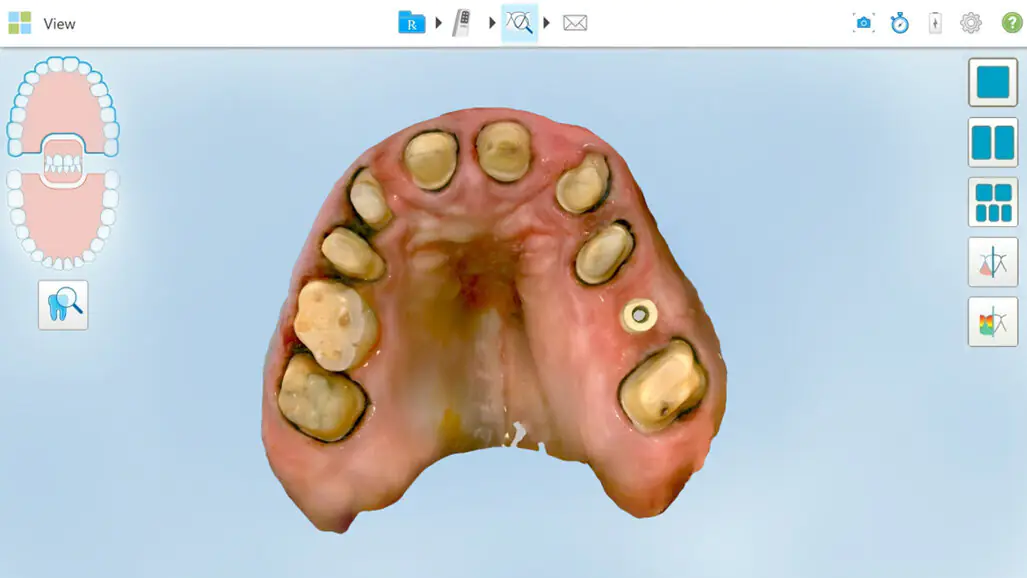
TEMPE, Ariz., US: Next-generation intra-oral imaging technology, supported by a suite of digital tools, enables efficient restorative and multidisciplinary ortho-restorative workflows while aiding in the diagnostics of interproximal caries above the gingiva.* The iTero Lumina Pro dental imaging system, powered by iTero Multi-Direct Capture technology, is supporting general dentists in enhancing practice efficiency and achieving excellent clinical outcomes.
Initially launched in February 2024, the iTero Lumina intra-oral scanner delivers faster scanning speed,** higher accuracy,*** superior visualisation,**** and a more comfortable scanning experience.+ Its enhanced capabilities provide an outstanding scanning experience and performance, suited to both simple and complex restorative cases. These improvements are complemented by streamlined workflows that allow for the capture of anything from single-unit dental crowns to full arches with multiple preparations in a single pass—all with the wave of a wand.
Dr Karla Soto, a general dentist practising in Boca Raton in Florida in the US, said: “The iTero Lumina scanner excels in traditionally challenging scans with long spans, such as full-arch implant restorations or even edentulous areas. The amount of data and tissue it can capture is outstanding, making what was once a challenge an easy, fast and comfortable procedure for me, my team and my patients.”
Effortless scanning experience and optimised workflows to simplify patient records and reduce chair time
- Capture simple to complex cases as well as extra-oral appliances and material in one uninterrupted motion, without the need to scan each individual preparation.
- Enjoy versatility and efficiency, with up to five capabilities integrated into one device. Designed to minimise maintenance time and cost, the system facilitates full automation of daily tasks, from scanning to patient communication and lab collaboration, including:
- photorealistic 3D models,
- high-definition intra-oral camera,
- support for detecting interproximal caries with NIRI technology,*
- photorealistic scans that remove the need for intra-oral photos for Invisalign case submission,****
- and scans within comparable thresholds of photogrammetry++—all in one scan.
- Treatment planning across multiple procedures can be simplified by reusing previous patient scans, eliminating the need for additional scans and associated chair time.
Superior clinical accuracy* for exceptional outcomes**
- Achieve predictable and repeatable first-time restoration fit+++ from single-unit crowns to removable prosthetics. Superior full-jaw accuracy, as compared with other tested intra-oral scanners,*** supports outcomes within photogrammetry thresholds for full-arch implant restorations++++—the highest standard for prosthetic planning captured in a single scan.
- Provide laboratories with comprehensive patient data, including multi-bite and articulation information, to support the optimal design of restorations and appliances.
Enhanced staff and patient experience
- Deliver a quick and comfortable scanning experience for patients.+
- Foster patient engagement and understanding through a modern, tailored approach, supported by patient-centric visualisations of oral health conditions.#
A special edition of the Digital Excellence Series will highlight the performance of this new technology in real-world settings. Drs Andrea and Alessandro Agnini, Ingo Baresel and Luis Ilzarbe will share insights from their clinical practices across Europe, demonstrating how the system meets their needs for a wide range of patient cases—from simple restorative solutions to complex multidisciplinary workflows. The session will also explore how factors such as field of view, scan distance and data quality can impact procedures involving restorations, implants or removable prosthetics. Furthermore, evidence on full-arch accuracy of intra-oral scanners will be discussed.
The 90-minute online session is scheduled for 30 April at 7:30 p.m. (CET) and will be conducted in English. Entry is complimentary; however, registration is required for access.
