,A versatile single-bottle adhesive and a pulp protectant/liner with unique apatite-stimulating ability—both from BISCO—are go-to materials for DPS readers, , ,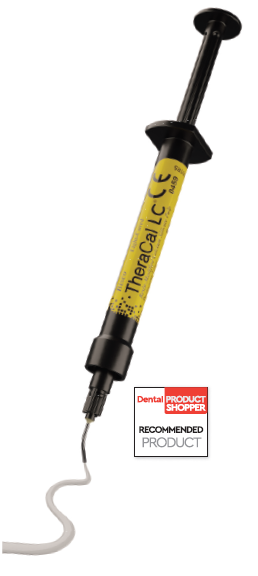 It’s great when a dental material performs well and results in successful patient outcomes, but it’s the proverbial icing on the cake when that material can be used to improve the oral health of patients who might not otherwise have access to basic dental care. That was the case when Marisol King, DDS, traveled to Guatemala recently to be part of a week-long outreach program in a country where dental treatment is not always accessible. The 2 products that were her go-to’s all week long? BISCO’s TheraCal LC and All-Bond Universal—which were both deemed winners in this year’s Readers’ Choice survey., ,“I used TheraCal LC and All-Bond Universal every day while providing donated dentistry at a local clinic in Guatemala,” Dr. King explained. “Nearly all of the decay I saw had pulpal approximation, and I used TheraCal LC beneath every single restoration I placed. Using it helped me feel even more secure in a scenario where follow-up care and visits may not ever happen. I believe that with TheraCal LC, I provided restorations that encourage longevity and pulpal protection.”, ,TheraCal LC, ,When a dental material performs well, word spreads fast. So fast, in fact, that TheraCal LC has been named a DPS Readers’ Choice award winner 4 years in a row. The proprietary hydrophilic resin formulation of TheraCal LC allows for a high release of calcium* ions, which provides a protective seal and stimulates hydroxyapatite and secondary dentin bridge formation.1-3 Ideal for direct and indirect pulp capping, TheraCal LC is light-cured for immediate placement and can also be used as a protective liner under composites, amalgams, cements, and other base materials., ,“I do use TheraCal LC for both indirect and tiny direct pulp capping, but predominately, I use it as a protective liner in all caries-approximating lesions where pulpal irritation is a high risk following restoration,” Dr. King shared. “Time is everything when finishing dental procedures, particularly in younger patients, and I feel that because it’s light cured, it affords significant time savings.”, ,Protect the Pulp, ,
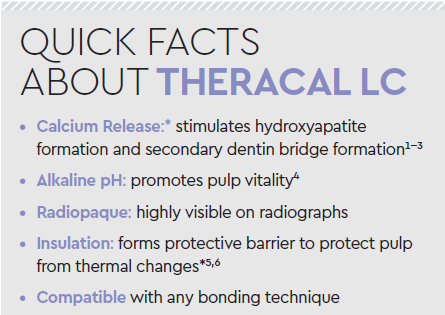 A resin-modified calcium silicate-filled liner material, TheraCal LC insulates the pulp by forming a protective barrier against thermal changes.5, 6Additionally, the alkaline pH promotes pulp vitality,4 a benefit highlighted by Cynthia Leung, DDS, who added, “TheraCal LC is my go-to product when the decay is close to the pulp.”, ,Steven LeBeau, DDS, FAGD, agreed, sharing, “BISCO’s TheraCal LC is the only material we use for direct pulp caps or for whenever a large pulp horn is near on a younger person. We switched to TheraCal LC after I read the research from BISCO that proved it was a stronger base-lining material that cures faster than other calcium hydroxide materials we previously used,” he explained., ,“My Main goal is to preserve the health of the pulp, particularly one with reversible pulpitis, and TheraCal LC is the product I use to do this,” Dr. King continued. “I use it because of what happens after placement: predictable calcium release, long-lasting pulpal protection with apatite formation, and secondary dentin creation over time. It is wonderful at protecting the pulp!” she added., ,All-Bond Universal, ,
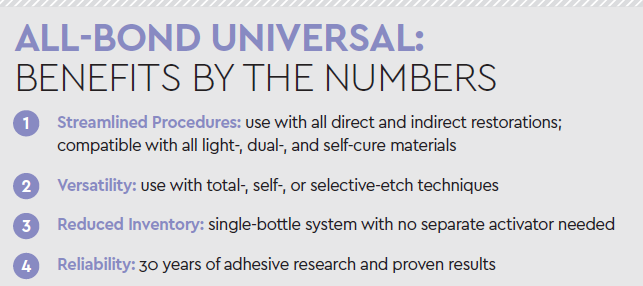
 Honored with a Readers’ Choice award for the second time, BISCO’s All-Bond Universal is a light-cured dental adhesive. Compatible with light-, dual-, and self-cured materials, resin composites, and cements, All-Bond Universal can be used with both direct and indirect restorations, as well as self-, total-, and selective-etch bonding techniques., ,“When searching for the right bonding system, I was looking for something that had high compatibility with all of the materials I was using, and All-Bond Universal delivered on that,” explained Dr. King. “It is a true universal product—I can use all my favorite materials because it adheres well to all substrates and everything I bond in my practice,” she said., ,
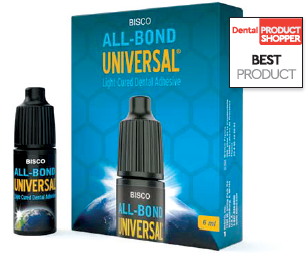 BISCO’s All-Bond Universal contains MDP for strong bond strength to tooth structure, zirconia, metals, and metal oxide substrates. A universal single-bottle system, All Bond Universal does not require a separate activator. It is not moisture sensitive and can be used on wet, dry, or moist tooth structure with virtually no postoperative sensitivity., ,“It’s a single-bottle system, and I can feel confident knowing it will not displace or fail because it bonds well to all substrates,” said Dr. King., ,Dr. Leung uses All-Bond Universal for direct resin restorations, crown placement, core build-ups, post cementation, and cementing ortho brackets. “I can trust it to bond because I have tried to remove a crown post cementation after years and the bonding was so tight it was difficult to remove.”, ,“I do not have to worry about resto- rations debonding because this is, in my opinion, the best, most predictable universal single-bottle adhesive out there,” concluded Dr. King., ,
 ,References:,*Data on file.,1. Gandolfi MG, Siboni F, Taddei P, Modena E, Prait, C. Ap- atite-forming ability of TheraCal pulp-capping material. J Dental Research. 2011; 90(Spec Iss A); Abstract 2520 (www.dentalresearch.org).,2. Cannon, M, et al. Primate pulpal healing after exposure and TheraCal application. J Clin Ped Den. 2014; 38 (4); 333–7.,3. Yamamoto, S, et al. Evaluation of the Ca ion release, pH and surface apatite formation of a prototype tricalcium silicate cement. Inter Endo J. 2017; 50; e73-e82.,4. Okabe T, Sakamoto M, Takeuchi H, Matsushima K. Effects of pH on mineralization ability of human dental pulp cells. J Endod. 2006; 32(3):198–201.,5. Sangwan P, Sangwan A, Duhan J, Rohilla A. Tertiary dentinogenesis with calcium hydroxide: A review of proposed mechanisms. Int Endod J. 2013; 46 (1):3–19.,6. Savas S, Botsali MS, Kucukyilmaz E, Sari T, Evaluation of temperature changes in the pulp chamber during polymerization of light-cured pulp-capping materials by using a VALO light curing unit at different curing distances. Dent Mater J. 2014; 33 (6):764–9, , ,FOR MORE INFORMATION:, ,800.247.3368 | www.bisco.com,


