

Engineered for highly polished ceramic surfaces, Arti-Ceram tells clinicians where to adjust with its high-contrast green markings and works reliably in wet environments
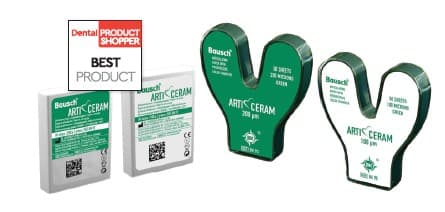
Bausch’s Arti-Ceram has become Dr. Michelle Na’s favorite articulating paper. Why? For starters, the progressive green markings reflect pressure intensity, so she always knows exactly where to adjust.
“It is very accurate, and I can differentiate where the hyperoccluding spots are by looking at the intensity of green,” she said. “I use the green marking on adjacent teeth as my reference point, and then adjust the occlusion until the restoration shows that same intensity of marking.”
Karen Guo, DMD, also relies on Arti-Ceram, which comes in 100-.m and 200-.m thicknesses in strips and horseshoe shapes. She said it outperforms other articulating paper—especially on highly polished porcelain and gold restoration surfaces.
“Arti-Ceram, specifically the 100-.m thickness, is adept at identifying precise, pinpoint premature contacts that can be challenging to find and adjust with traditional articulating paper,” she said. “It also helps me find heavy occlusal contacts on highly polished gold and porcelain restorations.”
The surface, Dr. Guo said, is what makes it so effective. “The texture is the secret sauce,” she explained. “Compared to most other articulating paper, the surface is slightly coarse, which allows for clear markings that other papers may not detect.”
Consistent Markings—No Matter What
Dr. Na loves that Arti-Ceram works well in a wet environment, which isn’t the case with other options.
“I often run into a situation where a patient closes their mouth right after marking, and then saliva wipes the markings away, especially when working on second molars,” she said. “Arti-Ceram markings stay, even in wet conditions.”
This shortens Dr. Na’s adjustment time, as she doesn’t have to wipe the surface, constantly ask for suction, worry about drying the articulating paper, or grab another paper as she works.
Building Patient Trust
With Arti-Ceram, one articulating paper does it all, Dr. Na said. It can be used multiple times, and because it comes in both thick and thin options, there’s no need to have 2 kinds of articulating paper on her restorative tray.
Arti-Ceram “precisely detects premature centric and excursive contacts, which is crucial,” Dr. Guo added. She can adjust restorations minimally and efficiently—and that builds trust.
“The longer I spend adjusting a restoration, the less confident the patient is in the result,” she said. “Precise markings mean precise adjustments, which equal seamless, efficient deliveries, and, most importantly, satisfied patients.”
