


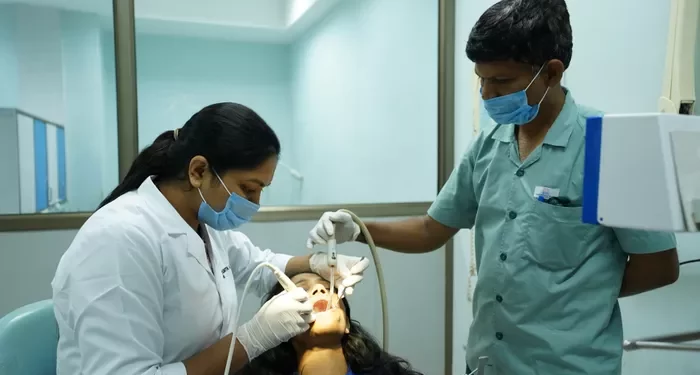
A dentist from Ahmedabad has spent five years traveling 37,000 kilometers across 23 states to create what may be India’s most comprehensive forensic dental database, revealing how teeth vary across the country and what these variations indicate about a person’s ancestry and region of origin.
Dr. Jayasankar P. Pillai, a senior faculty member at the Government Dental College and Hospital, analyzed 2.23 lakh teeth to build a systematic map of dental morphology in India. His research, which recently earned him a PhD from the National Forensic Sciences University (NFSU), could revolutionize the way investigators identify victims in crimes and disasters.
Currently, Dr. Pillai’s classification method achieves a 36% success rate in pinpointing a person’s specific region of origin and a 63% success rate in determining gender using only dental samples. He believes these figures could improve significantly through the use of artificial intelligence and an expanded database.
India’s dental records system is limited compared to many Western countries, often making forensic identification challenging. Investigators sometimes have to rely on photographs of smiling individuals to match dental evidence. Dr. J.M. Vyas, vice-chancellor of NFSU and Dr. Pillai’s doctoral guide, emphasized the value of teeth in forensic science:
“Teeth can survive for decades or even centuries and serve as reliable identification markers. Efforts are underway to establish a national dental registry,” he said.
Dr. Pillai’s research uncovered notable patterns across regions. In several northeastern and northern states, people commonly have shovel-shaped incisors—front teeth with ridged backs resembling the inside of a shovel. In Gujarat and western-southern regions, molars often have more cusps, sometimes six or seven. These variations are not random but reflect genetic ancestry encoded in enamel and dentine.
“From 2020 to 2025, I collected samples from 23 states and six geographic zones, analyzing 2.23 lakh teeth for their morphological traits,” Dr. Pillai said. Each tooth was evaluated across 15 non-metric crown traits using international dental anthropology standards, including the ASUDAS/Turner-Scott system. Some traits, such as the Cusp of Carabelli—typically found in Caucasian populations—appeared in certain Indian regions as well, highlighting historical genetic influences from Central Asia and Western Europe.
“Our genetic history is etched in our teeth,” Dr. Pillai said. He plans to continue expanding the database and make it accessible to agencies responsible for identifying unidentified persons.
Tags: teethtooth