

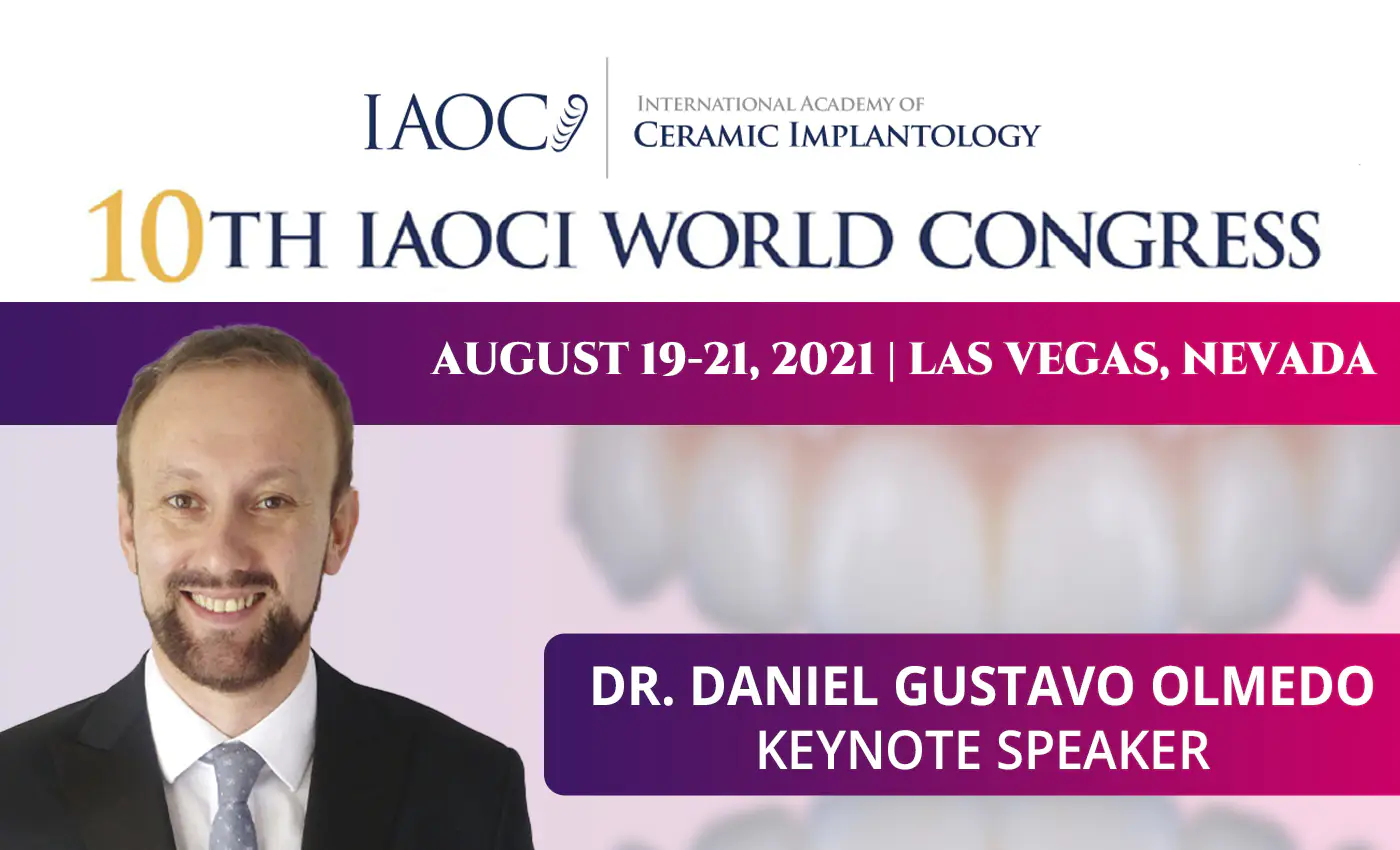
10TH IAOCI WORLD CONGRESS
Ceramic Implants: A New Reality in Ceramic Implantology
AUG 19-21, 2021
Paris Las Vegas, Resort & Casino, Nevada, United States
TOPIC: Biotribocorrosion of Titanium Dental Implants: Local and Systemic Tissue Effects
SPEAKER: Daniel Gustavo Olmedo, DMD, PhD
Course Description
Humans are exposed to different types of particles that can enter the body mainly by inhalation, ingestion or dermal absorption. In view of the widespread use of biomaterials in medicine, another potential source of body contamination with micro (MPs, >100nm) and /or nanoparticles (NPs, 1-100nm) is the surface of metallic biomedical devices. Titanium is widely used in the manufacture of dental and orthopedic implants due to its excellent biocompatibility. It is a highly reactive metal, and on exposure to air or fluids it rapidly develops a layer of titanium dioxide (TiO2), which passivates the metal. However, as a result of electrochemical corrosion processes, frictional wear, or a synergistic combination of both, ions/particles may be released from metal implants into the bioenvironment.
The combined effect of mechanical, biochemical, and electrochemical factors is known as tribocorrosion. When this process occurs in a biological environment, it is referred to as biotribocorrosion. As a consequence of this phenomenon, the surface of a biomedical implant can be a potential source of release not only of MPs but also of NPs, into the biological milieu. Because NPs have a greater surface to volume ratio, they are biologically more reactive and potentially more harmful to human health.
The chemically active metal ions/particles released from an implant surface, may bind to the surrounding tissues, but may also bind to proteins and be disseminated to distant organs in the vascular and lymphatic systems. Research in human samples conducted by our group has shown the presence of titanium particles in peri-implant tissue around failed human dental implants, in oral mucosa in contact with implant cover screws, in cells exfoliated from peri-implant oral mucosa around titanium dental implants, in reactive lesions in the peri-implant mucosa, and in infrequent pathologies in peri-implant tissues associated with titanium dental implants. In addition, our studies in experimental animal models demonstrated deposition of titanium MPs and NPs in target organs and the presence of a tissue response to these particle deposits. This presentation will address the local and systemic effects of biotribocorrosion of titanium, as shown by our studies in experimental animal and human tissues.
Learning Objectives
To know the general concepts pertaining to corrosion and tribocorrosion, and explain the risk of these processes occurring on the surface of a biomedical metallic implant, mainly titanium, placed in a biological milieu
To recognize the local and systemic effects of biotribocorrosion of titanium, mainly as shown by studies in experimental animals and human tissues.
To evaluate the possible clinical implications of biotribocorrosion of titanium dental implants.
Why should you participate in the 10th World Congress?
20 World Renowned Speakers
Discussions based on the Past, Present & Future of Ceramic Implantology
Case Studies Based on 15+Year Follow-ups
Lectures & Courses on the Design, Concept, Science & Biomechanical Aspects of Ceramic Implants
Dentist Channel Online is the official Media Partner for the 10th IAOCI World Congress 2021.

