
Lower-Jaw All-on-6 for Severe Periodontitis
On this page~3 min read
Service
Patient Profile
- Patient: Vicky
- Age: 59
- Gender: Female
- Country: Australia
Main Concern
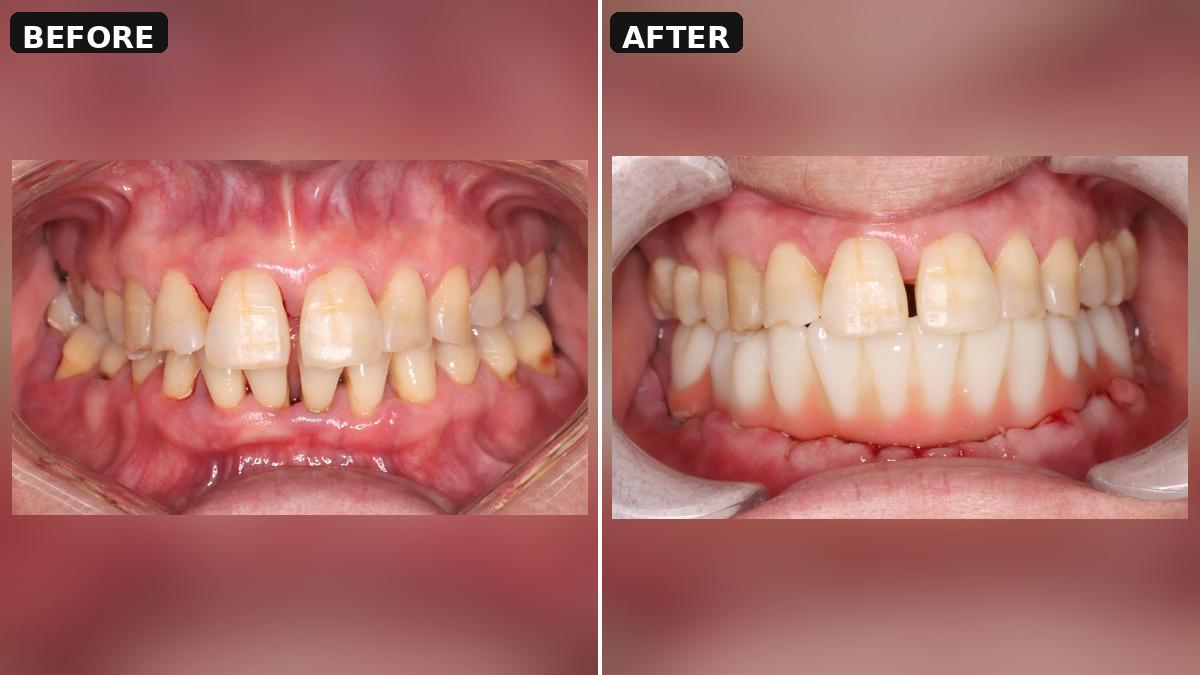
Vicky reported bleeding while brushing for more than three years. She also experienced long-term mobility affecting all her lower teeth, making comfortable chewing increasingly difficult.
Examination and Diagnosis
Clinical and radiographic examinations identified different conditions in the upper and lower jaws.
Upper jaw:
- Mild redness and swelling of the gums
- Varying degrees of alveolar bone loss
- Chronic periodontitis
Lower jaw:
- Severe periodontal disease
- Extensive mobility of the teeth
- Elongation of opposing teeth
The findings indicated that the lower teeth had a poor long-term prognosis and could not predictably support conventional restorative treatment.
Treatment
Treatment began with full-mouth professional cleaning and periodontal therapy to reduce plaque, calculus and inflammation.
The lower-jaw treatment included:
- Removal of hopeless and severely mobile teeth
- Cleaning and preparation of the extraction sites
- Placement of six Straumann BLT implants
- Bone grafting where additional support was required
- Immediate placement of a fixed provisional full-arch restoration
- Bite adjustment and evaluation of implant stability
- Review, wound assessment and suture removal
At the follow-up appointment, the surgical area showed satisfactory early healing without obvious swelling or inflammation. Immediate loading was selected according to implant stability, available bone and the clinician’s assessment; it is not suitable for every patient.
Materials and Brands
- Straumann® Bone Level Tapered implants
- Titanium full-arch framework
- Zirconia crowns
- Bone-grafting material
Straumann describes BLT implants as tapered implants designed to support primary stability. Its SLActive surface is intended to support early osseointegration, which may be relevant when immediate loading is clinically appropriate.
Treatment Period: 9 days
Treating Dentists:
- Dr. Bo’an Jiang
- Dr. Shaohua Xu
Doctor’s Notes
- Maintain careful oral hygiene around the provisional bridge and implant sites.
- Follow the prescribed medication and mouth-rinse instructions exactly.
- Choose soft foods during the early healing period.
- Avoid biting hard, sticky or chewy foods with the provisional restoration.
- Do not place excessive pressure on the lower fixed bridge.
- Attend scheduled reviews so implant stability, gum health and the bite can be monitored.
- Contact the dental team promptly if persistent bleeding, worsening swelling, fever, severe pain or bridge movement occurs.
- Long-term professional maintenance is essential because a history of periodontal disease increases the need for careful implant monitoring.
Frequently Asked Questions
Can dental implants be placed after severe gum disease?
Yes, but active periodontal infection should first be assessed and controlled. Implant suitability depends on gum health, available bone, general health, oral hygiene and other individual risk factors. Patients with previous periodontitis require careful long-term maintenance.
Source: American Academy of Periodontology – Dental Implant Procedures
Can All-on-6 implants receive teeth on the same day?
In selected cases, a temporary fixed bridge can be attached shortly after implant placement. This requires adequate primary implant stability, suitable bone conditions and a carefully controlled bite. The final decision must be made during clinical and radiographic assessment.
Source: American Academy of Periodontology – Immediate Loading
Does periodontitis cause loose teeth and bone loss?
Yes. Periodontitis damages the gums and supporting bone around teeth. As the disease progresses, teeth may become loose and can eventually require extraction.
Source: CDC – About Periodontal Disease
How should All-on-6 implants be maintained?
Patients should clean around the implants and beneath the bridge as instructed, attend regular professional reviews and avoid smoking. Consistent plaque control helps reduce the risk of inflammation around the implants.
Source: American Academy of Periodontology – Implant Follow-Up
Considering Full-Arch Dental Implants?
Severe gum disease and loose teeth do not always mean that removable dentures are the only option. Huangshan Dental can review your dental scans, bone condition and medical history to determine whether an All-on-6 or another full-arch treatment may be appropriate.
Disclaimer
This case is provided for general educational purposes. Treatment suitability, timing and results vary according to oral health, bone condition, medical history and clinical assessment.