

Normal Occlusion – The dental arches are in correct alignment, with all the teeth in anatomically correct contacts, and in physiologically optimal occlusion with the corresponding teeth in the opposite dental arch.
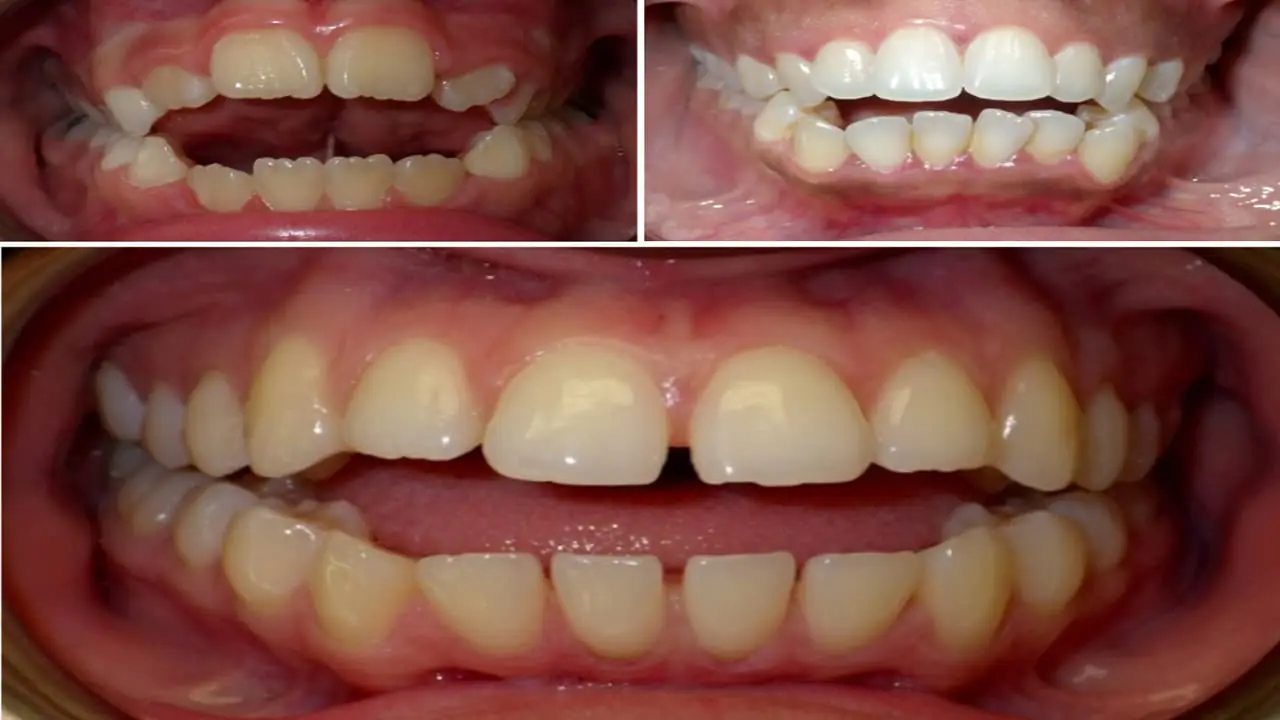
Malocclusion – Malocclusion is defined as an irregularity of the teeth. The etiology of malocclusion is generally categorized into two causes: (1) Hereditary, such as jaw‐teeth size discrepancy, and (2) Developmental, such as premature loss of teeth or habits (e.g. thumb sucking or tongue thrusting).
Malocclusion may be associated with one or more of the following –
Malposition of the teeth –
-
- Tipped teeth
- Displaced teeth
- Rotated teeth
- Teeth in infra occlusion
- Teeth in supra occlusion
- Transposed teeth
Malrelationship of the Dental Arches
Shape of Dental Arches, and Associated Facial Types
Classification of Malocclusion
Molar Classification (Angle’s Classification) – Was developed in 1890, Angle’s classification system was based on the upper first molars as being the “Key to Occlusion”. According to Angle, the mesiobuccal cusp of the upper molar should occlude in the buccal grove of the lower first molar.
- Class I Malocclusion –
- The tip of the mesiobuccal cusp of the maxillary first permanent molar occludes with the mid‐buccal groove of the lower first permanent molar.
- Class II Malocclusion –
- The tip of the mesiobuccal cusp of the maxillary first permanent molar occludes anterior to the mid‐buccal groove of the mandibular first molar. This is also known as “disto‐ occlusion”.
- Class II div 1 ‐ The upper central incisors are proclined
- Class II div 2 ‐ The upper central incisors are retroclined
- Class III Malocclusion –
- The tip of the mesiobuccal cusp of the maxillary first permanent molar occludes distal to the mid‐buccal groove of the mandibular first permanent molar. This is also known as “mesio‐occlusion”.
Canine Relationship
In situations where early extraction of the first molars has occurred, the alternative to using the Angle’s classification of malocclusion is to use the position of the canine to determine which type of occlusion.
Incisor Classification
- Class I ‐ The lower incisor edges occlude with or lie immediately below the cingulum plateau
- Class II ‐ The lower incisor edges lie posterior to cingulum plateau of the upper incisors
- Class II div 1 ‐ The upper central incisors are proclined
- Class II div 2 ‐ The upper central incisors are retroclined
- Class III ‐ The lower incisor edges lie anterior to the cingulum plateau of the upper incisors
Although several authors have calssified malocclusion, these are some of the most commonly used systems in day-today clinical scenarios.
Article by Dr. Siri. P.B.
