

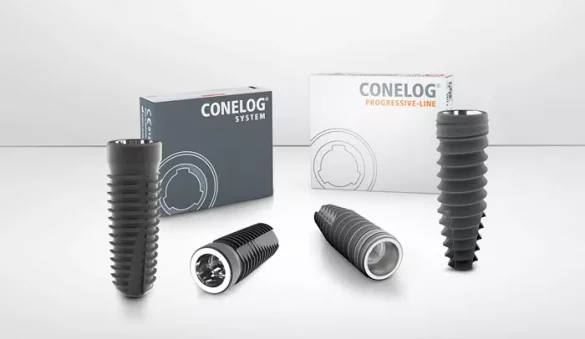
Conelog is a dental implant system developed by Camlog, introduced to provide advanced, reliable solutions for implant dentistry. It features a high-precision, deep conical implant-abutment connection with integrated Platform Switching, designed to preserve bone and offer excellent stability. The implants are slightly conical and self-tapping, enabling easy insertion and optimal primary stability through continuous bone contact. Conelog supports both epicrestal and subcrestal implant positioning, making it versatile for various clinical scenarios. This system is widely used for its evidence-based clinical success and long-term preservation of peri-implant crestal bone.
Why Choose Conelog?
Conelog stands out for several reasons:
Precision Fit: The implant-abutment connection includes a 7.5° self-locking conical taper with three indexing grooves, minimizing micro-movements and ensuring superior positional stability compared to other conical connections. This precision reduces complications such as abutment screw loosening and microbial leakage at the microgap, which is essential for patients with sensitive teeth or those vulnerable to gum disease.
Platform Switching: This design feature moves the microgap away from the bone margin, helping preserve crestal bone and promoting healthier gum tissue around the implant.
Primary Stability: The conical apical macro design and crestal thread provide high initial stability, especially critical for immediate restorations or loading and for patients with softer bone quality or limited bone height.
Proven Clinical Results: Supported by scientific studies, Conelog implants have shown reliable outcomes, contributing to patient satisfaction and implant longevity.
Versatility: Conelog implants come in various diameters and lengths, including diameter-reduced implants, allowing treatment for a wide range of clinical cases, including complex ones.
Types of Conelog Implants and Their Applications
Conelog implants are mainly available in two versions:
Conelog Progressive-Line: This implant type includes a crestal anchorage thread for extra support in cases with limited bone height and an anatomically shaped conical area to ensure stable placement in soft bone. It is suitable for immediate placement and immediate loading protocols, making it ideal for extraction sockets and full arch restorations.
Conelog Screw-Line: Slightly conical and self-tapping, this implant is designed for easy insertion with continuous bone contact, providing solid primary stability. It is useful for cases requiring controlled insertion and delicate bone management.
Applications include single tooth replacements, bridges, or full dentures for partially or fully edentulous patients, with options for immediate or delayed implant loading. This flexibility addresses various restorative needs in patients, including those dealing with gum disease or sensitive teeth issues where preserving bone and soft tissue health is paramount.
How Much Do Conelog Dental Implants Cost?
The cost of Conelog dental implants can vary widely depending on factors such as geographical location, the complexity of the case, number of implants required, and the additional procedures involved (e.g., bone grafting or sinus lifts). On average, a single Conelog implant system might range from $1,500 to $3,000 per implant, including the implant fixture and abutment but excluding the prosthetic crown or other surgical procedures. Costs may also be influenced by the choice of implant type (Progressive-Line or Screw-Line) and related accessories. It is best to consult with a dental implant specialist for an accurate and personalized estimate[User knowledge].
Material of Conelog Dental Implants
Conelog dental implants are primarily made of commercially pure titanium, renowned for its excellent biocompatibility, mechanical strength, and osseointegration properties. Titanium is favored in dental implantology as it resists corrosion and integrates well with the jawbone, which is critical in patients with conditions like gum disease, as it supports stable bone and soft tissue integration. Additionally, Conelog systems include components made from zirconia dioxide in specific versions (e.g., Ceralog) that offer high esthetics for patients sensitive to metal.
Who is a Candidate for Conelog Dental Implants?
Candidates for Conelog dental implants typically include:
Patients with missing teeth requiring restoration for function and aesthetics.
Individuals with sufficient bone density or those suitable for bone augmentation.
Patients with controlled gum disease, as implant success demands healthy or well-managed periodontal conditions.
Individuals who suffer from sensitive teeth and require stable, long-lasting dental restorations.
Patients interested in immediate or delayed implant placement and restoration techniques.
Those who want a reliable system with proven clinical outcomes and bone preservation benefits.
However, individuals with uncontrolled systemic diseases, severe bone loss not amenable to augmentation, or poor oral hygiene habits may need alternative approaches or preliminary treatments before implant placement.
Clinical Benefits of Conelog Implants
Conelog implants offer multiple clinical advantages, including:
Bone Preservation: The integrated Platform Switching and deep conical connection increase the distance of the microgap from the bone, reducing bone resorption around the implant neck.
High Primary Stability: Their design, especially of the Progressive-Line, achieves firm initial fixation, facilitating immediate loading protocols which can shorten treatment times.
Precision and Stability: The implant-abutment interface shows excellent rotational and vertical stability, reducing mechanical complications and potentially extending implant lifespan.
Adaptability: Suitable for various bone qualities and clinical situations, including immediate placements and soft bone scenarios, they expand treatment possibilities for clinicians.
Esthetic Outcomes: The implants support esthetic restorations with minimal soft tissue recession, important for patients with aesthetic concerns or sensitive gums.
Reduced Micro-Movements: This leads to better osseointegration and less inflammation risk, relevant for patients prone to gum disease.
FAQs
Are Conelog implants suitable for patients with gum disease?
Yes, Conelog implants can be placed in patients with controlled gum disease. Proper management of gum health prior to implant placement is essential to ensure success and prevent peri-implantitis.
How long does the Conelog implant procedure take?
The procedure time varies depending on the number of implants and complexity, but the design allows for efficient placement. Some cases may permit immediate loading, reducing overall treatment time.
Can Conelog implants be used for patients with sensitive teeth?
While implants replace missing teeth rather than treating sensitivity directly, Conelog’s precise fit and stable integration can provide durable restorations that eliminate issues related to sensitive or compromised teeth.
Conclusion
The Conelog dental implant system offers a highly precise, stable, and clinically proven solution for tooth replacement encompassing a range of treatment needs. Its advanced conical implant-abutment connection, integrated Platform Switching, and versatile implant designs (Progressive-Line and Screw-Line) provide excellent clinical outcomes including bone preservation, strong primary stability, and esthetic results. Suitable for patients with sensitive teeth and those managing gum disease, Conelog implants support successful long-term oral health. Though costs vary, investing in Conelog implants ensures durable, reliable restorations backed by scientific evidence and a history of positive patient outcomes.
