

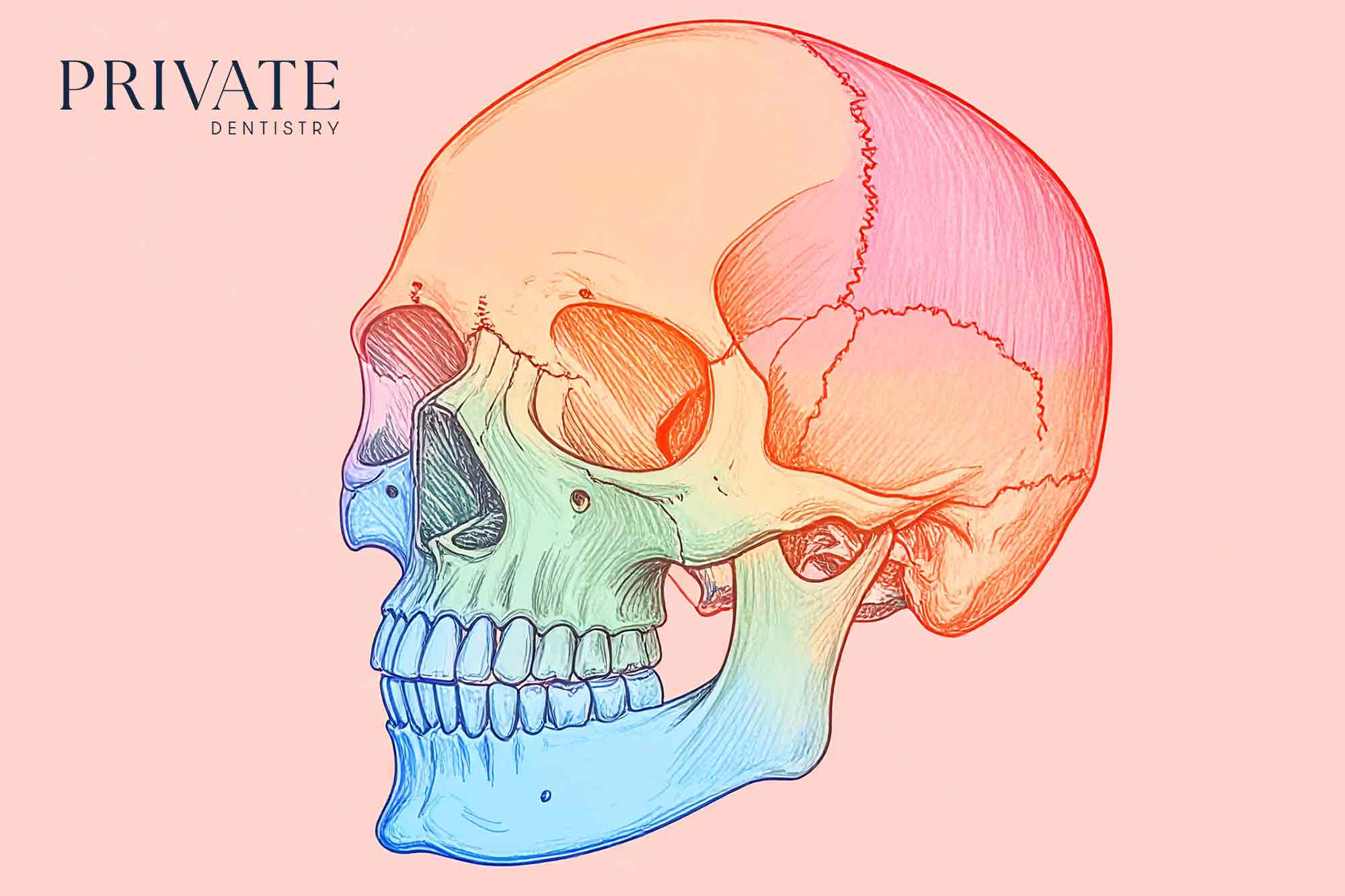
In this article, Chris Harris makes the case that understanding cranial osteopathy isn’t just relevant to dentistry – it is essential.
Is an understanding of cranial osteopathy relevant for dentistry? Yes, it is. In fact, I would argue that it is not only relevant but essential. The following is a condensed whistlestop tour of some important points. It will likely stimulate more questions than provide answers, but these questions will be welcome.
Cranial osteopathy: a brief explanation
The fontanelles in an infant skull close over as the bones grow together, the largest at the vertex at about 18 months. The skull then fuses into a solid one-piece structure: this is the understanding of most medics. The bones are initially separate at birth to allow a needed shape adaptation for a vaginal birth. This is not correct: they do not fully fuse. They approximate, interdigitate and form joints – joints designed for movement.
The anatomy of the sutures suggesting this was spotted by Dr Sutherland in 1899. He was student of the original osteopath Dr Still. Anyone with a little patience can feel the movement with their hands.
The movement is often described as fluid pump for the cerebrospinal fluid. With patients I talk about a slow-motion heartbeat of the nervous system: roughly eight cycles a minute. The whole body minutely changes shape, a bit like a big domed jellyfish as it moves along. We call it flexion and extension.
Movement is roughly symmetrical along the midline: left and right do opposites. Flexion equals broader and shorter, extension equals narrower and longer. This includes the supposedly fused head, but actually goes throughout the body.
‘Working in the cranial field is a wonderful and many tapestried thing. I have been doing it for 30 years and will continue as long as I’m able, irrespective of any possible lottery wins’
All 22 bones of the skull move and jostle and give a little to allow it. If the movement is disrupted by strains and compressions there will be a health consequence, sometimes a profound one.
It’s a complicated system, and probably the most complicated aspect of it all is the face. There is a series of well-designed anatomical shock absorbers that allow the strong forces of mastication to happen without disruption elsewhere. These are the vomer, the zygoma and, my personal favourite, the palatines. These provide an essential bit of slip and slide between the maxillae and the sphenoid.
These areas are frequently affected by dental work, particularly by dental orthopaedics and orthodontics – even if performed by good hearted, well trained and highly-skilled practitioners. If there is not an understanding the structures affected, then there can be real-world consequences.
The work of a cranial osteopath
Working in the cranial field is a wonderful and many tapestried thing. I have been doing it for 30 years and will continue as long as I’m able, irrespective of any possible lottery wins.
Using these techniques allows us to feel into a smorgasbord of strains, compensations, compressions and tissue quality changes that can occlude healthy homeostasis. When you can feel them, you are more than halfway to helping facilitate a release. This frequently leads to a positive functional change. Otherwise intractable issues can become relatively straightforward to help.
There are many clinical examples I could give both from paediatric and adult patients – complex trauma, birth strains, recovery after surgery or childbirth, promoting and supporting correct dentofacial development and so on. This last being of most interest here, of course.
1. Impact on dentofacial development
- Subtle cranial restrictions can influence maxillary growth, mandibular position and occlusion
- Early identification of these issues allows for intervention before they contribute to malocclusion or airway compromise.
2. Interaction with dental procedures
- Orthodontics, extractions, and certain restorative or orthopaedic interventions can alter cranial motion, especially in key bones such as the vomer, palatines and zygomas
- Understanding these effects helps minimise unintended functional consequences.
3. Airway and breathing considerations
- Cranial bone relationships affect nasal airway patency and tongue posture, which in turn influence breathing patterns
- Awareness can guide treatment planning to protect airway function.
4. Enhanced multidisciplinary care
- Collaboration between dentists, cranial osteopaths, and myofunctional therapists can improve outcomes – reducing treatment time, minimising side effects, and supporting stable, long-term results.
5. Potential for prevention
- Recognising early cranial and facial growth patterns allows for proactive measures, reducing the need for extractions or aggressive orthodontics later
- Supports the broader goal of promoting healthy structural and functional development in younger patients.
Back to dentistry – and controversy
This section will start as rather negative, please do persist as it will end positively!
A perennial grumble within cranial practitioners is relating to the after-effects of some common dental practices.
We often moan about the problems we associate with fixed braces, three to three retaining wires, reverse pull elastics and so on. We share our bemused horror regarding the extraction of beautiful healthy recently erupted premolars. Prematurely destined for the clinical waste bin, rather than 70 odd years of smiling and happily chewing tasty food.
‘Human responsibility 101: do your best to support the subsequent generation’s robust health. Also do your best to not mess it up’
The functional consequences of such practices are of such breadth and occasional severity that it’s hard to know where to start. The further compression of already underdeveloped arches crowds airways, impairs nasal breathing, forces tongues into unnatural postures, and shifts postural balance by changing head and neck relationships. Mandibles are kept retruded and put pressure on the TMJs because they cannot fit far enough forward within the narrowed maxillary arch.
It gets worse. Any cranial practitioner will describe system wide effects from the locking up of the zygomae, the vomer and the palatines. On palpation, it can feel like a spanner in the workings of a well-oiled machine. The whole wonderful fluctuation of fluid is disrupted. This can result in system wide issues. I have observed plenty where there was an occlusal dental connection. Confirmed to my satisfaction by osteopathic work in this area proving useful.
The challenges and some positives
The situation today is that malocclusion and poorly developed dental arches are becoming more and more common. This process possibly started centuries ago, and there are a variety of possible reasons why this has happened – a softer diet requiring less masticatory effort, possibly changes in our nutrients affecting intrauterine development. We don’t know exactly, but we have to do something about it. There is a need, and it is basic. Human responsibility 101: do your best to support the subsequent generation’s robust health. Also do your best to not mess it up.
There is a persistent misconception that facial growth is predominantly a given from genetic factors. In other words, our growth is largely predetermined. Environmental factors we have experienced during our lifetime are not significant. Therefore, that it is not possible to change the shape of bones without surgery.
Many people are told – as I was – that they have their ‘mother’s mouth and their father’s teeth’, hence, the need for extractions to ‘make room’. To all the osteopaths I’ve ever spoken to, and almost all the dentists I now speak to, this is clearly nonsense. We are given a basic genetic blueprint. How it grows and shapes itself is then down to how are lives are lived from conception onwards.
Bones are in a constant state of change. Both internally and, within limits, in overall external shape. Osteoblasts lay down bone and osteoclasts take it away. This goes on until we die and leave just the calcium matrix behind.
The orientation of the trabeculae, the honeycomb within a bone, is precisely orientated to be as strong as possible and as light as possible for the job at hand. It changes throughout life in response to the uses we put our bodies to. Uses such as a hearty and healthy suckling at a breast, or taking up running. The former will stimulate facial growth, the latter will increase the sturdiness and knobblyness of the muscle attachment just below the kneecap.
So why wouldn’t it be possible to gently stimulate growth when needed? It is possible. In skilled hands and using exquisitely designed devices such as the ALF. I believe the results coming through anecdotally are irresponsible to deny.
This goes further. Myofunctional therapy normalises patterns of muscular activity, changing forces acting on bones, which then get to work reorganising trabecular patterns. This then changes morphology: overall shape. This is particularly useful if the muscular activity was abnormal before.
Development of multiple millimetres across the maxillary arch is common. This also happens with cranial osteopathic treatment. I find that poor development is associated with a rubbery, compressed tissue quality and I am frequently working to release this within maxillae.
There is growth afterwards as the bones remodel, and certainly ortho work takes place more smartly. At twice the speed with half the side effects is a rule of thumb me and dental colleagues I work with can agree on.
A favourite of mine is making space for undescended upper canines. Decompress the maxilla and correct the strains along the embryological seam between the pre- and post-maxilla (between the twos and threes) and there’s often a nice dentally unexpected result.
The biggest positive
These dentofacial developmental problems are preventable. With the understandings developed across the disciplines, treatments can be effective in promoting lifelong health.
What is more, the work is fascinating, profoundly helpful to patients, and deeply satisfying all in equal measure. It is also common sense. More obviously so when a practitioner becomes familiar with what I have touched on here.
The Society for Dentofacial Growth and Function, a lively and rapidly growing organisation, is at the centre of this work. I have no doubt, not one scintilla, that this kind of integrative work is on the right side of history.
The examples of observed benefits and my osteopathic explanations are not based on rigorous double-blind trials, so cannot be considered as proved. However, they are based on many years of direct experience, both my own and that of many colleagues. I present them here to illustrate osteopathic thinking and to encourage dialogue. As a primary care practitioner, it is my responsibility to refer to other medical professionals when necessary. This I do regularly.
Interested in finding out more about integrative dentistry and holistic care? Dive in to a different way of thinking with our essential guide to holistic dentistry, curated by Dr James Goolnik.
Holistic care
