

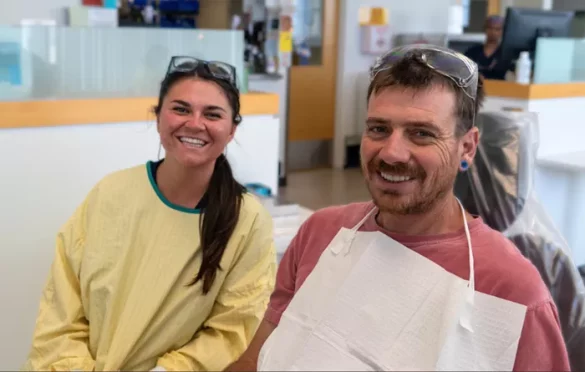
When Kathy Michel explored the cost of Invisalign invisible braces in 2024, she chose the University of Colorado School of Dental Medicine (CU SDM) on the Anschutz Medical Campus in Aurora. One of her front teeth had slightly turned inward, affecting her smile. Invisalign offered a way to correct it.
Michel was quoted nearly $4,000 at a local private practice. At the CU Orthodontic Clinic, she paid about $400 for a year of treatment, described by clinicians as a limited-care case.
“It was a no-brainer in terms of cost,” Michel said.
As CU SDM’s director of marketing and communications, Michel said campus care is also convenient.
“Since I work on campus, it’s easy to see my dentist and orthodontist,” she said. “I save a lot of time because I can walk from my office to the clinic.”
Her experience has also informed her professional work.
“It gives me a deeper understanding of the patient journey and helps me support teaching and research at the dental school,” Michel explained. “Learning more about clinical care allows me to communicate more authentically about the school’s impact.”
Eight Specialty Clinics Meet Diverse Dental Needs
CU SDM operates eight specialty clinics to serve a wide range of dental needs:
Dental Team Care Clinic: Offers fees up to 50% lower than private practice. Students provide care under faculty supervision, often in longer appointments.
Dental First Aid Clinic: Treats dental emergencies such as lost or loose teeth, infections, or appliance-related trauma.
General Practice Residency Clinic: Provides advanced, comprehensive care including cosmetic dentistry, implants, veneers, and root canals.
Graduate Periodontics Clinic: Focuses on gum and bone tissue issues, providing thorough periodontal care.
Veterans Program: Offers care funded by the Colorado Department of Military and Veterans Affairs.
Leading Clinical Research and Innovation
CU SDM has a long tradition of training skilled dentists, said Micaela Gibbs, DDS, MHA, professor and senior associate dean of clinical affairs and professional practice.
“As educators, we aim to provide the latest knowledge, techniques, and evidence-based care,” she said.
This allows patients access to new treatments and technologies not widely available elsewhere.
“For example, we use digital technology to design and create crowns and bridges without messy impression material,” Gibbs said. “We are also among the few dental schools testing inkjet printing to make dentures. This innovative method produces stronger, faster, and more reliable dentures, with a digital file ready for replacement if needed.”
