

Discover how AI-enabled caries detection is revolutionizing patient care as we know it, providing real-time decision support for clinicians while improving chairside communication

Without a doubt, artificial intelligence (AI) is growing fast and continuing to advance across various industries. Dentistry is no exception, with an increasing number of products and software leveraging AI to improve diagnostics and treatment planning. That’s old news to Rick Hagstrom, DDS, owner of A Shop for Smiles in La Mesa, CA, and an early adopter of AI’s debut into dentistry.
“I was thrilled to start test driving Dentrix Detect AI at a few months ago,” said Dr. Hagstrom. “I test a lot of products in my practice, and not many of them come out of the box working as well as this one.”
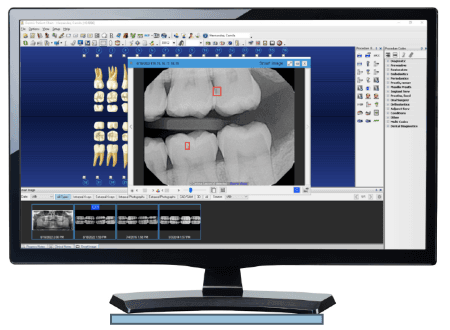
Powered and manufactured by VideaHealth, Dentrix Detect AI is an x-ray analysis tool that provides real-time clinician decision support in the form of AI-enabled caries detections and interproximal radiographic bone level (RBL) measurements.
“Dentrix Detect AI takes my subjective viewpoint out of the diagnosis because it’s a computer picking up the problem, and how can anyone argue with a computer?” Dr. Hagstrom added. “It’s a really powerful communication tool.”
A Second Set of Eyes
Working seamlessly with existing Dentrix imaging workflows, Dentrix Detect AI automatically annotates x-ray scans with highlighted caries annotations and flagged indications on patient charts—making it easier for clinicians to confirm patient conditions more quickly and accurately.
“I’m not the ‘bad guy’ anymore telling patients they need to get a bunch of fillings and crowns done and it’s going to cost them a ton of time and money—it’s the computer’s fault,” explained Dr. Hagstrom. “Most practices have monitors in their treatment rooms, so Dentrix Detect AI provides a neat way to get the conversation going. It’s essentially providing patients with a second opinion without worrying about them going to another dentist.”

The AI-enabled software visually displays caries detections and interproximal RBL measurements, which help clinicians track the progression of bone loss conditions. With that, they can make informed decisions that go beyond the limitations of their own experience thanks to having x-ray analysis available at their fingertips. “I think it makes me a better dentist because it critiques my treatment and pulls my eye toward areas that may need my attention,” Dr. Hagstrom said.
More Transparency, Better Treatment
Additionally, Dentrix Detect AI helps builds patient trust through greater chairside transparency. Helping patients better understand proposed treatment boosts case acceptance and improves clinicians’ overall patient care.
“Nowadays, we need to make sure we’re documenting everything for insurance purposes,” noted Dr. Hagstrom. “Dentrix Detect AI provides a great way to not only encourage patients to get treatment, but to document it objectively so that their insurance will pay on it.”
Technology is on the Agenda
Ultimately, Dentrix Detect AI is like a visual roadmap supporting clinicians in what to look out for before they even begin the exam. “As far as caries detection goes, it just grabs my eye and gives me an agenda going into the examination,” concluded Dr. Hagstrom. “I’m excited to see how this technology evolves.”

