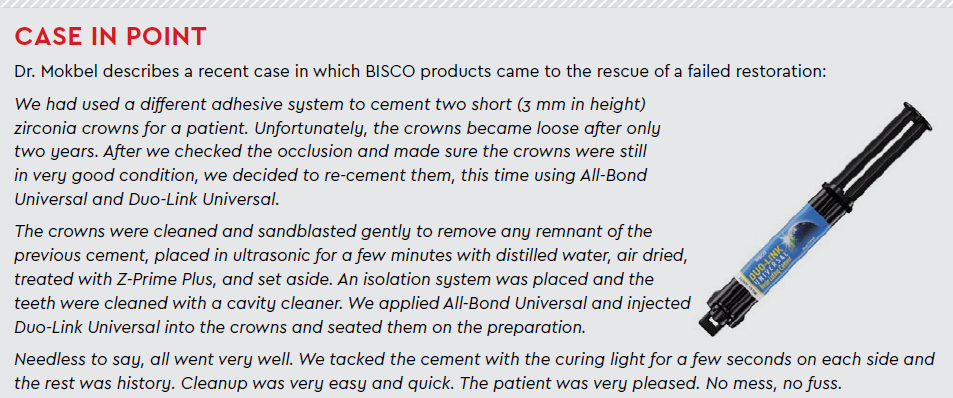
,For Dr. Robert Mokbel, a practicing prosthodontist who for over 35 years was a clinical assistant professor of restorative dentistry and prosthetics at the University of Southern California, dentistry has come a long way in the development of a streamlined, universal cementation system, , , To say that adhesive dentistry has come a long way in the 35 year that Robert Mokbel, DDS, DSO, has been practicing would be an understatement. While materials and techniques have evolved, the greatest change, he said, has come from understanding the adhesive process., ,He recalls, for example, the period of no etching, the move to total and selective etching, and finally, new delivery systems that incorporate etching into the bonding agent itself. Meanwhile, the dental profession learned about the smear layer and, over time, nearly eliminated sensitivity from bonding procedures. Along the way, once-unreliable dentin bonding became far more predictable and bond strengths climbed from a few MPa to as much as 45 MPa., ,“Adhesive dentistry has completely revolutionized dental treatment from the way we knew it 35 years ago,” said Dr. Mokbel, who operates SoCal Prosthodontics in Fountain Valley, CA., ,The changes in dental adhesion affected not only filling materials, but also led to a new class of indirect restorations that were not thought possible. “Where we used to have gold restorations as the standard of care, nowadays indirect ceramic restorations are more the norm in dentistry,” he said. “Yes, dental adhesives changed our state-of-the-art dental practices.”, ,Overcoming the Indirect Challenge, ,Although bonded restorations have become mainstream in dentistry, with most dentists using either zirconia or lithium disilicate, Dr. Mokbel noted that the technique still presents a challenge. “On one hand, you need to prepare the restoration itself by using a specific etchant, cleaner, and primer, and on the other hand you need to prepare the tooth itself with a similar protocol to make sure that the two pieces come together perfectly,” he said., ,Ultimately, the goal is to achieve reliable bonding for long-term crown-and-bridge cementation with a simple technique and quick cleanup. Last year, Dr. Mokbel found exactly that when he participated in the Dental Product Shopper evaluation of Duo-Link Universal resin cement combined with All-Bond Universal light-cured dental adhesive for indirect restorations., ,Formulated for quick, easy, and durable cementation of all indirect restorations, Duo-Link Universal is compatible with all dental materials. It uses an auto-mix, dual-syringe to simplify mixing and placement. All-Bond Universal, a universal single-bottle adhesive, is suitable for direct and indirect restorations with any bonding technique and with light-, dual-, and self-cured materials. The two products are designed to work together as a user-friendly adhesive cementation system that can simplify procedures, product selection, and inventory., ,Dr. Mokbel, a user of other BISCO products such as those in the Thera family, found the cementation system to be straightforward and predictable. He lauded Duo-Link Universal for its working time, flowability, and consistency., ,“The dual-cure cement is very dependable and assures that curing does not depend on the curing light to achieve a full cure in the deepest portions of the restoration,” he said, adding that any excess cement is able to be removed quickly and without any effort., ,With All-Bond Universal, Dr. Mokbel said the procedure is further streamlined because he does not need to use a dual- or self-cure activator. He also has found no issues with sensitivity when using the bonding agent, even in deep preparations., ,Saving Time and Inventory, ,The Duo-Link Universal and All-Bond Universal system has enabled Dr. Mokbel to place crowns with less time, effort, and inventory. “The fact that this is a dual-cure formula makes it a universal choice for all restorations—not only inlays and onlays, but all kinds of crown and bridge restorations. There is no need to have a different cement for different types of restorations,” he said., ,Having followed closely the evolution of dental adhesion over the years, Dr. Mokbel can attest that companies such as BISCO are enhancing the ability to achieve successful outcomes in the most efficient manner., ,“Zirconia crowns are the most common crowns prescribed by dentists these days,” he said. “BISCO has made zirconia cementation very simple and very reliable.”, ,