

Thanks to ready-to-use syringe delivery and Active BioSilicate Technology, Septodont’s resin-free bioceramic sealer enables easier, more predictable root canal obturation
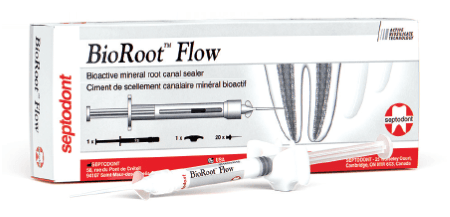
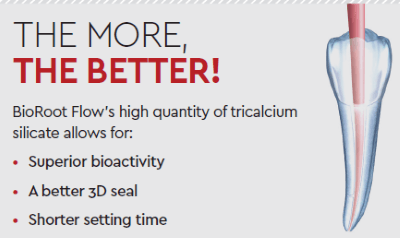
A DPS Best Product, BioRoot Flow is a bioactive mineral root canal sealer that leverages Septodont’s Active Biosilicate Technology, which comprises highly pure tricalcium silicate (CS3). While CS3 is the active ingredient in bioceramic sealers, quantity matters—and in this case, the more CS3, the better.
BioRoot Flow has the highest quantity of CS3 on the market,* which allows for superior bioactivity and a better 3D seal. “BioRoot Flow actually stimulates bone healing and reformation, helping the body move in the right direction after treatment,” said Dr. Kuhn Nuth.
BioRoot Flow comes premixed in ready-to-use syringes, with a consistent viscosity that adds predictability to every treatment. While Dr. Kuhn Nuth said she was used to sealers with thinner, runnier consistencies, she found that BioRoot Flow afforded her a faster, easier obturation workflow. “It’s simpler in terms of setup and cleanup, which makes procedures go a lot quicker,” she said. “It’s also very predictable to use—with thinner sealers, you don’t have as much control, but BioRoot Flow goes and stays exactly where I want it to.”
Add to this its moderate radiopacity, which shows sealer location without obscuring additional anatomical findings, and it’s no surprise that BioRoot Flow is Dr. Kuhn Nuth’s preferred sealer. She concluded, “We do everything we can to clean the root canal system during treatment, but there’s no way to completely sterilize it. A bioactive, antimicrobial sealer takes care of any bacteria that are left behind and continues our work once the patient leaves the chair.”
