

Abstract
Purpose/Objective:
On 11 March 2020, the World Health Organization declared COVID-19 a pandemic, and universities transitioned to online learning. The objective of this study was to evaluate the experience of students with the online education program offered during the initial phase of the pandemic.
Methods:
In April 2020, an anonymous online survey was distributed to 248 undergraduate dental and dental hygiene students in Dalhousie University’s faculty of dentistry. The survey contained 10 Likert-type and 3 open-ended questions asking students to evaluate their online learning experience and their preferences regarding in-person and online learning.
Results:
The response rate was 62.5%. Two-thirds (65.8%) of respondents reported that their educational experience in a virtual setting was very or somewhat positive, while only 14.8% said it was negative or somewhat negative. However, 60.6% agreed or strongly agreed that they preferred face-to-face learning over virtual classroom learning. Students were evenly split on whether online teaching should replace classroom teaching where possible (38.1% agreed/strongly agreed, 39.3% disagreed/strongly disagreed). Analysis of the responses to open-ended questions gave rise to 6 themes: online teaching and assessment methods; helpful online instructor behaviours/traits; advantages of online learning; disadvantages of online learning; combining online and in-person learning; online learning during the pandemic.
Conclusions:
Although the sudden transition to online learning was generally well received by students, there still appears to be support for maintaining some form of traditional, face-to-face learning methods in dental education. Students felt that ensuring faculty were creative, understanding and flexible was paramount in the transition to teaching in an online format.
The rapid spread of severe acute respiratory syndrome coronavirus 2 (SARS-CoV-2 or COVID-19) throughout the world in early 2020 and the subsequent declaration by the World Health Organization of COVID-19 as a global pandemic on 11 March 2020 resulted in the cessation of in-person activities by many teaching institutions. Academic institutions all over the world were required to rapidly shift their teaching strategies to remote, online teaching and learning. As the pandemic continued throughout 2020, academic institutions adjusted their instructional approaches in response to changes in local prevalence of the disease, regional public health advisories and government restrictions on in-person gatherings.
For clinical programs, such as dentistry and dental hygiene, where a large portion of the training relies on patient care and simulated laboratory exercises, moving to an entirely online setting is particularly challenging.1 Most dental schools had to suspend patient care procedures, except for dental emergencies, for some period during the pandemic.2-4 Most didactic sections of the curricula were delivered virtually.
Considering the global impact of the current COVID-19 pandemic as well as past viral outbreaks (such as severe acute respiratory syndrome [SARS] and the Middle East respiratory syndrome [MERS]) and the potential for similar outbreaks in the future, research is needed to investigate the effect of such events on undergraduate dental education. The pause in conventional, in-person dental instruction provided an opportunity to implement, evaluate and improve alternative instruction methods. Early results of this work are beginning to emerge from around the globe.5-11
In response to the pandemic, Dalhousie University abruptly stopped all in-person instruction in March 2020. Faculty were instructed to migrate all in-person teaching to online learning formats within 1 week. The faculty of dentistry developed online teaching and assessment protocols that guided the remote delivery of both didactic and clinical teaching of dentistry and dental hygiene students for the remainder of the term.
The objective of this study was to evaluate undergraduate students’ experiences with the online education program offered during this initial phase of the COVID-19 pandemic. Understanding students’ perspectives is essential to inform the incorporation of online learning into the traditional dental curriculum going forward.
Methods
On 30 April 2020, an invitation to complete an online survey hosted on Opinio Survey (ObjectPlanet) was distributed to all 248 undergraduate dental and dental hygiene students in the faculty of dentistry, with a reminder email sent on 5 May 2020. The deadline to complete the survey was 15 May 2020. The questions were formulated to assess the students’ perceptions of and experiences with online learning. All responses were submitted anonymously.
The survey contained 10 Likert-type questions, asking students to evaluate various aspects of their online learning experience, such as access, communication, organization, etc.; their preferences regarding in-person and online learning; and their overall experience with online learning. It also included 2 open-ended questions — “What did the faculty do to enhance your online learning experience during the current pandemic situation?” and “What do you think about using an ‘online, self-directed’ concept as an addition to more traditional learning experiences (i.e., face-to-face lecturing)?” — as well as an opportunity for students to add other comments. Frequency analysis was conducted on the responses to the Likert-type questions. Responses to open-ended questions were coded and grouped into common themes.
On review of the alignment of objectives and protocol for the Evaluation of the Online Learning Experience of Dalhousie Dentistry and Dental Hygiene Students during COVID-19 Pandemic Outbreak with the Dalhousie University Research Services Guidelines for Differentiating among Research, Program Evaluation and Quality Improvement, it was determined that this project meets the guideline for program evaluation specified under the Canadian Tri-Council policy statement: Ethical Conduct for Research Involving Humans (TCPS2 2018).12 Because Canadian universities are guided by TCPS2 standards, ethics approval from Dalhousie’s Health Sciences Research Ethics Board was not indicated.
Results
Of the 248 undergraduate students, 155 responded to the survey for a response rate of 62.5%.
Quantitative Analysis of Likert-type Questions
Most students responded favourably regarding their online learning experiences. Students reported that virtual course spaces were easy to access (87.7% agreed/strongly agreed), that communication with instructors was timely and effective (76.8% agreed/strongly agreed), that course objectives were met (72.3% agreed/strongly agreed), that there was adequate discussion time in the virtual course space (70.3% agreed/strongly agreed) and that online assessment tested course content and objectives fairly (68.4% agreed/strongly agreed) (Table 1).
|
|
Strongly agree |
Agree |
Neither agree nor disagree |
Disagree |
Strongly disagree |
|---|---|---|---|---|---|
|
No. (%) |
No. (%) |
No. (%) |
No. (%) |
No. (%) |
|
| I feel confident that the course objectives were met in a virtual setting. | 22 (14.19) | 90 (58.06) | 23 (14.84) | 17 (10.97) | 3 (1.94) |
| Instructors were prepared and organized for online teaching. | 22 (14.19) | 67 (43.23) | 39 (25.16) | 24 (15.48) | 3 (1.94) |
| Virtual course spaces were easy to access. | 52 (33.55) | 84 (54.19) | 13 (8.39) | 5 (3.23) | 1 (0.65) |
| Instructors allowed adequate discussion time for the subject material presented in the virtual course space. | 35 (22.58) | 74 (47.74) | 24 (15.48) | 22 (14.19) | 0 (0.00) |
| Online assessments tested course content and objectives fairly. | 29 (18.71) | 77 (49.68) | 26 (16.77) | 20 (12.90) | 3 (1.94) |
| Feedback provided regarding online assessments was adequate and constructive. | 18 (11.61) | 69 (44.52) | 35 (22.58) | 25 (16.13) | 8 (5.16) |
| Communication with my instructors in the online course space was timely and effective. | 33 (21.29) | 86 (55.48) | 29 (18.71) | 7 (4.52) | 0 (0.00) |
| Where possible, online teaching should replace classroom teaching for didactic subjects. | 27 (17.42) | 32 (20.65) | 35 (22.58) | 38 (24.52) | 23 (14.84) |
| I prefer traditional face-to-face, classroom learning instead of virtual classroom learning. | 55 (35.48) | 39 (25.16) | 31 (20.00) | 18 (11.61) | 12 (7.74) |
Just over half agreed or strongly agreed that instructors were well prepared and organized for online teaching (57.4% agreed/strongly agreed, 17.4% disagreed/strongly disagreed) and that feedback provided on online assessments was adequate and constructive (56.1% agreed/strongly agreed, 21.3% disagreed/strongly disagreed).
Two-thirds (65.8%) of respondents felt that their educational experience in a virtual setting was very or somewhat positive, while only 14.8% felt it was negative or somewhat negative (Figure 1). Despite this, students were evenly split when asked whether online teaching should replace classroom teaching where possible: 38.1% agreed/strongly agreed while 39.3% disagreed/strongly disagreed. Furthermore, most (60.6%) agreed/strongly agreed that they preferred face-to-face learning over virtual classroom learning (Table 1).
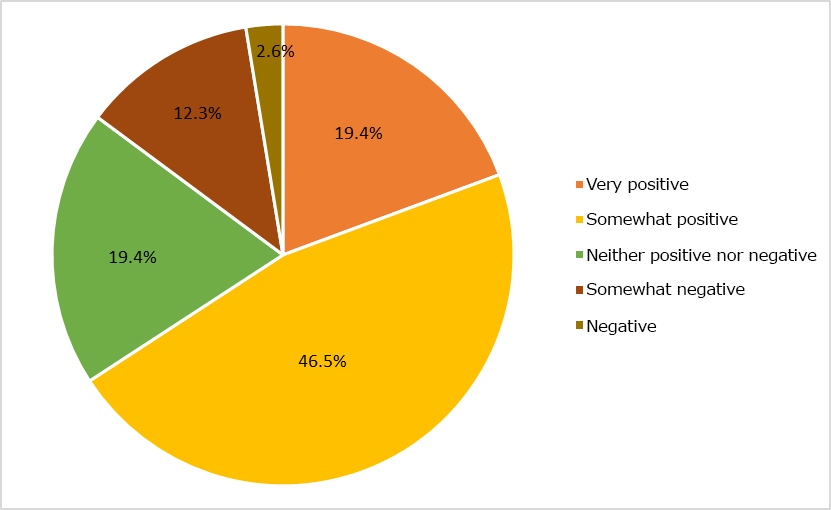
Figure 1: Responses to the question, “My educational experience in a virtual setting has been…” (n = 155).
Qualitative Analysis of Open-Ended Questions
Analysis of the responses to the open-ended questions gave rise to 6 themes: online teaching and assessment methods; helpful online instructor behaviours/traits; advantages of online learning; disadvantages of online learning; combining online and in-person learning; and observations regarding the rapid shift to online learning during the pandemic (Table 2).
|
Themes |
Subthemes |
|---|---|
| Online teaching and assessment methods |
|
| Helpful online instructor behaviours/traits |
|
| Advantages of online learning |
|
| Disadvantages of online learning |
|
| Combining online and in-person learning |
|
| Student observations regarding the rapid shift to online learning |
|
-
Online Teaching and Assessment Methods
Students preferred pre-recorded lectures provided as a slide show with narration rather than annotated slide shows with no narration. They liked being able to control the pace of the lecture and re-watch sections.Online discussion boards provided opportunities for communication with instructors and peers. Anonymous posting was perceived as helpful for “shy” students.
Live videoconference sessions, whether lectures, question-and-answer sessions or student-led presentations, provided opportunities for interaction and communication with instructors and peers.
Instructors replaced traditional in-person closed-book examinations with a variety of online assessment methods. Weekly online quizzes and assignments were mentioned favourably by students, as was an online 1-on-1 oral examination. Students had many positive comments about at-home open-book (or closed-book) timed examinations or assignments. Open-book assessments with generous time windows were significantly less stressful and promoted deeper understanding of concepts compared with traditional in-person examinations. However, there were some concerns about the possibility of cheating with at-home assessments, and a few students expressed a preference for traditional, in-person closed-book examinations.
-
Helpful Online Instructor Behaviours/Traits
Various instructor behaviours or traits were noted by students as being helpful during the shift to online learning. Most of these revolved around communication, which can be a particular challenge in remote learning. Students valued frequent contact with instructors, whether it was initiated by the student or the instructor. They expressed appreciation of instructors who made themselves available and responded promptly to questions by email or discussion board. Students perceived learning to be more challenging in courses where they had had limited or sporadic access to instructors. A few students also commented on the importance of receiving individualized feedback on their assessments. Students desired clarity and transparency from their instructors regarding remote teaching and assessment methods. They appreciated instructors who were organized and had course materials posted on time or in advance.Students also expressed appreciation of instructors who were flexible and receptive to student suggestions and who accommodated students’ preferences and needs. Finally, several students noted helpful instructor traits, such as being “supportive,” “patient” and “understanding.”
-
Advantages of Online Learning
The most frequently mentioned advantage of online learning was that it allows students to work at their own pace. Many students enjoyed being able to do their assigned work or listen to lectures on their own schedule when they felt most alert. They also liked the ability to pause and review recorded lectures as needed.Several students found that their self-directed online learning was more efficient than in-person learning. They noted the time lost by commuting to in-person classes, as well as unproductive down-time between scheduled classes. With online learning, these students found they had more time to focus on challenging material, as well as more time for self-care and personal relationships.
Other advantages of online learning were that it can accommodate different learning styles and that it may make education more accessible for students who face mobility and transportation barriers.
-
Disadvantages of Online Learning
The most frequently mentioned disadvantage of online learning was that some students struggled to find the motivation needed to keep up with the material. They missed the routine and structure provided by in-person classes. Relatedly, a few students found online learning to be less efficient because of the lack of a set schedule. Some students found organizing their own schedules and learning materials to be a challenge.Another disadvantage of remote learning is that not all students have a home environment that is conducive to online learning. Several mentioned that they found themselves easily distracted at home by noise, housemates or family obligations.
Finally, the lack of interaction with instructors and classmates is a significant disadvantage of online learning. Students stated that they missed being able to discuss concepts in real-time in a lecture setting, with the instructor and their peers. They noted that students learn from listening to others’ questions and that being together builds a sense of community that can be lacking online.
-
Combining Online and In-person Learning
When specifically asked for their thoughts about the “online, self-directed” concept as an addition to traditional learning experiences, student responses ranged from complete rejection of any online learning to an embrace of fully online learning. However, most were in favour of some combination of the two. Students noted that although clinical and preclinical courses in the dentistry and dental hygiene curricula do not lend themselves well to remote learning, didactic courses may. For such courses, students suggested using online resources either as a supplement to, or a replacement for, in-person classes. Students who prefer face-to-face learning, suggested retaining in-person lectures but making recordings of lectures available as online reference material for those who wish to use them. Other students were in favour of replacing all, or most, in-person lectures with pre-recorded online lectures. There were differing opinions about how the time created in the students’ schedules by removing in-person classes should be used. Some felt it should be reserved for self-directed learning and not be filled up with other scheduled instruction, while others felt it should be used for additional scheduled in-person learning, such as case discussion sessions or preclinical/clinical experience. -
Student Observations regarding the Rapid Shift to Online Learning During the Pandemic
A final theme related specifically to the rapid shift to online learning during the pandemic. A number of students expressed their appreciation to faculty for their efforts to maintain teaching and learning during the pandemic emergency. Others commented favourably on how quickly faculty adapted to the circumstances.A few students expressed disappointment at being unable to complete the practical component of some courses or frustration at losing a week of instruction time when classes were paused.
Several students noted that the forced switch to online learning had shed light on inefficiencies in the existing in-person curriculum and had provided an unprecedented opportunity for curriculum restructuring.
Students noted that there was a lot of variation in their online courses in terms of mode and frequency of communication with instructors, the format of online lectures and assessment methods. They suggested that online teaching and assessment methods be standardized within the faculty for consistency and clarity.
Discussion
The current cohort of dentistry and dental hygiene students is primarily from the “millennial” generation who generally have a higher level of literacy in a digital setting and are comfortable with online resources.13 However, shifting from an in-person learning environment to a virtual setting can be a challenge for both students and educators. Certainly, in dental education, where a large portion of the training is reliant on patient care and simulated laboratory exercises, moving to an entirely online setting can result in a lack of hands-on experience and heightened anxiety for students who need to grasp and apply foundational skills and knowledge in their future profession.
Online learning has come a long way in the past decade, and the required technology is commonly supported by higher education institutions.14 However, most courses in Dalhousie’s faculty of dentistry offer in-person classes and primarily use a learning management system (i.e., Brightspace) as a repository for lecture notes and course administration. The sudden shift to fully online learning, in response to the COVID-19 pandemic, thrust students into an unfamiliar educational setting that must be evaluated in terms of their experience compared with more traditional classroom settings.
The survey focused on the student experience rather than acquisition of knowledge. It was assumed that the content being delivered to students did not vary significantly from what they would have received in face-to-face lectures. The shutdown of in-person classes at Dalhousie University occurred rapidly and without notice. Consequently, most faculty provided a basic form of online learning, whereby they converted their existing lectures (PowerPoint/Keynote) to recorded narrated lectures that could be viewed by students asynchronously. Some students indicated that narrations were not helpful when all content was present on the slide and the faculty member simply read what was written. Classroom engagement can be a challenge for in-person teaching and becomes even more so in a virtual setting. Using slides as a “script” for the lecture without improvisation or the addition of material not already posted on the slide, results in student disengagement and 1-way, teacher-dominated learning.15
The use of Brightspace in all courses in the faculty of dentistry was mandatory even before the pandemic. Consequently, students were already comfortable accessing content through this learning management system. Most students (87.7%) reported that virtual course spaces were easy to access. The 12.3% who neither agreed nor disagreed/disagreed might be uncomfortable with the learning management system or with technology in general. Students found that having access to lectures outside regular class hours was extremely useful and helped supplement their learning. Furthermore, from a pedagogical standpoint, the freedom to access material on a student’s terms is essential in adult education.16
Communication between a student and instructor is paramount to a safe and constructive learning environment for the student. Martin and colleagues17 identified 5 motives students report for interacting with their instructors: relational (to develop a personal relationship with their instructor), functional (to offer reasons regarding material and course assignments), excuse making (to explain why work is late or not turned in), participatory (to demonstrate interest in the class) and sycophantic (to make a favourable impression on the instructor). Without face-to-face contact, much of the relationship cannot be cultivated.
Online communication presents a unique set of advantages and disadvantages. Unlike the classroom setting, email, chat boards and messaging features allow students and teachers to communicate at any time.18 Students felt that, overall, communication with instructors was timely and effective. With 76.8% of respondents agreeing/strongly agreeing, this is a good indicator that faculty managed the questions raised by students without delay. Students stated that they appreciated faculty emphasizing that they were always reachable by electronic communication for questions. They commented that this greatly reduce anxiety levels during an already stressful time. However, the lack of temporal boundaries to electronic communication can result in a shift in work–life balance for faculty, with students expecting answers to questions well outside regular work hours. Furthermore, without non-verbal cues, sensitive issues may be misconstrued and result in emotional and mental setbacks that may be avoided through in-person discussions.
In addition to direct interaction with instructors, students’ in-class experience includes communication between students. Of the respondents, 70% felt that adequate time was provided for discussions in the virtual space. Classroom discussion is 1 of the most frequently used and often embraced pedagogical strategies.19 Its benefits include the development of critical understanding, self-awareness and an appreciation of diverse perspectives.20 Class discussions occur both in and out of formal class time. During a synchronous class, students can be given the opportunity to ask questions or provide discourse on the subject material through chat boards or “in person” using video-conferencing software. Asynchronous discussions can be supported through discussion forums that can be accessed outside of the formal class time but are monitored by the instructor to ensure professionalism and accuracy of concepts. The latter requires extra time for both students and instructors and that added burden must be considered.
For classes that occur primarily asynchronously, students appreciated the scheduling of synchronous discussions or seminars. This allowed them an opportunity to not only ask their own questions but also learn from hearing other students’ issues. Silva and colleagues11 found that use of virtual meetings/discussions was associated with better quality of life for dental students during distance learning and social isolation. A potential negative outcome of this format might be that shy or highly self-conscious students might not feel comfortable asking questions in this setting. Several students noted that having an opportunity to ask questions or comment anonymously increased their likelihood of participating in class discussions. Thus, it is important to ensure that private avenues of questioning are also available for students.
Course objectives are clearly stated for all courses in the faculty of dentistry and are provided to students at the beginning of a co…
