

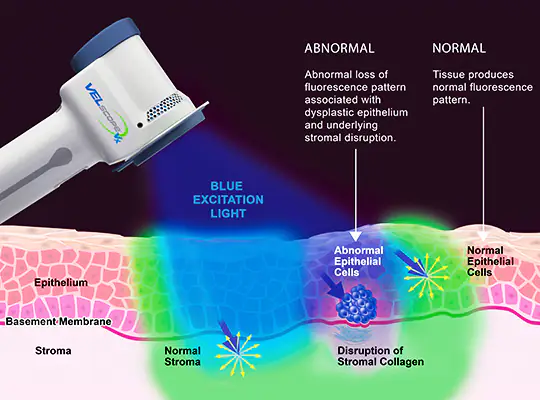
Diagnosis of oral cancer at an early stage is a boon to the patient, as it can significantly affect the morbidity and mortality caused by oral cancer. There are several methods of oral cancer detection ranging of direct visual inspection to fluorescence visualisation methods and many others. This article focuses on fluorescence based methods for oral cancer detection.
Fluorescence Visualization Technology
- It is a light-based detection technology.
- Fluorescence diagnosis (FD) is of increasing interest in oral cancer detection.
- Example: Velescope
The Visually Enhanced Lesion Scope, is a handheld screening device intended to enhance the visualization of oral mucosal abnormalities that may not be apparent to the naked eye.
- Healthy tissue appears pale, lime green
- Abnormal tissue appears dark green to dark rust
Advantages:
- Unlike the other light-based systems, fluorescence does not require a pre-rinse.
- VELscope is a portable unit.
- Detects lesions, white and red patches.
- Can be combined with digital photography.
- Detects problem areas that cannot be seen under white light.
- Exposes precancerous and cancerous tissue.
- Helps dentists check that diseased soft tissue is completely removed.
- Helps diagnose oral cancer in its earliest stages, exponentially increasing the chance of survival.
- Quick, painless examination
- There are no contraindications for the use of fluorescence

Identafi 3000 – fluorescence with fiber optic and confocal microscopy
- Combines anatomical imaging with fluorescence, fiber optics and confocal microscopy to map and delineate precisely the lesion in the area being screened.
- The advantage of this device over the Velscope :
- It is small in size
- Easy accessibility to all tissues in the oral cavity.
- Detects changes in angiogenesis with green-amber light (540- to 575-nm wavelength) illumination
- Increased angiogenesis is a known process during oral carcinogenesis and oral cancer progression
- The amber light – enhance the reflective properties of the oral mucosa, allowing a distinction between normal and abnormal tissue vasculature
Take home message
India has one of the highest incidences of oral cancer in the world, as 4 in 10 in all cancer are oral cancers. The high incidence of oral cancer and oral pre-cancerous lesions in India has long been linked with the habit of betel quid chewing incorporating tobacco. Statistics show that annually 130,000 people succumb to oral cancer, which translates into approximately 14 deaths per hour. Oral cancer is the most challenging fatal health problems faced by the mankind. It ranks number one in terms of incidence among men and third among women. We are in the era of information overload. The fields of medicine is changing and we have come a long way. Change is a part of evolution and innovation. There is still much to be done as far as patient management and accuracy of diagnostic methods is concerned, which will enable the society as a whole to be more productive and healthier.
Article by Dr. Siri P.B.
https://dentistchannel.online/2021/10/02/minimally-invasive-oral-cancer-detection-methods/
https://dentistchannel.online/2021/08/23/oral-cancer-why-you-need-to-be-mouthaware/


