

Abstract
Introduction:
Evidence-based practice (EBP) is an expectation of medical professionals and is positively received in the dental community. Investigations of evidence-based dentistry (EBD) have discussed its use in broad terms and daily clinical practice, but there is only limited information about its use and barriers with respect to particular dental specialities.
Methods:
A cross-sectional questionnaire was developed to survey implementation and obstacles to EBP; EBD specific to periodontics; and preferences for types of dissemination of evidence. The target population was active general dentists in Nova Scotia (n = 446). An email link to the questionnaire was distributed to dentists, and reminders were sent 4 and 10 days later.
Results:
The response rate was limited (16.6%). Most respondents were comfortable evaluating the growing body of research, although many reported use of low-level evidence, including that from other health professionals or expert opinion. A common barrier to use was insufficient time. Respondents who found strong evidence for certain periodontal procedures were more likely to refer these procedures, which included tissue regeneration and periodontics related to endodontics. On-site lecture-based dissemination was preferred by most respondents.
Conclusion:
General evidence-based concepts and use were similar to EBD results reported elsewhere, although external validity is limited by our low response rate and narrow target population. Specific data related to periodontics may be useful in directing a modified questionnaire to a broader target population. Respondents who are truly interested in EBD and responded to our questionnaire may ultimately benefit the most from our results, where further educational opportunities can be tailored to overcome the identified barriers and aid in more effective translation of evidence-based periodontal decisions in a general dental practice.
Introduction
The principles of evidence-based practice (EBP) reflect the core ethical values and conduct expected of dental professionals. Specifically, EBP is the integration of the clinician’s expertise, patient values and judicious use of current best evidence to guide clinical decision-making.1 This definition has been adopted by professional organizations such as the Canadian and American Dental Associations, and evidence-based dentistry (EBD) is a competency required of all graduating dentists.2,3 Attitude and intent toward EBP are generally positive, with self-reported use by general dentists at 32–88%; however, it is still underused to a large degree.4-9
Most dental programs have incorporated EBD into curricula; however, even with tools to critically appraise and apply knowledge from the literature, practitioners face a number of internal and external barriers to implementation.10-14 Many recent graduates report insufficient time to keep up with current research.6 Other clinician-centred barriers include reliance on personal experience, lack of knowledge to select the most appropriate articles and critically appraise the evidence and a perceived lack of applicability of research outcomes to their practice and patients.15,16 External barriers may be attributed to government health care factors focusing on cost efficiency and reimbursement and the influence of the dental industry on research projects and patient expectations.16 For example, as information is becoming increasingly more accessible and advertising infiltrates social media, patients may demand certain treatment modalities for which there may be limited evidence. Furthermore, the sheer volume of research material and access to the evidence is yet another external pressure contributing to the already difficult task of implementing an evidence-based clinical approach.13,17 As a result, general practitioners often rely on clinical expertise or information from colleagues, rather than sourcing and critically analyzing the constantly growing and potentially conflicting body of literature.6,14
There are many sources of primary research and research syntheses, such as systematic reviews and practice guidelines.12 However, for those not familiar with analyzing evidence, these sources may also be difficult to interpret and apply. A number of resources are accessible to guide a practitioner through the process of finding, evaluating and applying evidence from the literature,10,18-20 including the American Dental Association’s EBD Champion Program.21,22 In today’s digital world, several online initiatives are also available to facilitate the translation of research evidence into practice situations,13,23 including Canadian-developed ebhnow.com.24
A multifaceted, active learning approach is most likely to facilitate application of knowledge from clinical research.10,21,25 Involving practitioners in research through participatory means (practice-based research) may also be a solution to some of the barriers outlined above.15,17 This model creates data relevant to their practice and patients and potentially shortens the process from conception to adoption of research. Sampling a specific population of general dentists and tailoring continuing education to reflect their reported barriers may also be an effective method to simplify the EBD concept. The purpose of our research was to assess the extent of use, implementation and barriers to an EBP approach among a population of general dental practitioners in Nova Scotia, Canada, as it relates to the field of periodontics.
Materials and Methods
Questionnaire
A cross-sectional questionnaire was developed to assess implementation and obstacles to EBP; EBD specific to periodontics; and preferences for types of dissemination of evidence. The survey consisted of 27 questions formatted on Opinio (ObjectPlanet, Inc., Oslo, Norway); it was tested for face and content validity26 with a sample of 5 clinical and academic periodontists at Dalhousie University, Halifax, Canada.
The EBD implementation and obstacles section of the questionnaire was adapted from 2 sources: a survey distributed at the American Dental Association’s EBD Champion conference in 2008 by Spallek et al.9 and that of Straub-Morarend et al.6 A specific section related to periodontics, aimed at adding to the growing body of EBD evidence, included a range of topics that paralleled parameters of care and position papers available on the American Academy of Periodontics website.27
Questions included multiple choice (requiring single and multiple answers), matrix of choices, open-ended textboxes and comment/essay boxes. For questions that assessed frequency, a Likert-type scale with 5 categories was used: always, sometimes, occasionally, rarely, never. Open-ended “other” textboxes were available for most multiple-choice questions under the given choices.
Sample
A sample size calculation28 (using a 95% confidence level, with a margin of error of 5%) from a recruitment population of 446 licensed general dentists registered in Nova Scotia, resulted in a target sample size of 207. Recruitment was by emailed invitation distributed by the Nova Scotia Dental Association (NSDA) through its regular newsletter, Dispatch. Reminder emails were sent 4 and 10 days later, and access to the survey was closed following day 14. Responses were anonymous, as data were not linked with email or IP addresses. Consent was indicated by completing the survey. Participants could withdraw at any point throughout the survey. No reimbursements were given for participation.
Statistical Analyses
Statistical analysis was performed using SPSS v. 24. Descriptive statistics were used to summarize the data. χ2 tests were used to compare respondents’ referral behaviours based on their use of evidence and respondents’ depth of article-read based on their graduation cohort. Spearman correlation was used to assess the relationship between respondents’ number of courses attended and their reported use of EBD. A p value < 0.05 was considered statistically significant.
Ethics Approval
The Health Sciences Research Ethics Board at Dalhousie University granted ethics approval for the project (REB#2017-4254).
Results
Demographics
Of the 446 dentists invited by email, 74 completed the questionnaire, giving a final cumulative response rate of 16.6% (74/446). The number of respondents for each question varied, as participants were free to skip any questions they did not want to answer. The largest cohort by age was 25–34 (36.5%), with a similar number (36.1%) graduating in 2010 or later (Table 1).
|
|
Respondents |
|
|---|---|---|
| No. | % | |
| Age, years (n = 74) | ||
| 25–34 | 27 | 36.5 |
| 35–44 | 15 | 20.3 |
| 45–54 | 17 | 23.0 |
| 55–64 | 13 | 17.6 |
| 65+ | 2 | 2.7 |
| Gender (n = 74) | ||
| Male | 32 | 43.2 |
| Female | 38 | 51.4 |
| Not disclosed | 4 | 5.4 |
| Year of graduation (n = 72) | ||
| Before 1980 | 2 | 2.8 |
| 1980–1989 | 15 | 20.8 |
| 1990–1999 | 11 | 15.3 |
| 2000–2009 | 18 | 25.0 |
| 2010 or later | 26 | 36.1 |
| Practice profile (n = 73) | ||
| Solo practice | 19 | 26.0 |
| Community clinic/public health | 4 | 5.5 |
| Academia | 4 | 5.5 |
| Group practice | 48 | 65.8 |
| Associate or practice owner (n = 74) | ||
| Associate | 33 | 44.6 |
| Owner | 34 | 45.9 |
| Other | 7 | 9.5 |
Barriers to Applying Evidence
Most respondents were “somewhat comfortable” (56.2%) or “comfortable” (30.1%) when evaluating research studies for scientific validity, and most reported using evidence from clinical research in daily practice “occasionally” (24.7%) or “often” (52.1%). When asked about searching for an answer to a clinical question, 86.1% reported they were able to find the answer, although 41.7% questioned the validity or level of evidence.
Barriers to EBD use included “insufficient time” (64.9%), “difficulty staying current” (51.1%) and “lack of clarity in research” (43.2%) (Fig. 1). Although 74.6% of respondents had access to online resources, 66.0% reported that they do not regularly use evidence-based resources.
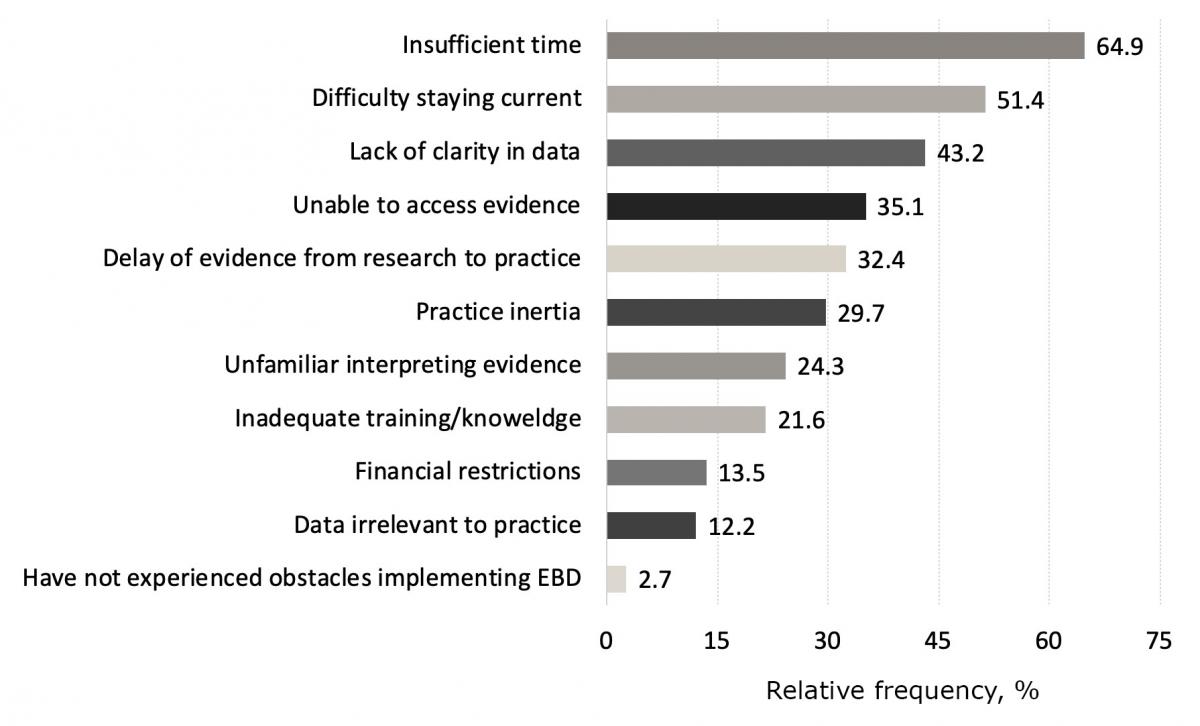
n = 74).
Sources used in determining diagnosis and planning treatment included “experience and past knowledge” (94.5%), “another health professional” (82.2%) and “expert opinion” (63.0%). Synopses of research evidence (42.5%), research syntheses such as systematic reviews (31.51%) and original research studies (26.0%) were reported far less often (Table 2).
|
|
Relative frequency, % (no.) |
||||||
|---|---|---|---|---|---|---|---|
| Likelihood of accessing resources for a procedure not currently delivered (n = 73) |
Very likely | Somewhat likely | Unlikely | Very unlikely | N/A | Total | |
| Past experience | 47.7 (31) | 38.5 (25) | 4.6 (3) | 6.2 (4) | 3.1 (2) | 100 (65) | |
| Other health professionals | 59.2 (42) | 36.6 (26) | 1.4 (1) | 2.8 (2) | 0.0 (0) | 100 (71) | |
| Expert opinion | 49.3 (33) | 38.8 (26) | 6.0 (4) | 4.5 (3) | 1.5 (1) | 100 (67) | |
| Original research studies | 19.4 (12) | 33.9 (21) | 27.4 (17) | 19.4 (12) | 0.0 (0) | 100 (62) | |
| Clinical treatment guidelines | 52.2 (36) | 36.2 (25) | 7.3 (5) | 4.4 (3) | 0.0 (0) | 100 (69) | |
| Research syntheses | 23.4 (15) | 34.4 (22) | 28.1 (18) | 14.1 (9) | 0.0 (0) | 100 (64) | |
| Synopses of research evidence | 22.2 (14) | 42.9 (27) | 22.2 (14) | 12.7 (8) | 0.0 (0) | 100 (63) | |
| Manufacturer’s websites | 19.1 (12) | 41.3 (26) | 22.2 (14) | 17.5 (11) | 0.0 (0) | 100 (63) | |
| Textbooks | 27.9 (17) | 27.9 (17) | 18.0 (11) | 26.2 (16) | 0.0 (0) | 100 (61) | |
| Would not seek further information | 0.0 (0) | 2.2 (1) | 15.6 (7) | 60.0 (27) | 22.2 (10) | 100 (45) | |
| Other | 4.6 (1) | 0.0 (0) | 4.6 (1) | 0.0 (0) | 90.0 (20) | 100 (22) | |
| “I read the following dental/biomedical journals” (n = 73) |
Always | Often | Occasionally | Rarely | Never | N/A | Total |
| Journal of the Canadian Dental Association (JCDA.ca) | 29.6 (21) | 35.2 (25) | 22.5 (16) | 9.9 (7) | 1.4 (1) | 1.4 (1) | 100 (71) |
| Journal of Dental Research | 1.7 (1) | 18.3 (11) | 26.7 (16) | 23.3 (14) | 30.0 (18) | 0.0 (0) | 100 (60) |
| Journal of the American Dental Association | 8.2 (5) | 11.5 (7) | 31.2 (19) | 26.2 (16) | 21.3 (13) | 1.6 (1) | 100 (61) |
| Other | 16.0 (4) | 20.0 (5) | 12.0 (3) | 4.0 (1) | 28.0 (7) | 20.0 (5) | 100 (25) |
| Number of continuing education events attended in the past 12 months (n = 73) | 1–2 | 2–5 | 6–10 | >10 | N/A | Total | |
| Online courses | 34.3 (23) | 14.9 (10) | 9.0 (6) | 9.0 (6) | 32.8 (22) | 100 (67) | |
| On-site courses | 25.4 (18) | 43.7 (31) | 22.5 (16) | 7.0 (5) | 1.4 (1) | 100 (71) | |
| Journal clubs | 11.1 (6) | 1.9 (1) | 0.0 (0) | 0.0 (0) | 87.0 (47) | 100 (54) | |
| Study groups | 32.2 (19) | 15.3 (9) | 10.2 (6) | 3.4 (2) | 39.0 (23) | 100 (59) | |
| Other | 0.0 (0) | 10.5 (2) | 5.3 (1) | 10.5 (2) | 73.7 (14) | 100 (19) | |
The Journal of the Canadian Dental Association (JCDA.ca) was the most commonly read resource (97.2% of respondents), while the Journal of Dental Research and the Journal of the American Dental Association were read by 58.3% and 65.3% of respondents (Table 2).
When reading a scientific article, respondents focused mainly on conclusions (56.7%) or abstract only (42.0%), with 25.7% reading the article in its entirety. Graduates before 2000 were much more likely to read the abstract only (52.2%) than graduates since 2000 (26.9%) (χ2 = 4.32, df = 1, p = 0.032).
EBD Specific to Periodontics
In the past year, 63.5% of respondents attended continuing education (CE) related to periodontics, with 57.5% attending a course associated with surgical implantology and 44.7% for treatment planning and management of periodontal disease.
Periodontal surgical therapy was provided by 26.0% of all respondents. Among these responses, the most common in-office procedures were crown lengthening (84.2%), soft tissue grafting (47.4%) and surgical implantology (36.8%).
Most respondents (95.9%) referred at least 1 type of procedure to a periodontist. Soft tissue grafting was the most commonly referred procedure, while hard tissue grafting, tissue regeneration, crown lengthening and surgical implantology were frequently referred by 2 thirds of our respondents (Fig. 2). Over 2 thirds agreed that they found strong evidence to justify referrals for these same procedures (Fig. 3).
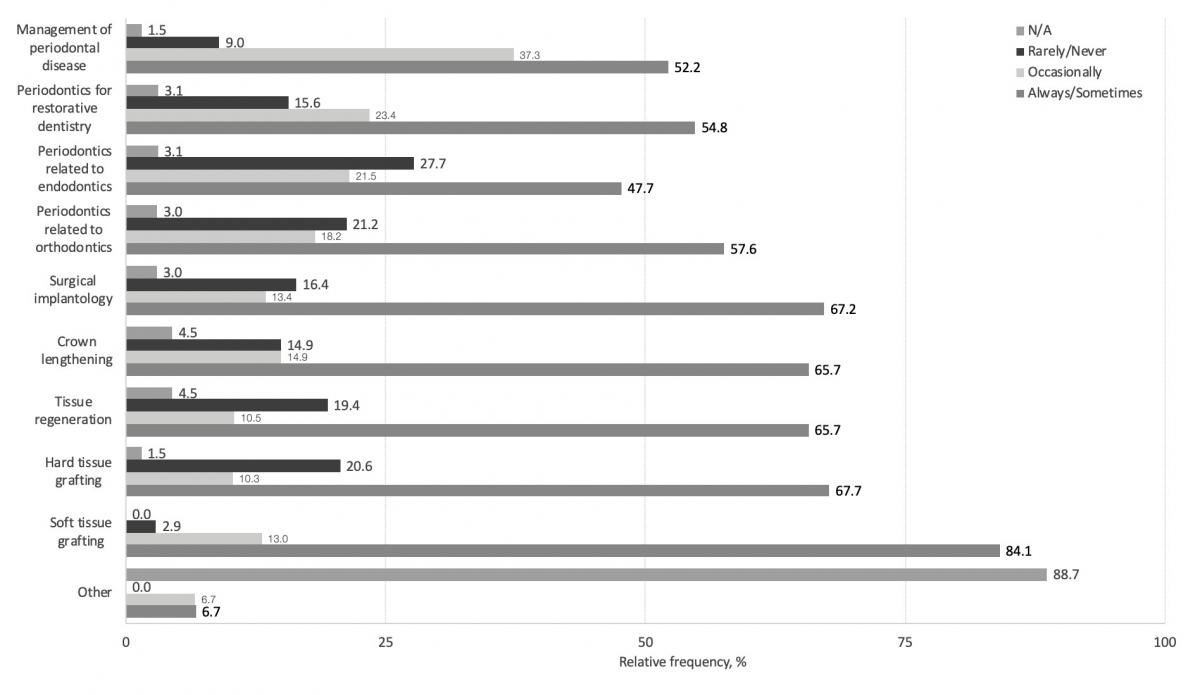
n = 74).
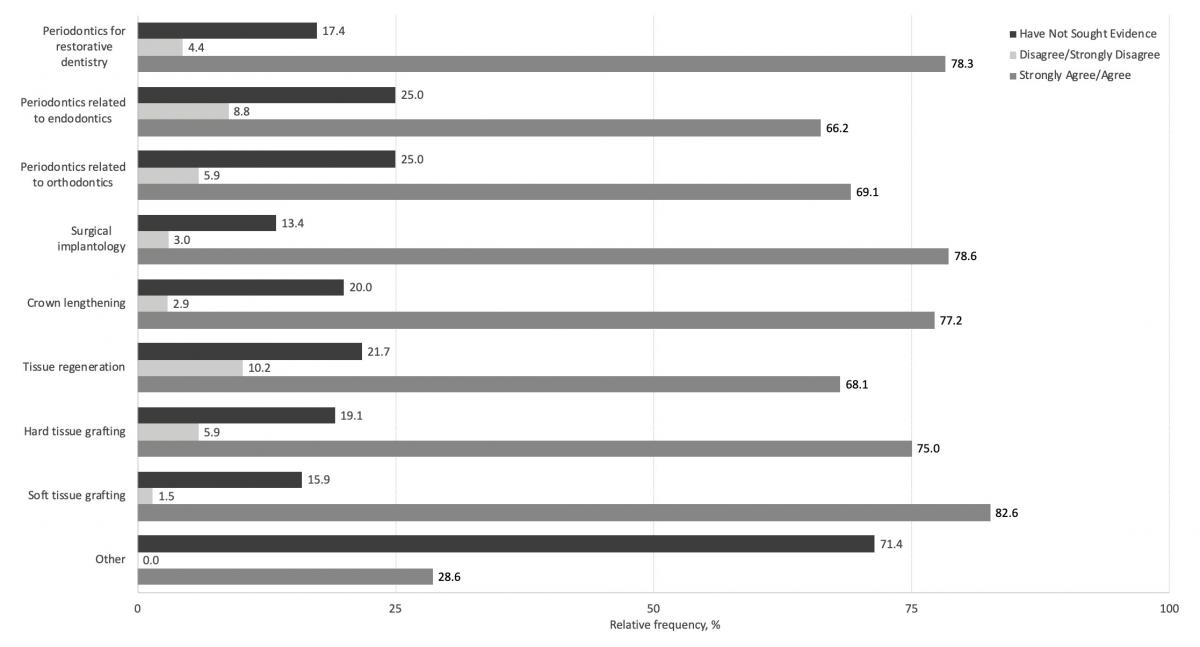
n = 74).
A comparison of procedures referred (Fig. 2) with level of agreement with evidence (Fig. 3) showed that respondents who reported being able to find strong evidence for certain procedures were more likely to refer these same procedures. These procedures included tissue regeneration (88.6% vs. 11.4%, χ2 = 11.44, df = 1, p = 0.001) and periodontics related to endodontics (85.0% vs. 15.0%, χ2 = 14.13, df = 1, p = 0.001); no significant differences were found for the other procedures.
With respect to CE opportunities, most respondents were interested in learning about periodontics related to restorative dentistry (62.5%). Other popular topics included treatment planning and management of periodontal disease (58.3%) and the relationship between systemic disease and periodontal disease (58.3%), followed by soft tissue grafting (48.6%) and surgical implantology (45.8%). No significant associations were found between the frequency of procedures referred and desired CE topics.
Methods of Dissemination of Evidence
The preferential delivery medium was on-site, lecture-based (84.9%), with 95% attending at least 1–2 events in the past 12 months. Online courses were attended by 67.2%, while study groups and journal clubs attracted 61.0% and 13.0%, respectively. There was no significant correlation between respondents use of EBD and the number of on-site courses attended (rs = 0.1, n = 71, p = 0.406).
Discussion
Our questionnaire was developed to determine barriers to using evidence-based periodontics in a target population of 446 general dentists, practising in Nova Scotia, Canada. The final response rate of 16.6% is at the lower end of the range of responses achieved in similar electronically distributed EBD questionnaires (16–41%).9,14,29 For privacy reasons, our survey was designed to collect anonymous responses; targeting non-responders was not possible, and no incentives were given to complete the questionnaire. In addition, the resources at the NSDA were unable to provide a mixed-mode distribution approach, which could have included other methods of questionnaire dissemination, such as distributing hard copies by traditional mail and/or sending recorded reminders by telephone. This approach of using multiple modes of dissemination may have been more effective.30 With a low participation rate, a non-response bias is likely. As a result, our findings may not be generalized to all dentists in Nova Scotia; however, we believe respondents to this survey may be more inclined to attend continuing education courses involving EBD. To our knowledge, this is the first collection of EBD data related to a specific dental specialty and may be useful in directing a modified questionnaire to a broader target population.
Our respondents reported that they “often” (52.1%) or “always” (15.1%) use evidence from clinical research in daily practice. This corresponds to habits of dentists in the European Regional Organization zone (32.1%),4 but is lower than those reported elsewhere.4,6,14 Although it is encouraging that such a large percentage of dentists report using an evidence-based approach in their daily practice, there is some difficulty in estimating the true frequency, as one may misinterpret familiarity with the concept of EBD a…
