Pulpal exposures are unfortunately a routine occurrence when treating carious teeth and frequently lead to endodontic treatment owing to the size of the pulpal exposure or the tooth being non-vital, whether or not a periapical radiolucency is present. Alternative care may be indicated when the tooth is vital, caries is close to the pulp radiographically, there is minimal dentine present at that spot and there is no periapical radiolucency present.
“Laser usage in endodontic treatment has been increasing and includes treatment of pulpal exposure to address pulpal inflammation and promote pulpal healing.”
Direct pulp capping helps extend the life of a diseased tooth by maintaining tooth vitality. This has been utilised for decades when an exposure is encountered during caries removal, but a low success rate has been reported in the literature.1 This appears to be dependent on which material is utilised for the direct pulp capping, and better long-term outcomes have been reported for mineral trioxide aggregate (MTA) and Biodentine (Septodont) compared with calcium hydroxide.2, 3
The cause of pulpal infection and its continuation as a periapical pathology is bacterial. Therefore, elimination of bacteria at the pulpal exposure prior to pulp capping aids in eliminating the causative agent of pulpal infection. As dentine is a porous structure consisting of tubules that, when healthy, have a fibre running from the pulp to the amelodentinal junction, this can be an avenue for bacterial migration from the surface through the dentinal tubules to the pulpal tissue. Thus, although a pulpal exposure may not be noted, thin dentine overlying the pulpal tissue after caries removal should be treated similarly to a direct exposure to aid in preventing pulpal inflammation and infection.
Laser usage in endodontic treatment has been increasing and includes treatment of pulpal exposure to address pulpal inflammation and promote pulpal healing.4 Evidence has been accumulating on the effects of laser application on direct pulp capping. Lasers offer excellent characteristics in terms of haemostasis and decontamination of the field. The pulpal healing response is crucial for formation of a dentine bridge to seal off the exposed pulp. Studies have reported that lasers stimulate the exposed pulp to form tertiary dentine, sealing off the exposure. However, the sealing of exposed pulp with a dental material such as calcium hydroxide, MTA or a bioceramic is still required after laser treatment.5, 6 More than two-thirds of studies included in a systematic review and meta-analysis demonstrated that laser therapy used as an adjunct for direct pulp capping was more effective in maintaining pulp vitality than conventional therapy alone.7 Laser treatment of exposed pulps may therefore improve the outcome of direct pulp capping procedures.7, 8 Studies have indicated the efficacy of lasers in reducing inflammation, accelerating healing and increasing the thickness of a dentine bridge. According to the evidence, lasers used in combination with pulp capping agents enhance the success rate of vital pulp therapy.9 Comparison of pulpal exposure treated with a laser prior to pulp capping versus no laser found that the non-lased group showed more severe inflammation.10
Laser pulpal treatment
In photo-biomodulation therapy, electromagnetic radiation in the visible wavelength range (380–700 nm) or in the near-infrared range (700–1,070 nm) is used, penetrating hard and soft tissue to 3–15 mm in depth.11 Laser pulpal therapy stimulates odontoblasts to release tertiary dentine and form secondary dentine at the pulp exposure site or over thin dentine overlying the pulpal tissue.12 Photo-biomodulation therapy also may be beneficial in reducing inflammation of or damage to the pulp because of its biostimulatory capability, leading to increased patient comfort after treatment. The Nd:YAG laser has been reported to achieve successful results in terms of eliminating postoperative sensitivity after direct pulp capping.13
The patients in the example cases shown in this article were treated using an Nd:YAG laser in continuous wave mode and with a wavelength of 1,064 nm, an energy of 100 mJ, a frequency of 10 Hz, a power output of 1 W and a time of 60 seconds at a distance of 1 mm from the tooth surface and pulpal exposure. After removal of gross caries and any restorative material present, residual caries may be present on the preparation floor either in close proximity to the pulp or with a small pulpal exposure present (Fig. 1a). Laser treatment is performed to remove residual caries on the floor and to avoid creating a pulpal exposure or enlarging any minor exposures present (Fig. 1b). The result is elimination of bacteria in the dentinal tubules that may lead to pulpal pathology, as well as haemostasis at any minor pulpal exposure and a surface ready for direct resin bonding (Fig. 1c).
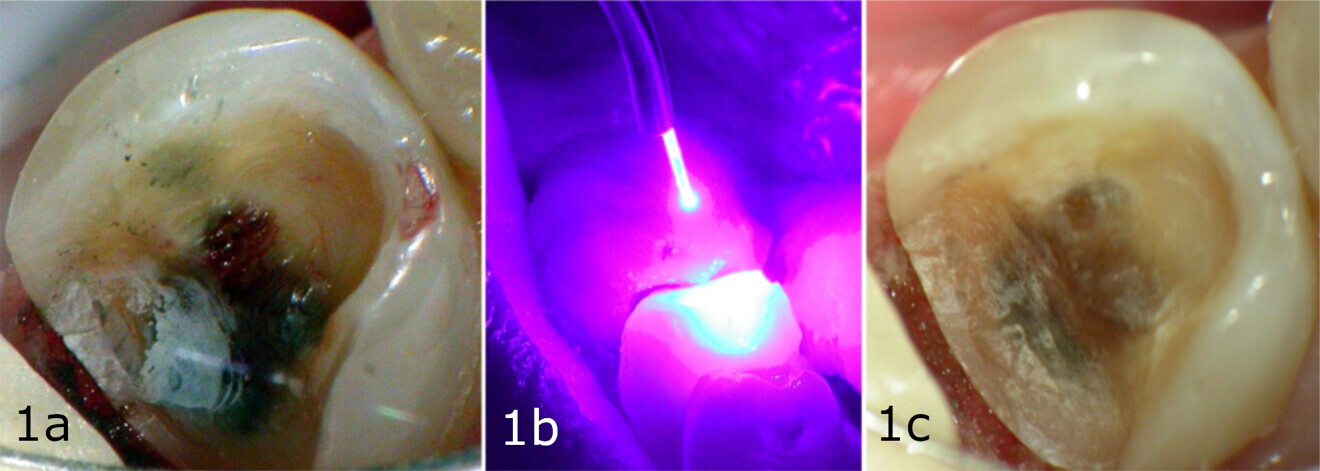
Figs. 1a–c: Example of laser treatment for the removal of residual caries after cavity preparation with standard burs. Caries noted on the pulpal floor and small pulpal exposure (a). Utilisation of the Nd:YAG laser (b). Resulting preparation floor ready for placement of a direct resin restoration (c).
Case 1
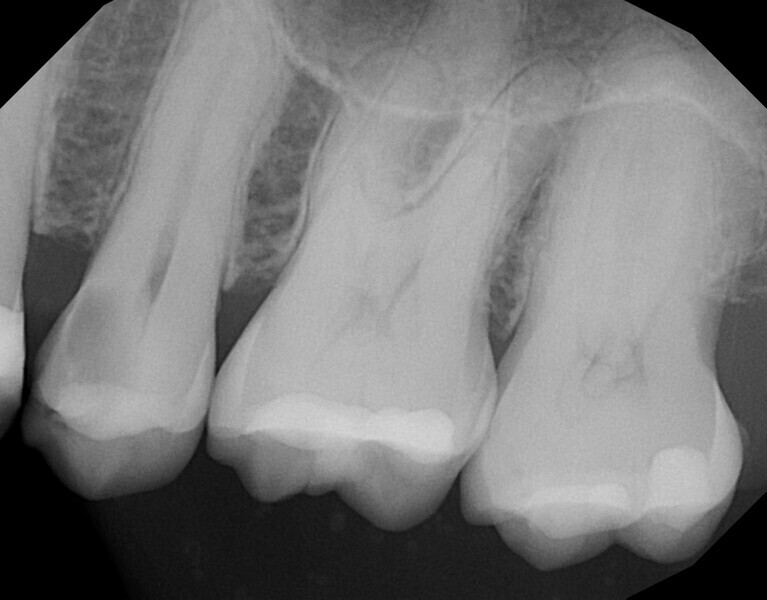
A 57-year-old male patient presented with the complaint of sensitivity to temperature in the maxillary left quadrant. A radiograph was taken (Fig. 2), and deep caries was noted in the second premolar with possible pulpal involvement. Periapical pathology was not noted radiographically. The tooth was tested with cold to verify that the pulp was vital. A mild reaction was noted when cold was applied that immediately resolved when cold was removed from the tooth, indicating that the tooth was vital. The patient was advised that endodontic treatment may be required if a large pulpal exposure resulted from caries removal or if the tooth became symptomatic after treatment. Should a small pulpal exposure be noted or caries removal result in thin dentine over the pulp, laser treatment would be utilised prior to core placement to sterilise the area and avoid pulpal infection developing. A core build-up and complete crown were planned for the tooth. The patient accepted the treatment recommendations.
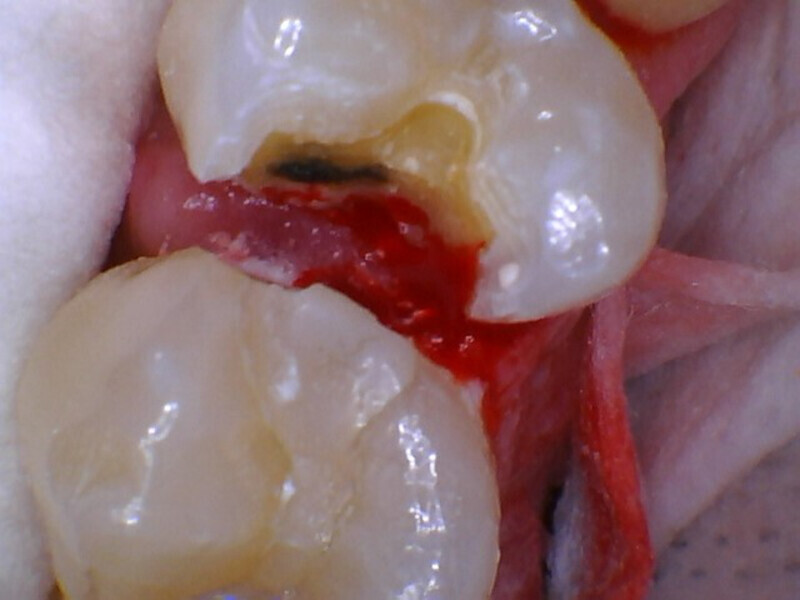
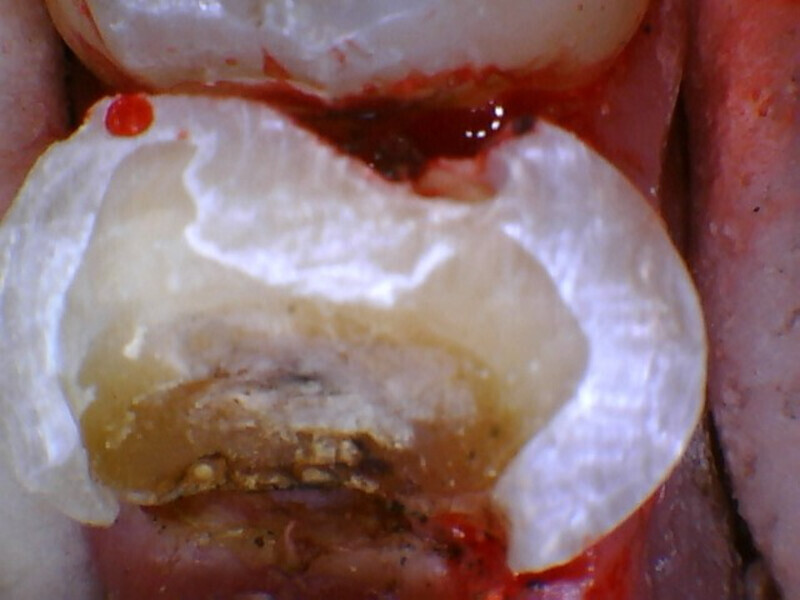
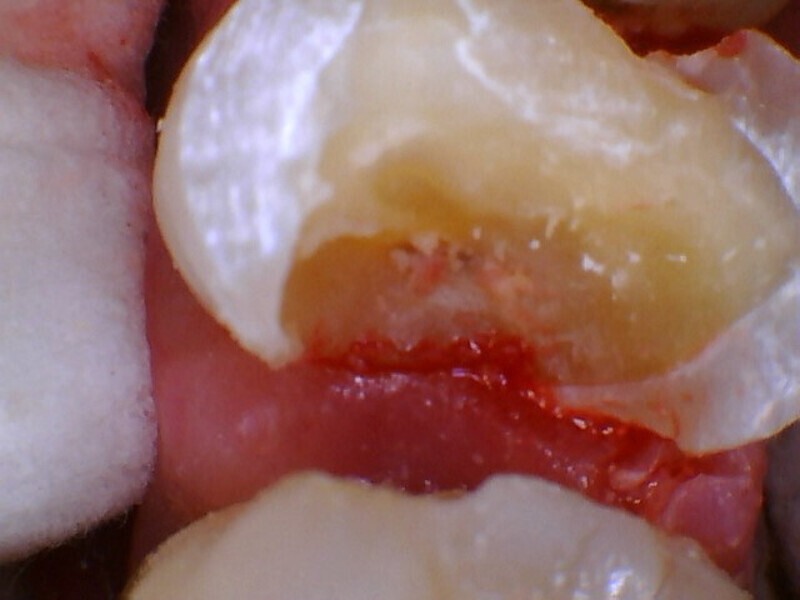
Local anaesthetic was infiltrated into the buccal vestibule adjacent to the tooth to be treated. Carbide and diamond burs were utilised in a high-speed handpiece with water to access and remove the caries, leaving a layer over the pulp (Fig. 3). A #4 round bur in a slow-speed handpiece was then utilised to remove the remaining affected leathery dentine until sound tooth structure remained (Fig. 4). A small spot of affected leathery dentine over the pulp was removed last, resulting in a small pulpal exposure (Fig. 5).
Immediately upon pulpal exposure, the Nd:YAG laser on the ablation setting (4.6 W, 100 µs, 230 mJ, 20 Hz) was applied to the area of exposure at 50–75 J to stop haemorrhaging and occlude the area of exposure without penetrating the pulp chamber greater than 3 mm (Fig. 6). The laser was next used on the same setting up to 162 J to sterilise the surrounding tooth structure and for biostimulation to activate stem cells and increase reparative dentine activity and decrease prostaglandins postoperatively. The treated area of the tooth was then sterile, and care was given to avoiding contamination before covering the dentine and pulpal exposure. Immediately a small amount of GC FujiCEM (GC America), enough to cover the exposure, was placed (Fig. 7). A core build-up was then applied utilising RelyX Unicem resin (3M ESPE) on the surrounding sound tooth structure to ensure a good bond between the core material and dentine. Crown preparation of the tooth was completed (Fig. 8). A digital impression was taken with a TRIOS scanner (3Shape), and a provisional crown was fabricated and cemented with IRM (Dentsply Sirona). The definitive crown was placed and luted two weeks later, and the patient reported no sensitivity since treatment had been performed on the pulpal exposure.