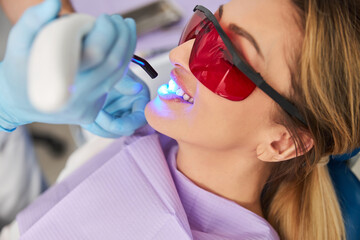
 Curing lights have come a long way since the ultraviolet, halogen, and plasma ARC lights of previous decades, with light emitting diode (LED) curing lights now widely used in most dental practices. When dental materials like resin-based composites, bonding agents, and cements need to be polymerized, the majority of dentists are going to reach for their trusty LED curing light., ,LED curing lights offer numerous advantages over other types of dental curing lights, including efficiency, energy savings, precision, portability, and versatility. Some of those advantages are explained below., ,Curing Speed,LED curing lights have fast curing times and can typically polymerize dental materials in a matter of seconds, usually ranging from 5 to 30 seconds. This efficiency is crucial in dental procedures where minimizing chair time is important., ,Consistency,For reliable and predictable results, LED curing lights provide consistent and uniform curing across the entire restoration. This consistency is essential for achieving optimal physical properties and esthetics of dental restorations., ,Energy Efficiency,Compared to traditional halogen lights, LEDs are more energy efficient and the bulbs have a longer lifespan. A higher percentage of electrical energy is converted into visible light, resulting in less wasted energy and lower power consumption. Bulbs don’t need to be replaced as often, contributing to cost savings and minimizing downtime for equipment maintenance., ,Wavelength Precision ,LED curing lights emit light at specific wavelengths that match the absorption spectra of the photoinitiators in dental materials. This targeted wavelength ensures effective polymerization, helping to avoid undercuring or overcuring of materials and contributing to the longevity and stability of dental restorations., ,Clinician and Patient Safety,LED lights produce minimal heat during operation, which keeps patients comfortable and helps prevent potential damage to the pulp, as excessive heat can be detrimental to dental tissues. Because they emit minimal ultraviolet (UV) radiation, LEDs are safer for both the dental professional and the patient., ,Portability,Many LED curing lights are compact and cordless, allowing clinicians to move freely without cords during dental procedures. This is especially advantageous in settings where mobility and portability are important., ,Environmental Impact,LEDs are considered more environmentally friendly due to their energy efficiency, longer lifespan, and the absence of hazardous materials like mercury, which is found in some other types of curing lights., ,While other curing technologies have been used in the past, the advantages of LED curing lights—including speed, consistency, efficiency, and precision—have made them the preferred choice for many dental professionals in contemporary practice.


