


Main Content
Introduction
Dental magnifying loupes have emerged as the “hallmark of dentistry” – a defining tool comparable to the stethoscope in medicine. These binocular optical devices magnify the oral cavity, enabling practitioners to visualize fine anatomical details with unprecedented clarity.
The confined nature of the dental operating field has long posed significant obstacles to clinical excellence. Traditional practice often forced clinicians to adopt awkward postures, leading to chronic eye strain and musculoskeletal disorders. Magnification-enhanced dentistry represents a fundamental shift in approach – when practitioners see more clearly, they work more precisely and deliver higher quality care.
Today, majority of American dental schools have integrated magnification loupes into their programs, recognizing that early adoption promotes proper habits students will carry throughout their careers. Dental loupes are no longer a luxury but a necessity for contemporary practice.
Why We Need Magnification in Dentistry
The human eye can distinguish objects separated by approximately 0.2mm under optimal conditions, but dental procedures frequently require visualization of much smaller structures. Research shows that even young dentists with excellent natural vision cannot achieve measurable results in intraradicular visual tests without magnification.
Key Reasons for Magnification
1.Visual Limitations:Detection of early carious lesions, hairline fractures, and additional root canal orifices requires enhanced resolution
2.Confined Operating Space:Limited direct visualization necessitates optical enhancement
3.Age-Related Decline:Presbyopia affects most practitioners by their forties, compromising clinical capabilities
4.Minimally Invasive Demands:Distinguishing sound from affected tissue at microscopic levels exceeds natural visual capabilities
5.Ergonomic Protection:Musculoskeletal disorders affect up to 81% of dental practitioners; loupes users experience significantly less pain in the lower back, neck, shoulders, and upper back Table 1: Comparison: Loupes vs. Naked Eye Parameter Naked Eye 2.5x Loupes 3.5x Loupes Minimum Resolvable Detail ~0.2mm ~0.08mm ~0.06mm Field of View Limited 80-100mm 60-80mm Fatigue Over Time High Reduced Reduced Posture Forward lean Improved Improved Studies show magnifying loupes significantly improve operator posture during dental preparations, reducing neck angulation and promoting upright positioning. Students using loupes receive better grades during assessments.
Parts of Dental Loupes
1. Optical Barrels (Oculars):The cylinder housing focusing lenses containing the objective lens, eyepiece lens, and prisms (in Keplerian systems). Quality optics utilize high-grade glass with multi-layer anti-reflective coatings.
2. Carrier Lenses:The mounting surface for optical barrels providing peripheral vision. Can incorporate prescription corrections and protective coatings.
3. Frame:Supports the optical system; options include plastic/acetate (lightweight, affordable), metal alloys (durable, adjustable), and titanium (lightest, most durable).
4. Accessories:Coaxial headlight systems providing shadow-free illumination, and working distance caps allowing focal length adjustment.
Types & Styles of Dental Loupes
There are 3 types of loupes:
1. Galiliean
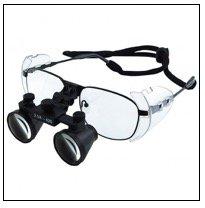
Galilean loupes use simple lenses to provide lightweight magnification, usually between 2.5×–3.5×. They offer a wider field of view and are ideal for general dental procedures.
2. Prismatic (Keplerin)
Prismatic loupes use a Keplerian prism system to deliver high magnification (3.5×–6×) with excellent resolution. They are suitable for precision procedures like endodontics and microsurgery.
3. Ergonomic
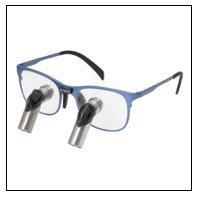
Ergonomic loupes are designed with steep declination angles to maintain a neutral head and neck posture. They reduce musculoskeletal strain and improve long-term operator comfort.
Table 2: Comparison of Loupe Types Feature Galilean Prismatic (Keplerian) Ergonomic Magnification 2.5x – 3.5x 3.5x – 8.0x 3.0x – 10.5x Image Quality Good Superior clarity Excellent Field of View Wide Moderate-narrow Moderate Weight Lightest Heavier Moderate Cost Affordable Moderate-expensive Premium Best For Beginners, general procedures Specialized, high precision MSD prevention There are 2 types of loupe styles:
1. Through the lens (TTL)
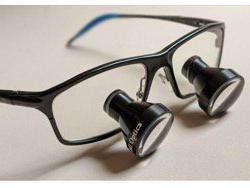
TTL loupes have the optics permanently fixed into the frame, giving a wider field and lighter weight. They provide customized working distance and superior clarity.
2. Flip-up
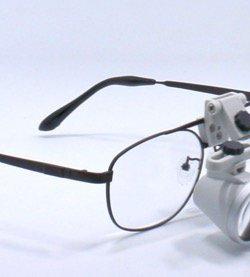
Flip-up loupes have adjustable optics mounted on a hinge, allowing easy repositioning or lifting when not needed. They offer versatility but are slightly heavier than TTL models.
Table 3: TTL vs. Flip-Up Loupes Feature Through-the-Lens (TTL) Flip-Up Field of View Wider Slightly narrower Weight Lighter, balanced Heavier (hinge mechanism) Customization Fully personalized User-adjustable Prescription Changes Expensive Easy, affordable Price Higher More affordable 1. LED Headlight System
Loupe Accessories
•Provides focused illumination directly into the oral cavity.
•Available in wired and wireless models
•Adjustable brightness settings
2. Battery Packs
•Rechargeable lithium-ion batteries
•Clip-on or belt-worn units
•Essential for powering loupe lights
3. Filters
•Composite curing filters (orange filter): Prevent premature polymerization of resin
•UV/Blue light filters: For specific procedures like adhesive dentistry
4. Protective Side Shields
•Attach to loupe frames for additional eye protection
•Help block aerosols, debris, and splatter
5. Head Straps / Headbands
•Provide better weight distribution
•Improve comfort during long working hours
•Helpful for users experiencing nose-bridge pressure
6. Customized Frames
•Lightweight titanium or polymer frames
•Designed specifically to balance loupe weight
•Various ergonomic and fashion styles
7. Magnification Flip Shields / Eye Shields
•Protective clear shields compatible with TTL and flip-up loupes
•Prevent contamination and improve safety
8. Carrying Case / Storage Box
•Hard cases to protect loupes from damage
•Heat-resistant interiors
•Separate compartments for lights and batteries
9. Cleaning Accessories
•Microfiber cloths
•Anti-fog sprays
•Alcohol-safe cleaning wipes
•Lens cleaning solutions
10. Adjustment Tools / Screwdrivers For tightening hinges or adjusting interpupillary distance (in flip-ups) Loupes with integrated LED lighting have become an essential tool in modern dentistry, significantly enhancing visual accuracy and clinical performance as compared to loupes without integrated lighting.
Loupes with integrated lights: A better tool
•They provide magnification and superior illumination, allowing clinicians to clearly visualize fine anatomical details, detect early carious lesions, identify cracks, and perform precision-driven procedures such as endodontics, restorative dentistry, and periodontal therapy.
•The focused light eliminates shadows caused by the operator or overhead lamps, and ensures a consistent, high-quality field of view.
•By promoting an upright posture and reducing unnecessary forward bending, loupes with light also contribute to better ergonomics, decreasing the risk of chronic neck and back strain.
•Additionally, they improve clinical outcomes, efficiency, and patient safety by enhancing the operator’s accuracy, reducing fatigue, and facilitating meticulous execution of procedures.
It does come with an additional cost for purchasing the light unit and battery packs, the need of regular charging and maintenance are required. Loupe lights increases the overall weight on the loupes or headband; and the wires (in non-wireless models) may restrict movement. However, as dentistry becomes increasingly detail-oriented, loupes with lights play a crucial role in elevating both diagnostic quality and overall treatment standards.
Clinical Applications
Restorative Dentistry:Enhanced caries detection, conservative preparations, superior marginal adaptation, and improved restoration quality.
Endodontics:Location of additional canals (MB2), identification of calcified canals, detection of root fractures, and microsurgical procedures. The European Society of Endodontology recognizes magnification as essential for quality treatment.
Prosthodontics:Refined preparation finish lines, accurate impression evaluation, and precise cementation verification.
Periodontics/Implantology:Microsurgical flap design, precise suturing, and accurate implant placement.
Pediatric Dentistry & Orthodontics:Early caries detection, precise bracket placement, and sealant application accuracy.
Table 4: Recommended Magnification by Specialty Specialty Magnification Loupe Type Dental Hygiene 2.5x – 3.0x Galilean General Dentistry 2.5x – 3.5x Galilean/Prismatic Pediatric Dentistry 2.5x – 3.0x Galilean Prosthodontics 3.5x – 6.0x Prismatic Endodontics 4.0x – 8.0x Prismatic/Ergonomic Periodontics 3.5x – 6.0x Prismatic Orthodontics 3.0x – 5.0x Galilean/Prismatic

Advantages of Dental Loupes
Clinical Benefits: a.Enhanced visualization revealing details invisible to naked eye b.Earlier detection of carious lesions and fracture lines c.More conservative cavity preparations d.Improved marginal adaptation of restorations e.Greater clinical confidence Ergonomic Benefits: a.Significant reduction in lower back, neck, and shoulder pain b.Decreased forward head posture c.Prevention of chronic occupational disorders d.Extended career longevity e.Reduced visual fatigue Professional Benefits: a.Enhanced teaching capabilities b.Better documentation and case presentation c.Practice differentiation and patient confidence Optical Limitations: a.Restricted field of view at higher magnifications b.Decreased depth of field requiring precise positioning c.2-4 week adaptation period Practical Considerations: a.Initial cost (73.25% cite price as main barrier) b.Maintenance and prescription update requirements c.Weight causing nasal bridge pressure during extended wear Clinical Limitations: a.Difficulty with visual measurement (reported by 28.5% of users) b.Not practical for all procedure types c.Initial coordination adjustment challenges Aspect Loupes Operating Microscope Cost $500 – $3,000 $10,000 – $50,000+ Portability Highly portable Fixed installation Learning Curve Moderate Steep Setup Time Immediate Requires positioning Space Requirements None Significant Loupes represent the optimal balance of cost-effectiveness, portability, adequate magnification, and reasonable learning curve for most clinical applications.
Disadvantages and Limitations
Advantages Over Other Magnification Systems
A workshop and hands on was conducted on 18/02/2025 for undergraduate students in ITS dental college, Ghaziabad on – magnification with loupes- organized by the college and mentored by the author. 100 students participated in full day workshop, gaining knowledge on significance of magnification with loupes to incorporate the habit through pre-clinical days.
References
a.Abasseri T, Ha W. Value of including loupes in prosthodontic and endodontic components of dental degrees: a systematic review. Br Dent J. 2023. PMID: 37558771. b.Aboalshamat K, et al. Practices and Attitudes of Dental Loupes and Their Relationship to Musculoskeletal Disorders. Int J Dent. 2020;2020:8828709. PMID: 32802065. c.Aldosari MA. Dental Magnification Loupes: An Update of the Evidence. J Contemp Dent Pract. 2021;22(3):310-315. PMID: 34210934. d.Costa RT, et al. Impact of using magnifying dental loupes on clinical performance during tooth preparation: A systematic review. J Clin Exp Dent. 2024;16(2):e186-e197. PMID: 38496818. e.Eichenberger M, et al. The impact of loupes and microscopes on vision in endodontics. Int Endod J. 2015;48(1):26-30. PMID: 24033447. f.Hayes MJ, et al. The effect of wearing loupes on upper extremity musculoskeletal disorders among dental hygienists. Int J Dent Hyg. 2014;12(3):174-9. PMID: 23890467. g.Plessas A, Bernardes Delgado M. The role of ergonomic saddle seats and magnification loupes in the prevention of musculoskeletal disorders. Int J Dent Hyg. 2018;16(4):430-440. PMID: 29318741. h.Chauhan S, et al. Magnification: The game changer in dentistry. World J Methodol. 2024. PMC11612727. i.New KMAK, Abdullah J. Magnification in endodontics: A review. J Conserv Dent. 2018;21(2):123-128. PMID: 29674811. j.Strassler HE, et al. A clinician’s guide to purchasing surgical loupes. Gen Dent. 2007;55(1):60-7. PMID: 17396708.
