

Innovative Imaging and AI Tools Bridge the Gap Between Dentistry and Broader Healthcare.
In a quiet but transformative revolution, Japanese company MEDIA is reshaping the way dental professionals communicate with patients and collaborate with other medical fields. By leveraging digital tools and artificial intelligence, MEDIA is helping dental clinics become central players in a more connected, preventative healthcare system.
Our mouths hold more than just teeth—they tell stories about our overall health. Oral conditions can reveal lifestyle habits and potential systemic issues, from nutrition and hygiene to chronic diseases. But while these signs are often clear to trained professionals, explaining them in simple, meaningful ways to patients remains a challenge.
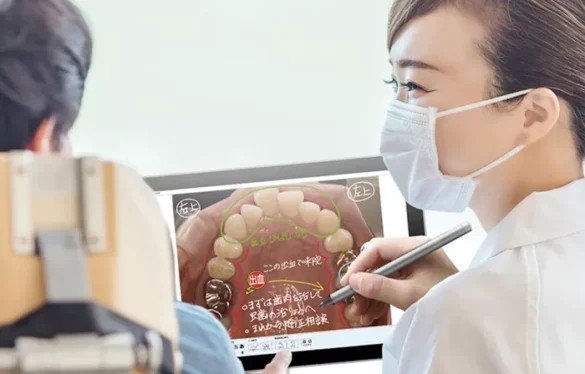
MEDIA aims to solve this communication gap. The company’s imaging solutions—centered around its signature product “Visual-MAX”—are designed to make complex medical information easier for patients to understand. Built around a pen display interface, Visual-MAX helps dentists visually explain diagnoses and treatment options. This approach gives patients a clearer understanding of their condition and empowers them to take an active role in their care.
Empowering Patients Through Visual Communication
MEDIA Chairman Hironobu Tsuji emphasizes the importance of visual data in medical communication. “In the future, healthcare will shift from a model driven solely by specialists to one where patients receive informed guidance and live with health in mind,” he explains. “Among all types of medical information, visual content has immeasurable value.”
This philosophy has driven MEDIA to expand its technology beyond basic communication tools. One of its latest innovations uses AI to analyze panoramic dental X-rays to detect signs of osteoporosis. This condition, known as the “silent disease,” often goes unnoticed until a serious fracture occurs—especially in elderly women. Early detection is crucial.
MEDIA’s AI system scans jawbone density in dental X-rays and alerts dentists to possible fragility. If signs of osteoporosis are present, the dentist can refer the patient to a specialist for early treatment. Approved by Japan’s Ministry of Health, Labour and Welfare, the software is the first AI-based dental device in the country to aid in diagnosing jawbone weakness. Tsuji sees this as a breakthrough that opens the door for closer cooperation between dentistry and general medicine.
A Vision for a Connected Healthcare Future
Beyond imaging and AI, MEDIA is committed to building the digital infrastructure of the future. Since its founding, the company has focused on creating electronic health record (EHR) systems tailored for dental practices. Tsuji envisions a nationwide medical information network, where clinical data from every institution is securely stored and accessible for longitudinal tracking and future care.
“The EHR network must be considered a core part of the national medical system,” he says. “Dentistry should offer valuable insights not only for dentists but also for medical doctors, nurses, and care providers.”
While Japan has historically lagged behind other developed nations in healthcare digitalization, progress has accelerated in recent years. Authorities are now building integrated medical information systems that aim to dissolve barriers between specialties. MEDIA’s technologies align with this vision by supporting digital transformation (DX) across the entire healthcare sector.
Tsuji is confident that the coming decade will bring sweeping change. “By 2032, when MEDIA marks its 50th anniversary, I believe digital transformation will be well established throughout Japan’s healthcare system,” he predicts. “ICT and AI will drive innovations that reshape the way we deliver care and ultimately lead to healthier, longer lives.”
As Japan advances its healthcare goals, MEDIA stands at the intersection of technology, dentistry, and patient empowerment—working to ensure that tomorrow’s care is both smarter and more connected.
