

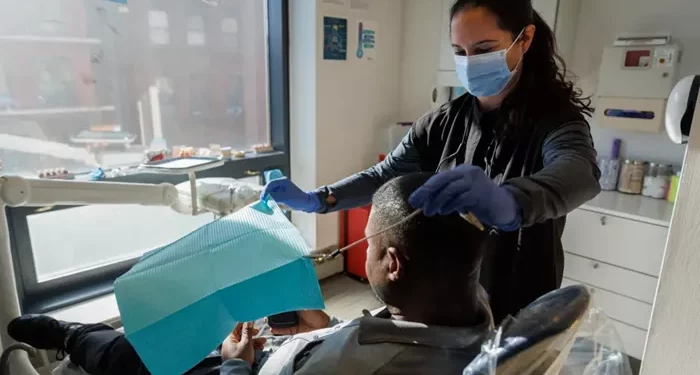
Harlem resident Furaha Moyé, 76, credits Harlem United with preserving her smile and confidence. For over a decade, the Upper Manhattan community health center has provided her with affordable, quality dental care—essential for her career as an actor and model.
“I know I would have really gone into myself had I not gotten that care,” Moyé said. “The self-esteem, the confidence—the whole nine—is impacted.”
Moyé appreciates Harlem United’s commitment to serving patients regardless of their ability to pay, highlighting the financial barriers many face in accessing dental care. “If your teeth are not good, the rest of your body can’t be good either,” she said.
Dental care costs remain a major barrier, particularly for low-income populations. Families living below the federal poverty line spent 2% of their income on dental care in 2021, compared to just 0.3% for high-income families, according to the CareQuest Institute for Oral Health.
Medicaid can provide critical support, offering dental coverage for children and, in some states, adults. Yet only one-third of New York dentists accept Medicaid due to low reimbursement rates and administrative challenges. “It’s a losing proposition,” said Dr. Maurice Edwards, president of the New York State Dental Association.
Missed appointments among Medicaid patients and socio-economic challenges like transportation and inflexible work schedules contribute to limited provider participation, experts say. “There’s a longer-term cultural shift needed in how society and providers view certain populations,” noted Colin Reusch of Community Catalyst.
In New York City, Medicaid dental shortages are concentrated in low-income communities of color. The Bronx, with over half its population Latino and a quarter Black, and Central Harlem face significant provider gaps. About 65% of Bronx residents are enrolled in Medicaid, according to the United Hospital Fund, while nearly 29% of Central Harlem residents live in poverty.
Oral health disparities are stark: Black and Latino adults experience untreated tooth decay at nearly twice the rate of white adults, with higher rates of tooth loss. Among children, over half of Latino youth aged 2 to 19 suffer untreated decay, contributing to school absences, low self-esteem, and poor academic performance.
Dr. Jerica Cook, president of the Bronx County Dental Society, emphasizes the “oral-systemic connection,” where oral health reflects broader medical conditions, including cardiovascular disease, diabetes, and Alzheimer’s.
Community health centers like Harlem United provide comprehensive care, including dental services, preventive medicine, and behavioral health. Harlem United’s dental team treated 1,200 patients in 2024, over half on Medicaid. Yet centers face financial strain, with rising costs for equipment, staff, and supplies outpacing reimbursement rates.
Nearly half of community health centers operate with less than 90 days’ cash on hand. Only 82% of New York’s centers offer dental care, compared to 96% offering mental health services. Medicaid funding accounts for 44% of revenue, but recent federal legislation threatens this support.
The Trump administration’s “One Big Beautiful Bill,” phased in starting late 2026, tightens Medicaid eligibility and recertification. In New York, an estimated 1.5 million people could lose coverage, reducing community health center revenue by more than $300 million annually. Dental services face particular risk of cuts.
“Health centers are already in trouble, and this may be what breaks them,” said Marie Mongeon of the Community Healthcare Association of New York State.
Staff at Harlem United say the new Medicaid requirements—80 hours of work, school, or volunteering per month and more frequent paperwork—create unnecessary barriers for patients already facing economic hardship.
Advocates call for increased Medicaid reimbursement and reinvestment in community health centers. Douglas York, CEO of Union Community Health Center in the Bronx, said, “It keeps people healthier. It detects diseases earlier. It prevents catastrophic illnesses later. Ensuring basic oral health benefits is just logical.”
With millions of New Yorkers relying on these safety-net providers, experts warn that preserving affordable dental care is critical not only for oral health but for overall community well-being.