

Next-Level Imaging
/
/
Next-Level Imaging

Next-Level Imaging

Carestream Dental’s digital sensors and 2D and CBCT imaging units work together to create a high-quality, seamless imaging workflow—and DPS readers agree
 

csrvg00.png

In today’s world of instant gratification, taking an x-ray for immediate review is perfectly aligned with practice and patient expectations. But it wasn’t always that way. Four decades ago, when Dr. Francis Mouyen invented RadioVisioGraphy (RVG), it was a game changer in dentistry that remains a staple of patient care today. Just ask DPS readers, who voted Carestream Dental’s RVG intraoral sensors as their go-to for quality, reliable images.


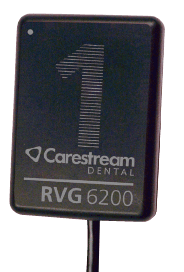
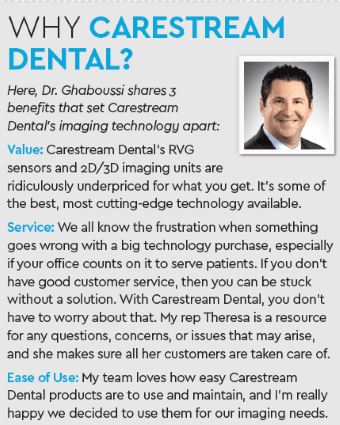
“I’ve found RVG sensors to be very high quality, ex­tremely easy to use, and practical. They come with built-in periodontic, endodontic, and dentin-enamel junction filters, which make it easy to see what you need to,” explained Dr. Kaveh Ghaboussi. “And with 24 lp/mm true image resolu­tion, the images come out crystal clear and easy to see. After all, we rely on our ability to diagnose to properly plan patient treatment, and diag­nosis becomes a whole lot easier when you can actually see what you are looking at!”


With a waterproof design and reinforced cable that’s 20% thinner than previous sensor generations, durability is a non-issue with the RVG 6200. “The RVG sensors are robust, and we haven’t had any problems with them,” added Dr. Ghaboussi. “They’re also rounded with a fairly flat exit point for the cord, which makes them less bulky than a lot of brands. Patients like this feature for comfort and assistants appreciate it for ease of use.” 

csrvg01.png

Versatile, Simple, and Everything in Between


Known for its integrated systems, Carestream Dental’s RVG 6200 and 2D/3D imaging systems all operate off the same imaging platform, creating a digital imaging hub for the practice. That means Dr. Ghaboussi can review a patient’s 2D images captured by the RVG 6200 and 3D images from his CBCT unit all within the CS Imaging version 8 platform. Dr. Ghaboussi uses the CS 9600 in his practice, which blends 2D panoramic and cephalometric imaging with CBCT imaging, and even 3D facial and model scanning.


“Our office uses this machine all day long,” he shared. “Its versatility allows me to take the size scan that I need with the minimum radiation exposure to the patient. If we are doing endo, we can take a tiny, 4-cm scan, all the way up to a 16×17-cm scan for an implant reconstruction. And then there’s the intuitive software with modules for airway, implants, and ortho, a Live Positioning Assistant, video cameras, and artificial intelligence—all of which make it easy to get a great scan on the first try.”

WhatsApp