

Highly radiopaque and compatible with most file systems, SimpliCore offers a dense 3Dfill, easy and efficient obturation, and predictable results

DAVE KING, DDS
Dr. King was born in Utah but grew up in Montana, Idaho, and the Kansas City, MO, area. Initially a music major at Central Missouri State University, he served a 2-year proselyting mission in Taiwan, where he realized the impact of a service-motivated mindset and changed his career focus to dentistry. He graduated from the University of Missouri-Kansas City School of Dentistry and practiced for 7 years in the Kansas City area, later relocating to Albuquerque, NM. After nearly 4 years there, he relocated back to Missouri where he currently is partnered with Lumio Dental and practices at Ballwin Family Smiles in Ballwin, MO. He creates and shares uplifting dental and lifestyle content on his YouTube channel: youtube.com/davekingdds.
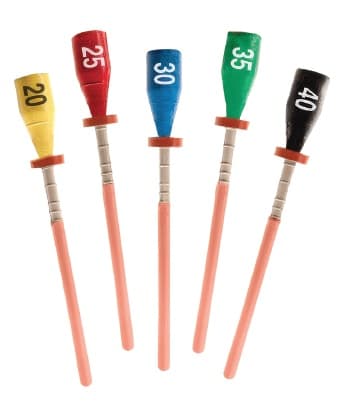
Highly radiopaque and compatible with most file systems, SimpliCore offers a dense 3Dfill, easy and efficient obturation, and predictable results
When it comes to obturators, everyone has their favorites. But the complexity of root canal treatments means clinicians need methods and materials that work simply and efficiently—every single time.
Just as its name implies, SimpliCore gutta-percha carrier obturators are designed to turn what tends to be a challenging technique into one that is simple. In fact, “simple” is one of the very first words Dave King, DDS, uses when describing his experience with SimpliCore.
Keep Your Technique
“I really like this particular modality,” he shared, “because it’s a simple, uniform system. You can easily see where the carrier is, and the obturators are easy to use. One concern of mine is that obturators can get expensive, especially when they repeatedly bend or break. I haven’t seen that with SimpliCore.”
For dentists using a carrier-based obturation method, SimpliCore is designed to work with their current file system and thermal obturator oven settings. A solid gutta-percha core with length verification markers, the SimpliCore system reduces the time it takes to obturate canals, offering an easier obturation method compared with warm vertical or cold lateral condensation techniques.
“One of the challenges I’ve experienced in the past with similar carrier-based systems is that once the carrier was inserted, I found that it would cool down too fast—or sometimes, it wouldn’t cool down fast enough,” noted Dr. King. “I really like the 3D fill with SimpliCore, and I haven’t had to worry about any redos. The adaptation to irregular anatomy or unique morphologies also is excellent.”
Compatible with most file systems, SimpliCore can fill .04 and .06 tapers, as well as tip sizes from 20 to 50. Highly radiopaque, the system includes an easily removable handle and offers dense 3D fills for consistent clinical outcomes.
“This system really shines when you have a nonstandard canal structure, such as a first or second premolar, or where you have an MB2 canal on an upper first or second molar,” he added.
Dr. King can easily visualize the carrier, and once it’s cooled, simply break off the handle without worrying about damaging the remaining gutta-percha.
“An obturation system should be predictable and simple, so that as clinicians, we can be comfortable with the technique we use,” he continued. “In my experience, SimpliCore has eliminated a lot of the complexity from the endo realm. I’d give it 5 stars and would highly recommend it.”

