

Backed by years of scientifically proven efficacy, this all-in-one dentin substitute has a healing effect that helps preserve pulp vitality
The main reason pediatric dentist Dr. Lance Kisby has relied on Septodont’s Biodentine, and now Biodentine XP, for years boils down to one key fact: it chemically bonds to dentin, and that protects pulp health.
The all-in-one dentin substitute is indicated for a variety of endodontic and restorative cases in both children and adults. For many clinicians, it’s their go-to for both indirect and direct pulp caps, as well as pulpotomies. Dr. Kisby even describes it as the “duct tape” of pediatric dentistry.
Biodentine XP doesn’t cause inflammation or harm to the pulp, he said, unlike other treatments that can slowly kill it. Because of the tight seal it forms with dentin, bacteria will never leak under the exposure and cause decay—which is what Dr. Kisby says “makes it so good.”
What Is Biodentine XP?
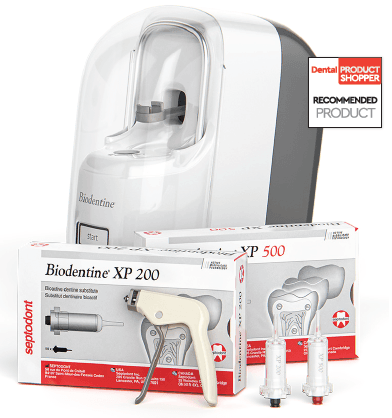
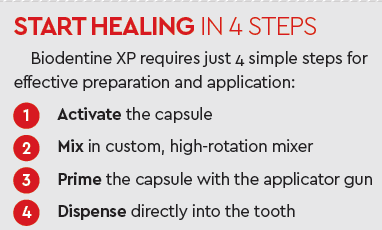
Featuring Septodont’s patented Active Biosilicate Technology, Biodentine XP comes in a ready-to-use capsule containing both powder and liquid. The XP version offers the same benefits as its predecessor but comes with a proprietary XP Mixer.
It takes about 30 seconds to mix the highly pure tricalcium silicate to a consistency that’s similar to very fine yogurt, said Dr. Kisby. It’s not gritty, making it easy to apply via the included applicator gun.
“We use the tricalcium silicate as an insulator for indirect pulp caps, and we use it for direct pulp caps to cover up an exposure to avoid root canals,” he added. “We turn what could be a $3,000 procedure into a $60 procedure.”
When only a thin layer of dentin remains after drilling, Biodentine XP can fill the deep holes, insulating and revitalizing the pulp. Not only does this protect patients from sensitivity to hot and cold, but it also can save the tooth.

Creating New, Strong Dentin
In the past, any pulp exposure—no matter how small—led to a root canal. Biodentine changed that, Dr. Kisby said. When Biodentine XP is placed for a direct pulp cap, the material ultimately creates a new dentinal bridge. When the patient comes back 3 months later, he sees healthy dentin.
“Unlike other products that have been used as dentin replacements, it doesn’t cause inflammation or pus,” Dr. Kisby said. “You’re stimulating the pulp to make good, normal dentin on its own.”
Biodentine XP also can be used for pulpotomies in primary teeth, Dr. Kisby said. If he bumps into the pulp while removing decay, he scoops out the infected pulp tissue and places the material. This leads to fewer root canals and happier patients.
“I create a hole, put Biodentine over it and it sets up hard as a rock,” Dr. Kisby said. “That’s why I call it the ‘duct tape’ of pediatric dentistry.”

