

Replacing a Failed Amalgam Restoration and Protecting the Pulp
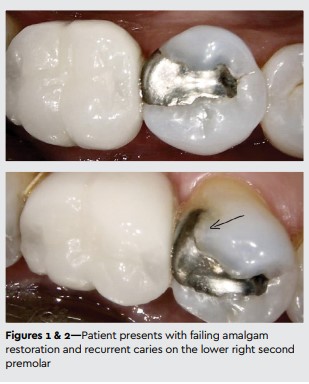
A 51-year-old man presented with a failing amalgam restoration with recurrent caries on the lower right second premolar, tooth No. 29. (Figures 1–2). The preop bitewing was taken to ensure that there were no other interproximal caries (Figure 3), and photos were taken with an intraoral camera (CS 1200, Carestream).
After applying inferior alveolar nerve block with 2% lidocaine with 1:100,000 epinephrine, a #24 clamp (Hu-Friedy) was placed on the second molar and a rubber dam was inserted.
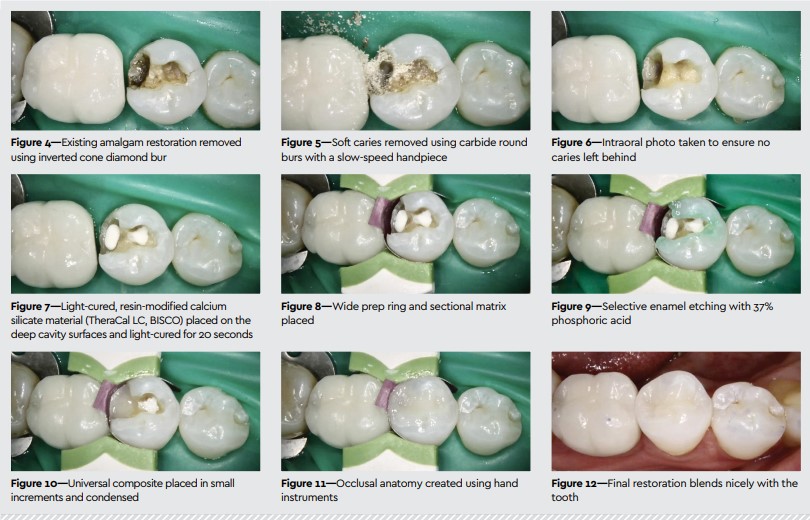
The existing amalgam restoration was removed using an 806.31.009 inverted cone diamond bur (Brasseler) to expose the recurrent caries and amalgam stains (Figure 4). All the soft caries were removed using carbide round burs (sizes RA 2, 4, 6) with a slow-speed handpiece (Midwest Shorty, Dentsply Sirona) (Figure 5). To make a clean and neat cavity preparation, all the superficial caries and stains were removed conservatively with a 6801.31.009 small round diamond bur (Brasseler). Then, an intraoral photo was taken to confirm that no caries were left behind (Figure 6).
After a clean and neat cavity preparation, a light-cured, resin-modified calcium silicate material (TheraCal LC, BISCO) was placed on the deep cavity surfaces and light-cured for 20 seconds (FlashMax P3, CMS Dental) to protect the pulp (Figure 7). Because TheraCal LC is opaque, it was also used to mask the dark amalgam stains that could show through the translucency of the composite.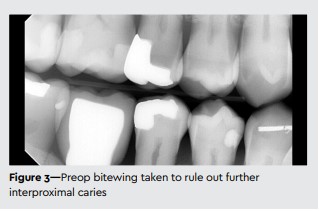
Due to the lingual extension of the cavity prep , a wide prep ring and sectional matrix (Composi-Tight 3D Fusion, Garrison Dental) were placed (Figure 8). Then, selective enamel etching was done using 37% phosphoric acid (Figure 9). The area was rinsed and dried, and a universal adhesive (All-Bond Universal, BISCO) was applied and light-cured.
A universal composite was placed into the gingival box first in small increments using a condenser and plastic instrument (Figure 10). Before light curing the final layer, some occlusal anatomy was created using several hand instruments: (21B Burnisher, Hu-Friedy), (Blue Titanium CIB3, Pioneer Solution), (#3A Explorer, Nordent) (Figure 11).
The occlusal adjustments and more detailed anatomy were created using a flame-shape diamond bur 274.31.016 (Brasseler). Finishing and polishing were completed using a large coarse disc (Sof-Lex, 3M), a #12 blade, and a sharp white stone (White Arkansas Stone, Dedeco). The final restoration has a natural appearance and blends nicely to the tooth (Figure 12).
THERACAL LC
A light-cured, resin-modified calcium silicate filled liner, TheraCal LC is indicated for direct and indirect pulp capping and as a protective liner under composites, amalgams, cements, and other base materials. The proprietary hydrophilic resin formulation creates a durable liner, while its light-cured set permits immediate placement.
ALL-BOND UNIVERSAL

ALL-BOND UNIVERSAL is the first universal dental adhesive to combine etching, priming, and bonding in one bottle. It can be used with both direct and indirect dental restorations; it will bond to all indirect substrates and is compatible with all composite and resin-based cements without an additional activator.

Dr. Chae has been practicing general and cosmetic dentistry in Diamond Bar, CA, since graduating from the University of California at San Francisco School of Dentistry in 2000. He is a member of the American Academy of Cosmetic Dentistry, American Dental Association, and California Dental Association. You can find Dr. Chae on Instagram @ diamondbar dentalgroup sharing his work and answering questions to his more than 27,000 followers worldwide.
