

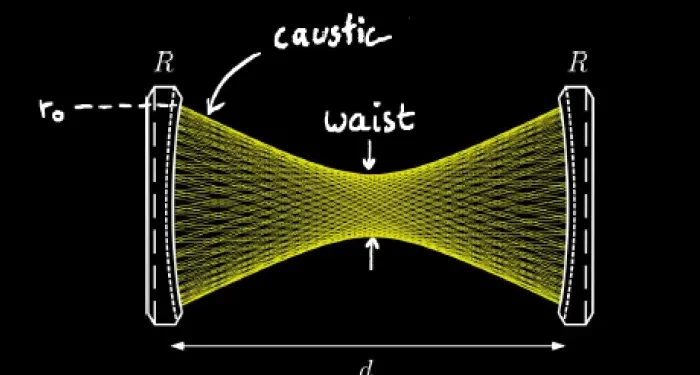
Scientists from Stanford University and collaborators have successfully developed an advanced cavity array microscope featuring over 600 individually controlled optical cavities, marking a significant step toward future quantum technologies. This new system offers enhanced stability and uniformity and paves the way for scaling to even larger arrays, with ambitions aiming for tens of thousands of cavities in the future.
The research team addressed key technical challenges that previously hindered the development of large, uniform cavity arrays—structures essential for manipulating light and matter at the quantum level. By overcoming issues related to optical aberrations, limited field of view, and performance inconsistencies, the scientists were able to achieve high finesse and strong interaction with individual atoms across the array. Their innovations could enable parallel quantum operations and more efficient readout of quantum systems, potentially transforming experiments in quantum electrodynamics.
A major breakthrough in this project was the careful engineering and characterization of the optical cavities. Each cavity had to be precisely controlled, and the system achieved an impressive average finesse of 114 across 603 cavities. This corresponds to a strong light-matter interaction, a key feature for fast and reliable quantum information processing. The scientists used specialized techniques such as aspheric lens displacement and advanced computer simulations to further improve cavity stability and identify remaining obstacles to scalability.
The team also analyzed sources of performance limitations, such as coating losses, surface irregularities, and dust, and established new methods to mitigate their impact. Using a field of view radius of 140 microns, the microscope demonstrated 537 mutually degenerate cavities, meaning they shared optimal operational conditions ideal for quantum operations. Further refinement, such as doubling the microlens array density and widening the microscope’s field of view, is expected to support even larger arrays while maintaining compatibility with current atom trapping technologies.
Experts say that this technology could unlock new possibilities for highly parallel quantum computations, fast quantum measurements, and exploring complex interactions between light and atoms. The study presents a clear path forward for building larger, more robust quantum systems and is seen as a major advancement toward practical applications in quantum networking and information processing.
Read More
