

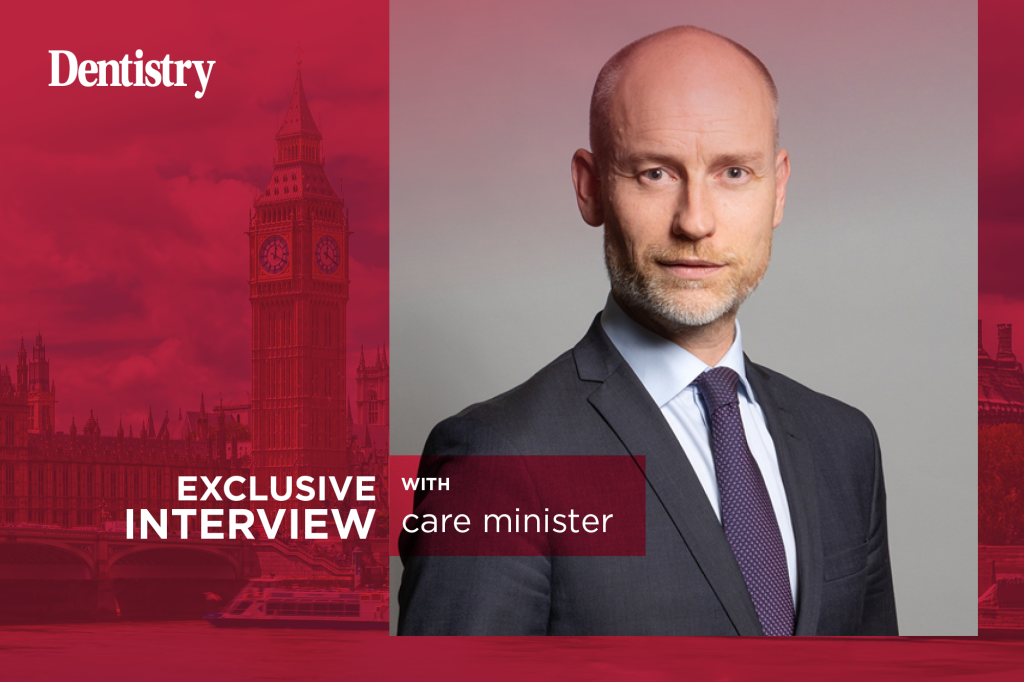
From graduate tie-in timeframes to NHS pensions for DCPs, care minister Stephen Kinnock breaks down the proposed NHS dental contract reforms in an exclusive interview with Dentistry.
This week, the government released a long-awaited consultation proposing changes to the NHS dental contract as part of its wider NHS 10-Year Health Plan.
Speaking to Dentistry, care minister Stephen Kinnock called the government’s plans for NHS dentistry a ‘two-stage process’.
‘What we have launched this week is about improving the contract as it stands, looking at quality and ensuring that we achieve our aims – particularly around urgent and unscheduled care,’ he said.
‘This is absolutely not the end of the story but an important building block for the bigger piece of work that’s coming down the line.
‘We are also going to be looking at a fundamental overhaul of the contract, which will look into some of the more structural and strategic issues within the contract. This will be coming in due course.’
Stephen Kinnock laid out the five main aims of the consultation proposals:
- Make life easier for those who need urgent dental care and unscheduled care
- A focus on complex care pathways
- Preventive oral care for children by promoting fluoride varnish treatments
- Reduce unnecessary recalls
- Develop minimum terms of engagement for dental associates. and quality.
The minister said there will be a ‘significant increase’ in remuneration for delivering urgent care.
‘We are proposing that the tariff for urgent dental care should be set at £70, plus a £5 administration and appointment fee,’ he said.
‘That is a significant difference – the average UDA now is around £40, so this marks a significant increase in what we’re offering.
‘We believe this will both incentivise urgent dental care but also mandate its delivery due to the percentage agreement that will be a result of the consultation.’
Will DCPs be eligible for an NHS pension?
An increase in the utilisation of dental care professionals (DCPs) features heavily in the proposals.
But is an NHS pension on the cards for them?
‘This is definitely something we want to look at as part of our longer-term contract reform work that’s not being covered in this consultation,’ said Kinnock.
‘Our fundamental objective is that by doing long-term contract reform, you have one that matches resource to need, and gives us a motivated and incentivised NHS workforce.
‘Terms and conditions are a really important part of that, so that would be in scope for the bigger piece of work that we’re doing.’
Timeframes for the dental graduate NHS tie-in
Last week, the government also revealed that UK dental graduates will be required to carry out NHS work for a minimum of three years after graduating – a policy that Kinnock calls one of ‘principle’.
‘On average, it costs the British taxpayer around £200,000 to educate and train a dentist,’ he said.
‘Yet we estimate around one third of the current workforce does no NHS work whatsoever. We don’t think this is right and I do think there’s an element of principle here. It is only fair that there is a return on that investment.
‘But we absolutely accept that it would be wrong to try to make people work based on the current contract when it is clearly broken, and in need of fixing.’
For Kinnock, there are two ‘mitigating factors’ that he wanted to make clear.
‘The tie-in policy will only come into effect for people who are newly entering the education process,’ he said.
‘This effectively means that it won’t come into force until 2031 because it would not be fair to impose this on people who are currently in study. This would also give us the time we hope to fix the contract so that those pursuing dentistry will do so knowing there is an NHS contract that actually works, incentivises you and has got fair remuneration.
‘The other point is that we will not be saying that you must commit 100% of your time to the NHS in those first three years. We recognise that dentistry is a mixed economy.’
A separate consultation will be launched to establish a ‘fair’ percentage of delivery, he said, adding that ‘it certainly will not be 100%’.
Dental professionals can take part in the consultation here. It is open for six weeks and will close at 11:59pm on 19 August 2025.
