A 2004 graduate of the New York University College of Dentistry, Dr. Nanavati is currently a private practice general dentist in Lindenhurst, NY, where he focuses on family, cosmetic, and implant dentistry. He is a Fellow of the International Congress of Oral Implantologists and volunteers with Donated Dental Services locally to provide care to those in need. Internationally, he has traveled to India to volunteer his services in communities who have no access to dental care.
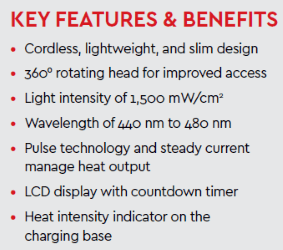
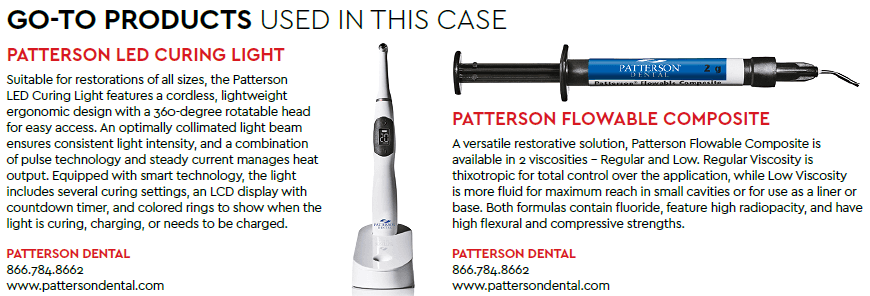
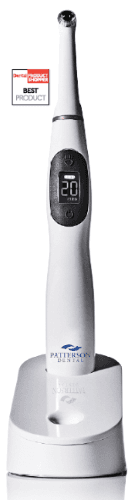
After obtaining consent from the patient, the treatment was completed as follows. No anesthesia was administered, as the treatment was minimally invasive. The area to be treated (teeth Nos. 4 and 5) was roughened with an inverted cone bur, and 35% phosphoric acid etch was placed for 20 seconds and then rinsed with water. A selfetch bonding agent was applied and cured with the Patterson LED Curing Light, and then Patterson Flowable Composite was applied to the teeth in shade A2 to cover the exposed dentin (Figure 2).
The flowable composite was cured for 20 seconds from the buccal side of the tooth, using the Patterson LED Curing Light. The light was comfortable and easy to use with good coverage from the orange shield, which could be rotated with ease. The angle of the head seems to allow easy access to all areas of the mouth and surfaces of the teeth.
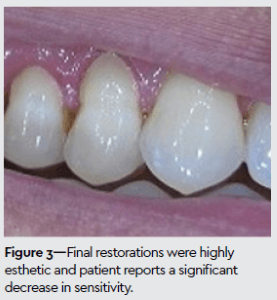
The composite restorations were smoothed with a pointed cone disposable diamond bur with a very fine grit (NeoDiamond, Microcopy) and polished with Sof-Lex polishing discs. The patient was pleased with the esthetic outcome of the case (Figure 3), and upon follow up, has described a significant decrease in sensitivity. He also was pleased with the contouring of the composite, as he had previously complained of a food trap in the abfractive areas.