


Soon after the mass adoption of clear aligners, it became apparent that a plastic shell did not provide sufficient purchase on the teeth for all movements. Attachments, or polymerised bumps of composite directly bonded to the teeth, were developed to provide a grip for these movements. Presumably, attachments provide better engagement between the teeth and aligner.

Fig. 1: Dispensing a flowable composite into an attachment template.
A technique for producing these attachments was developed in which a mould of the dental arch, or template, is used to form attachments directly on the teeth (Fig. 1). It is typically accomplished by injecting a small amount of composite into each of the attachment pockets in the template. This method enabled a great deal of customisation because many sizes and shapes of attachment may be produced, and there is wide choice regarding their position and orientation.
However, the procedure is complicated by the difficulty in dispensing the ideal amount of composite into the template. Too little composite results in the risk of bond failure or creation of an attachment with voids. In addition to affecting the ability of the aligner to engage the tooth and attachment, voids may cause discomfort because the craters left by bubbles may have sharp edges. Too much composite results in a significant excess, or flash, around the attachment perimeter (Fig. 2). Flash may attract stains, harbour plaque and inhibit the ability of the aligner to fully engage the attachment.1 All of these depend on the mould-filling technique, which can be difficult to standardise.
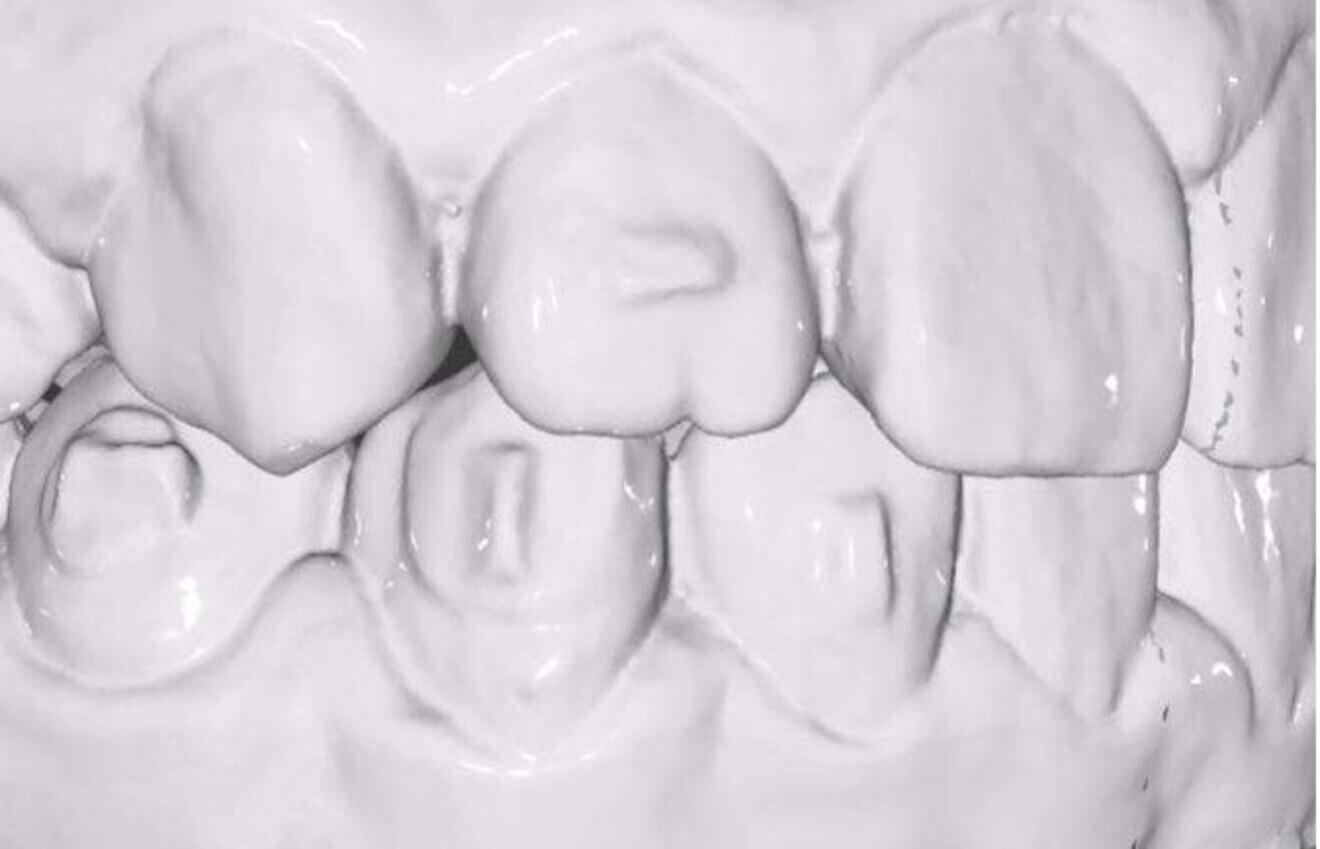
Figs. 2–3b: Poorly formed attachments and flash around attachments.
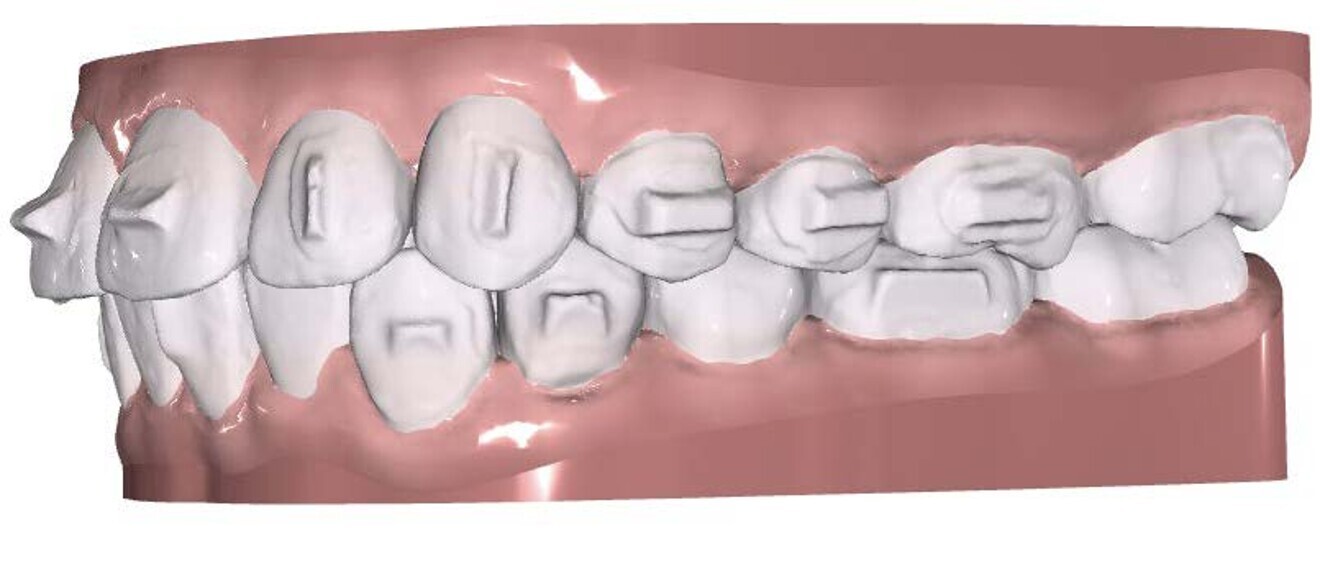
Fig. 3a
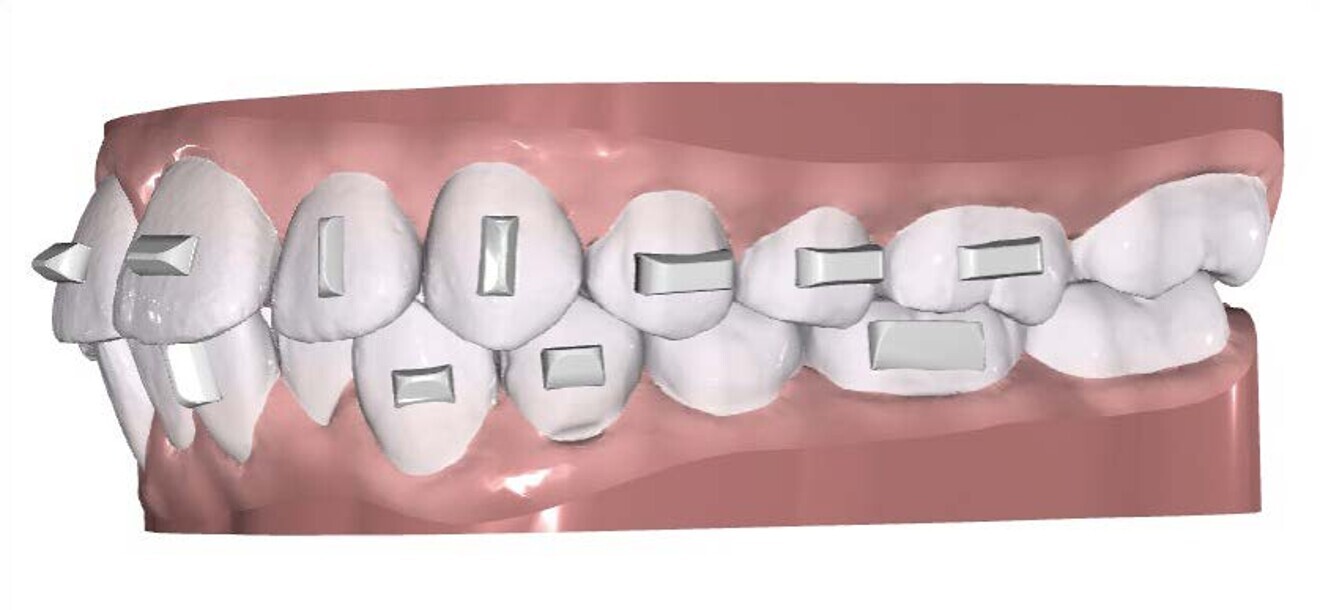
Fig. 3b
It has been recognised that clinical outcomes may be undermined by the lack of correspondence between the digital representation of the planned attachment and the actual attachment when bonded to the tooth.2, 3 This lack of correspondence may be the result of voids, flash or distortion of the attachment template (Fig. 3). We have used finite element analysis simulations to show that both composite flash and displacement may have deleterious effects on the direction of applied force. It is important for attachments to be accurately positioned and precisely shaped (Fig. 4).
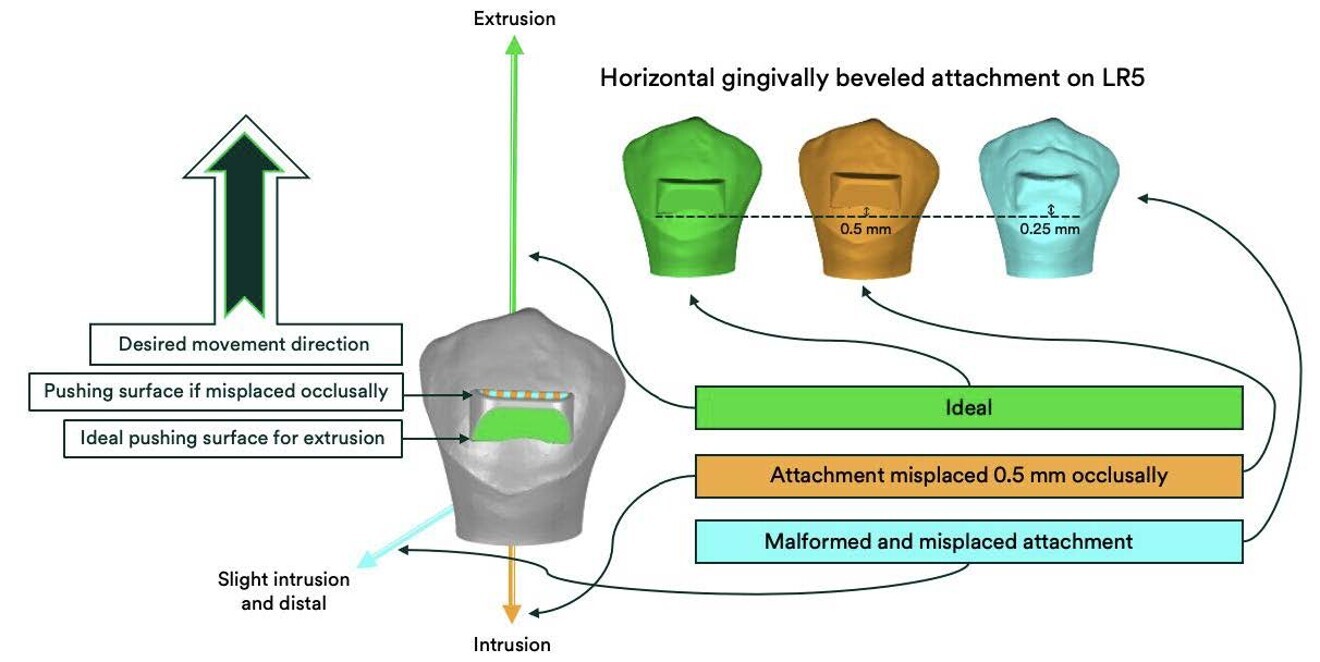
Fig. 4: Simulations of the force vectors obtained when horizontal gingivally bevelled attachments on tooth #45 are misplaced or malformed and misplaced. The green attachment achieves the desired force vector (green arrow). The orange attachment is misplaced 0.5 mm occlusally, resulting in a force vector in the opposite direction (orange arrow) of the desired force vector. The teal attachment is misplaced and has significant flash, resulting in a force vector in the incorrect direction (teal arrow).
Customisation through 3D printing
In order to deliver accuracy and precision, an improved process was needed. Ideally, the attachment templates could be delivered preloaded with composite. The tiny dimensions and custom shapes of attachments make precise filling of the pockets difficult. It is also difficult to judge the amount of material required to adapt to the curvature of the tooth surface; it must be estimated from the surrounding surface of the template.
To address this, we leveraged 3D printing as a solution. This technology offers the ability to efficiently produce custom articles with complex shapes and intricate detail. In this case, it is used to deliver to the clinician pre-hardened customised attachments. The fully polymerised, pre-hardened Clarity Precision Grip Attachments are delivered in a thermoformed attachment tray that relies on an intuitive bonding procedure (Fig. 5).
