

When it comes to dental adhesives, it’s time to learn the truth and improve your bonds
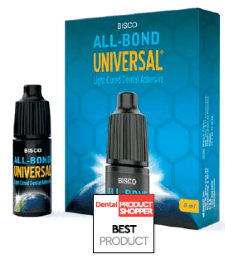
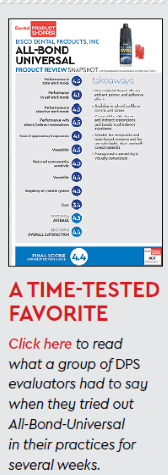
BISCO’s All-Bond Universal, for example, contains an MDP monomer while some others don’t. This functional, adhesion-promoting monomer bonds to every composite and resin cement as well as zirconia and other metal substrates. Universal adhesives also contain different solvents and water content. Ultimately, every adhesive performs differently. In some cases, the differences are nuanced, but in others they are huge.
BISCO’s All-Bond Universal is a true one-bottle universal system. It’s all you need no matter what material or bonding technique you use, reducing the inventory you must keep on hand and streamlining bonding procedures. Other systems require an additional bottle to work with indirect restorations, and it’s critical to know that before you get started. “It’s truly universal,” said Dr. Nuñez of what makes All-Bond Universal different. “You can use it with any product from any company and it’s going to work for you.”
2. The total-etch technique provides better strength than self-etch.
When using an adhesive like All-Bond Universal that contains the MDP monomer, the self-etch technique can be just as good—or even better—than total-etch on dentin,* BISCO President and Founder Dr. Byoung Suh affirms. MDP forms a strong, durable chemical bond with the tooth, so you don’t have to worry about the restoration failing. In fact, research shows the self-etch technique is better for dentin bonding, which is why BISCO recommends it for bonding procedures.
What is the advantage of using the self-etch technique? The smear layer is only altered, not removed, and that leads to less postop sensitivity. It also simplifies the procedure. “The adhesive acts as both an etchant and a primer,” Dr. Suh said. “This implies that etching and priming occur to the same depth of penetration. Before applying the self-etching primer, the preparation is dried. This means that there is no guessing as to ‘how wet is wet’ as with traditional, total-etch adhesives.”
Like with traditional ceramics, the bonding process still involves creating mechanical retention, it’s just done via different methods.
“Bonding to zirconia is possible,” Dr. Nuñez confirmed. “It is predictable and will yield a great clinical outcome.”
Better Bonds
BISCO is committed to developing products that improve bonding, as well as educating dentists on how to create better bonds no matter what technique or substrate is used. Knowing fact from fiction will help you bond with confidence, ultimately leading to long-lasting restorations your patients will love.
*Data on file, BISCO
