


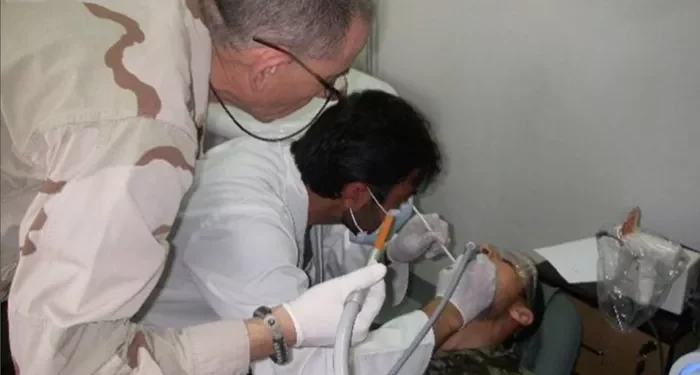
In a remote, war-torn valley in Afghanistan, a U.S. Air Force major is quietly driving change in local dental care.
Air Force Major and DDS Courtney Schapira was assigned to Forward Operating Base Lightning near Gardez to join an embedded training team of 21 medical experts from NATO member countries.
As the chief dental consultant at the Paktia Regional Military Hospital in Afghanistan, she is not only the only dental consultant on the team, but also the first expert to hold this position locally.
“Each member of our team has a different professional background, such as internal medicine, nursing and pharmacy,” said Schapira. “My mission is to improve the level of dental services in the Afghan military medical institutions.”
Since arriving in November 2023, Schapira has become a point of learning and cooperation with local Afghan dentists. “They are very eager to learn new knowledge, willing to ask questions, and try hands-on operations,” she said. However, she also admitted that there is a huge gap between dental technology in Afghanistan and the United States.
Although local dentists are skilled, many treatment processes are still lagging behind due to the lack of modern equipment and concepts. For example, anesthesia was rarely used during treatment in the past, causing patients to suffer unnecessary pain during multiple visits.
“Now, they will be anesthetized before all operations, which has significantly improved the treatment effect and efficiency.”
In the first few weeks after arriving, Shapira faced huge challenges. Not only did she have to deal with damaged equipment, shortages of supplies and outdated technology, but she also had to rebuild infection control processes and patient management systems. “I soon realized that I couldn’t solve all the problems in a short period of time, so I set phased goals.”
She first started to organize the clinic’s 6-foot by 10-foot storage room. In the past, it was full of unlabeled donated materials, and the management was chaotic, and it was impossible to clearly grasp the inventory status.
Due to the lack of basic training, local employees did not know how to classify and store or track the shelf life of materials.
“After the materials are sorted out, I can accurately assess the actual capacity of the clinic and future needs.” She explained.
With the equipment back to normal and the storage system in place, Shapira turned his attention to deeper reforms—including optimizing infection control procedures, introducing new technologies, and improving patient services.
“Training will now be our top priority,” Shapira said confidently. “I have laid the foundation for their success. I believe that as long as we continue to work hard, this dental clinic will have unprecedented potential.”