

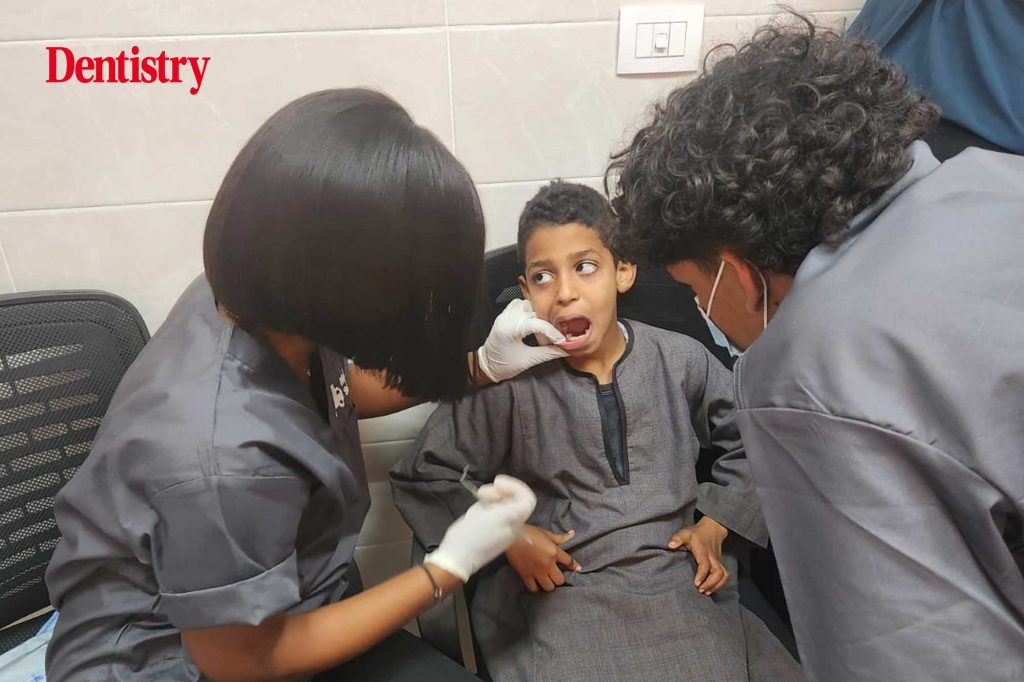
Chinwe Akuonu shares her experience of volunteering to deliver dental care to underserved communities in Luxor, Egypt.
Earlier this month, I travelled to Luxor in southern Egypt to volunteer with Mobile Smiles Charity, an organisation with a mission to deliver dental care to communities with limited or no access to treatment. The week-long trip began on 5 February and included four intensive days of clinical work from 6-9 February, providing essential dental services to adults and children who otherwise might not receive care.
Mobile Smiles focuses on delivering general dentistry in underserved communities – including extractions, restorations, professional mechanical plaque removal (gum treatments), preventive advice, oral hygiene instruction, fluoride application, and the distribution of toothbrushes and toothpaste. The aim is not only to relieve pain and infection, but also to support long-term oral health through education and prevention.
My decision to volunteer was rooted in something deeply personal. Giving back has always been central to why I chose dentistry – our profession is, at its core, a service to others. Having recently returned from Nigeria, where I was able to support my local community after more than two decades away, I felt inspired to continue on this path. Finding time within a busy professional schedule is never easy, but the desire to serve had been growing for some time.
Physical, financial and emotional commitment
The trip required significant planning and commitment. As a first-time volunteer with Mobile Smiles, I attended multiple online meetings with the team, led by Rafik, the founder, who coordinated preparations with clarity and organisation. These sessions helped orient us to the clinical environment, the patient population, and the practical realities of working in a mobile outreach setting.
Volunteers also contributed personally to the cost of the trip, covering flights and accommodation and taking time away from clinical practice – meaning a temporary loss of income. A fundraising campaign was set up to support the mission, and each team member helped transport essential supplies. Before departure, I visited Rafik’s practice to collect toothbrushes, toothpaste, and other materials, all of which had to be carried to Egypt as part of our luggage.
Even before arrival, it was clear this would require not just clinical skill, but real commitment – physical, financial and emotional.
Life on the ground
Each day began early. After breakfast, the team travelled for a couple of hours to reach the treatment site, working in collaboration with the local organisation Egypt Without Disease. Much of our clinical work took place in a mobile dental van – a compact but functional unit equipped with a single dental chair – alongside a treatment surgery inside a nearby building.
We worked in rotating roles: diagnosing and treatment planning, performing extractions and restorations, providing gum treatments and preventive care, and managing patient flow. Demand was overwhelming. Over the course of just four clinical days, we treated almost 300 patients. Our priority was to provide safe, effective care while helping as many people as possible.
The physical demands were considerable. Many procedures were performed on standard chairs rather than dental units, creating ergonomic strain. Headlights were essential, and although we brought personal protective equipment (PPE) from the UK, resources were sometimes stretched due to the volume of patients and the nature of the mobile setting. Equipment was available and functional, but not always as consistently as we might be used to in a fully equipped clinic.
Radiographs and imaging were not always available, so diagnosis often relied heavily on clinical judgement – percussion testing, careful examination, and close observation of patient responses. This required heightened awareness and precision, reinforcing the importance of strong diagnostic fundamentals.
Communication barriers
Language presented another challenge. I do not speak Arabic, so I was paired with a remarkable volunteering translator: 17-year-old aspiring medic/dentist, Youssef, whose empathy and attentiveness transformed communication with patients. His presence reminded me how much dentistry depends not only on clinical skill, but on human connection.
Teamwork was indispensable. Continuous collaboration, quick problem-solving, and mutual support enabled us to function effectively. The presence of oral surgeons, one hygienist, and local dentists supporting the team was invaluable. These clinicians guided us culturally and clinically, ensuring continuity of care through referrals when necessary.
Emotionally, the experience was intense but deeply rewarding. Patients expressed profound gratitude. We encountered significant levels of untreated decay in children and widespread gaps in oral health knowledge. Many parents associated dental problems with calcium deficiency rather than diet, hygiene, or fluoride exposure. Education became as important as treatment.
Providing care without sedation options added another layer of challenge. Managing anxiety and discomfort required patience, communication, and trust – skills that became as vital as any instrument.
Impact and ethical reflection
The impact of treatment was often immediate – relief from pain, restored function, and visible gratitude. Yet the experience also highlighted the broader realities of global oral health inequality. While I was already aware of these disparities, witnessing them again in practice reinforced how profoundly access to care varies across the world – and even within the UK itself.
Working closely with local dental professionals ensured some continuity through referral pathways, but short-term missions inevitably have limits. One of the most difficult aspects was prioritisation – deciding which patients could be treated and which could not. Saying no was often harder than any clinical procedure.
Cultural sensitivity also shaped clinical communication. In some contexts, even terminology required adjustment. For example, the word ‘disease’ carried strong negative connotations, prompting local clinicians to encourage more neutral language when discussing periodontal conditions. This reminded me that effective care must always be culturally informed.
Personally, the experience reinforced gratitude for clinical resources, diagnostic tools and healthcare systems we may take for granted. It also deepened my understanding that giving back is not simply financial, presence matters. Physical effort, emotional investment, and human connection create a different kind of impact.
Looking forward
This experience has strengthened my belief that global outreach is an important part of professional responsibility, particularly for those practising in well-resourced environments. Donating funds is valuable but being present on the ground offers perspective that cannot be replicated.
The team itself reflected the breadth of our profession – dentists at every stage of their careers, from newly qualified to retired, united by a shared commitment to serve. That collective generosity was as inspiring as the work itself.
I hope more dental professionals consider volunteering, even once in their careers. The experience is demanding, but profoundly meaningful. If travel is not possible, supporting outreach initiatives financially still makes a difference.
As for me, I intend to return. Service, once experienced this way, becomes something you carry forward.
