|
TARUN AGARWAL, DDS Dr. Agarwal is a full-time practicing general dentist who deals with the same issues all practitioners face— overhead, difficult patients, ups and downs of private practice, and team management. Despite his practice being contracted with insurance, he has managed to build a successful practice that is focused on clinical excellence, customer service, and allowing patients to choose optimal dentistry. Dedicated to continuing education, he has studied with many leaders in the field of dentistry, but readily admits his best learning has come from the “school of hard knocks. |
What CBCT Can Bring to Your Practice
A conversation with Dr. Tarun Agarwal about the overall value of CBCT in his practice
DPS sat down with Dr. Tarun Agarwal to discuss his views on CBCT and its value for the modern dental practice. Dr. Agarwal lists the various benefits of owning CBCT machines and some common misconceptions
|
|
I believe more dentists should investigate owning CBCT technology. I’ve been using 3D CBCT since 2009, and at my practice, we use it for nearly every patient. I look at the benefits of CBCT from 3 different angles:
1. Diagnostic Capabilities—to be able to see things in 3 dimensions versus 2 dimensions, to be able to see everything like the entire jaw or head instead of one small little x-ray is extremely profound.
2. Patient Communication—its use as a patient communication tool to be able to better convey what you’re seeing to the patient. This will help you gain better case acceptance and acknowledgement from your patient of their condition.
3. Expanded Services/Offering—its ability to expand the scope of services that you provide as well as its clinical growth opportunity. To me that’s the number 1 economic option—not just growing your practice but being able to expand it.
Those 3 benefits—the ability to diagnose more, the ability to communicate with your patients, and the ability to do new types of dentistry—are the real value propositions of 3D CBCT.
Diversify Your TreatmentsThe beauty of general dentistry is that you don’t have to be a specialist, so you can dabble in multiple disciplines. You don’t have to be an implant-only dentist, a sleep apnea dentist, or an orthodontic-only dentist.
That’s what I’ve really enjoyed about cone beam; it’s allowed me to introduce implants, sleep apnea, and more orthodontics into my practice. It has also added more complex diagnostics to my practice. For general dentists who have general practices, 2 or 3 of those different disciplines really makes a dramatic difference in the quality, speed, and economics of your practice.
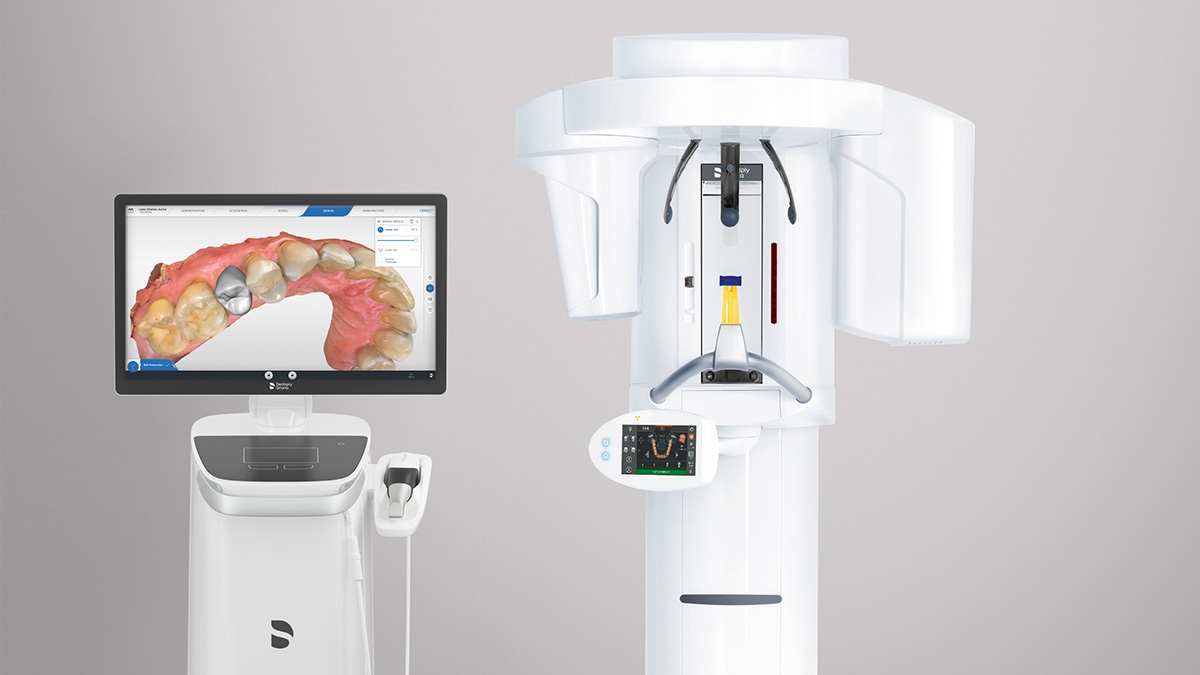
The Orthophos 3D/2D imaging system is also a one-stop tool for extraoral imaging. It is important to think of it as a dual-purpose machine. It gives you the capability of 2D imaging for those times when it is necessary and appropriate to take 2D images. In my practice, it is used 90% or more of the time for 3D imaging.
More on MisconceptionsThere are various misconceptions about buying into this technology. Again, a big one is the financial cost of it. I always like to say that technology is free, because it should be adding revenue to your practice, and thus paying for itself in a sense.
There is still the misconception that a lot of liability is created when you’re taking 3D images. CBCT has been widely available in dentistry for 15 years now, with thousands and thousands of units in offices across the country. Yet, we have not seen this supposed liability issue come up. While there is potentially some liability, this fear has not materialized. At this point, we have not seen any sudden, significant increases in liability in regards to using CBCT.
People also think that every scan has to be read by a radiologist, but I don’t find that to be true. Certain country or state laws or regulations may be different, but, here in the United States, not every scan needs to be read by a radiologist. Of course, if you see something you’re not familiar with or something out of the ordinary, then you should absolutely have it professionally read by an oral-maxillofacial radiologist. But again, that is a vast minority, it’s not the norm.
Tying in Other TechnologiesOne of the attributes of the Dentsply Sirona Orthophos 3D/2D imaging system is that it has a direct integration with their CEREC software. That’s an important point if you are a CEREC user and want the capability to integrate with the CAD/CAM software.
The Sidexis 4 imaging software comes with the Orthophos 3D/2D imaging system. This is not only used to capture 3D images and extraoral 2D images. It can also become an overall image management system, connecting with your intraoral sensors and photography technology as well, whether that’s intraoral cameras or a digital camera. Sidexis becomes an imaging hub for all patient imaging. This hub can be used to build and keep records of everything. It’s also the launching pad for the different modules within Sidexis, such as the diagnostic, endo, implant, and sleep modules. All of that is built directly within the Sidexis 4 software. This makes any clinical expansion more readily available and more seamless.
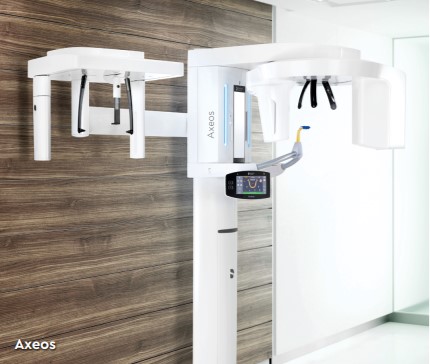
Dentsply Sirona’s latest 3D/2D imaging system, Axeos, brings 3D/2D imaging to a new level. It has the largest field of view of any Dentsply Sirona 3D/2D device. Compared to the company’s other devices, the Axeos can be used for the fullest range of functions in dental treatment.
What Are You Waiting For?I think it’s time to get off the fence. You can’t look backward and say, “I should have done it 10 years ago,” and you can’t necessarily look forward and say that you’ll do it 5 years from now either. The technology is proven. There is no question it helps you diagnose better; it helps you communicate better with patients, and it helps you expand your clinical scope of services.
|