


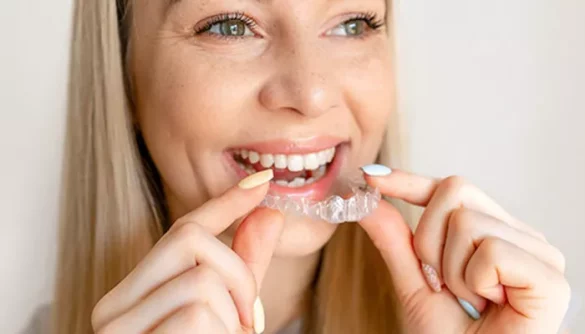
Invisalign has revolutionized orthodontics by offering a nearly invisible and comfortable alternative to traditional braces. With custom-made, clear aligners, it allows patients to straighten their teeth with minimal disruption to their daily lives.
However, not every dental case is suitable for Invisalign. Some conditions require more advanced orthodontic methods or even surgical intervention. This article explores in detail what types of teeth or dental issues may be considered too severe for Invisalign treatment.
What Is Invisalign and How Does It Work?
Invisalign uses a series of clear plastic aligners designed to gradually move teeth into their proper positions. Each set of aligners is worn for about two weeks before being replaced by the next set. These aligners are custom-made based on digital scans of a patient’s mouth. Invisalign works best for mild to moderate dental issues, including:
- Minor crowding
- Small gaps between teeth
- Slight overbite or underbite
- Mild crossbite
The effectiveness of Invisalign depends on patient compliance and the nature of the dental issue. Severe or complex dental problems may not be treatable using this method.
Which Dental Issues May Be Too Severe for Invisalign?
Not all teeth can be straightened with Invisalign. Some dental conditions fall outside the scope of what aligners can correct. The following are common situations where Invisalign may not be the right choice:
1. Severely Rotated Teeth
Teeth that are rotated more than 20 degrees from their normal position can be challenging to treat with Invisalign. The aligners may not provide the consistent force necessary to shift the teeth into alignment. Rotated molars are especially difficult to treat, even with traditional braces.
2. Large Tooth Gaps (Diastema)
While Invisalign can correct small to moderate gaps, wide spacing between teeth might require additional orthodontic appliances or procedures. Gaps larger than 6 mm often need more controlled force that Invisalign aligners may not deliver effectively.
3. Severe Overbite or Underbite
Invisalign can correct mild overbites and underbites, but severe cases typically require braces or even jaw surgery. When the upper or lower jaw protrudes significantly, bone structure needs to be adjusted. Invisalign cannot alter jawbone anatomy.
4. Intrusion or Extrusion Needs
Tooth intrusion (moving a tooth further into the gum) and extrusion (pulling a tooth outward) are difficult with Invisalign. These vertical movements are limited with clear aligners, especially in cases involving molars or premolars.
5. Complex Tooth Crowding
In cases of extreme dental crowding, where multiple teeth overlap or are misaligned, Invisalign might not be sufficient. Severe crowding may require tooth extraction or significant expansion of the dental arch, both of which may be better managed with traditional braces.
6. Open Bites in Adults
Open bites—where the upper and lower teeth do not touch when the mouth is closed—are particularly hard to treat with aligners. Though minor cases can be treated with Invisalign, more pronounced open bites in adults often need braces or surgical correction.
7. Midline Misalignment Greater Than 2 mm
The dental midline refers to the line between the two front teeth. If this midline is off by more than 2 mm, Invisalign may struggle to reposition the teeth effectively. Braces provide more anchorage and precise adjustments in such cases.
8. Dental Restorations and Missing Teeth
Patients with dental implants, bridges, or multiple missing teeth may face challenges with Invisalign. Implants are fixed and cannot be moved, which limits treatment options. Similarly, missing teeth can affect how aligners fit and move surrounding teeth.
How Orthodontists Evaluate Invisalign Suitability
Before starting Invisalign treatment, a dentist or orthodontist will evaluate several factors. These include:
- The degree of misalignment
- The number of teeth affected
- The patient’s bite and jaw alignment
- The presence of restorations, crowns, or implants
- Patient age and oral health
A digital scan or 3D imaging is often used to plan treatment. If the dentist determines that Invisalign cannot deliver the desired results, alternative options will be suggested.
Case Examples of Teeth Too Bad for Invisalign
Case 1: Severe Overbite With Jaw Deviation
A 25-year-old patient presents with a 10 mm overbite and misaligned jaw. Invisalign is not suitable due to the need for skeletal correction. Orthognathic surgery followed by braces may be required.
Case 2: Rotated Molars and Missing Teeth
A middle-aged adult with two missing molars and rotated second premolars will likely not benefit from Invisalign. The aligners cannot rotate molars effectively or replace lost teeth. Implants and braces may be necessary.
Case 3: Severe Crowding in a Teenager
A teenager with overlapping front teeth and insufficient space for canine eruption might need extractions and fixed appliances. Invisalign could only offer limited correction in such a case.
When Invisalign Might Still Work with Assistance
Some complex cases can still use Invisalign if combined with other treatments:
Attachments: Tooth-colored bumps that help aligners grip teeth better.
Elastics: Rubber bands that aid in correcting bite problems.
IPR (Interproximal Reduction): Filing between teeth to create space.
Hybrid Treatment: Starting with braces and transitioning to Invisalign.
These supportive techniques can extend the range of conditions treatable with Invisalign. However, they still have limitations.
What Are the Alternatives to Invisalign?
Patients who are not good candidates for Invisalign may consider these alternatives:
Traditional Braces: Most versatile option, especially for severe misalignments.
Lingual Braces: Braces placed on the back of the teeth for a discreet look.
Surgical Orthodontics: Necessary when jaw alignment needs correction.
Clear Ceramic Braces: Less noticeable than metal braces, but highly effective.
How to Know If Invisalign Is Right for You
The only way to know for sure is to have a consultation with a dental professional. During this visit, the orthodontist will take scans and determine if Invisalign can achieve the desired results. Being honest about your goals and expectations is essential.
Why Invisalign Might Not Work for Everyone
There are several reasons Invisalign may not be suitable, even if the patient prefers it:
Lack of patient compliance – Aligners must be worn 20–22 hours per day.
Severe skeletal or dental deformities – Require fixed appliances or surgery.
Unrealistic treatment expectations – Invisalign cannot work miracles.
Gum disease or decay – Must be treated before starting Invisalign.
Improving the Success of Invisalign Treatment
For those who are borderline candidates, these tips can help improve Invisalign success:
- Follow all instructions from your orthodontist.
- Wear your aligners at least 20–22 hours daily.
- Keep all scheduled dental appointments.
- Maintain excellent oral hygiene.
- Use chewies to seat aligners properly.
Being proactive in your care can make a significant difference in the outcome of your treatment.
Conclusion
Invisalign is a fantastic solution for many patients but not for everyone. Knowing what teeth are too bad for Invisalign helps you make informed decisions. Severe rotation, big gaps, extreme crowding, and bite issues often need more robust orthodontic solutions. Always consult a trusted dental professional to assess your individual needs and recommend the best path to a healthier, straighter smile.
If Invisalign is not right for you, don’t be discouraged. Modern orthodontics offers many options tailored to every case. The key is choosing the right one for your dental condition and long-term goals.