Over a century ago, Whip Mix was a small, family-owned business that offered a single analog product. Today, it stands as an industry leader in digital dental solutions.

Founded in 1919, Whip Mix derived its name from its first product: a dental inlay casting unit with a mechanical spatulator that whipped and mixed. Over the years, the company expanded its portfolio through internal development and acquisition, and with legacy product lines, subsequent generations of which it still produces today. Whip Mix’s chemical line also grew, and many of its early mechanical products, such as its vacuum mixers, trimmers, and articulators, can still be seen in dental laboratories—a testament to its longevity and enduring design.
Whip Mix CEO Anne Steinbock credits the changes the company has made over the last 20 years as having the most significant impact on preparing the company and its customers for the future. In 2007, Whip Mix opened its Digital Technology Solutions (DTS) division, marking the beginning of its journey into digital dentistry.

Ultimately, Whip Mix is committed to leveraging its technical expertise and manufacturing excellence to deliver practical solutions as a dynamic partner to dental professionals around the world. Whip Mix continues to evolve to meet the ever-changing needs that dental labs, dental practices, and dental schools face every day. As the company states, its love for the customer creates a relationship-driven business model that ensures success for all its global partners.
Back to Basics: Manufacturing
In July 2023, Whip Mix announced that it would be phasing out the reselling of its current portfolio of digital equipment. This decision was made to bring more focus to the company’s core strength of manufacturing quality products, including gypsums, investments, articulators, and 3D printing resin additives.
“This was a difficult decision given the strong brands represented, the success of our efforts, and the relationships we have developed with these key digital equipment manufacturers,” Steinbrock said. “Our restructuring effectively aligns our resources, strengths, and structure around our core digital and analog product lines. Since 1919 Whip Mix has continuously evolved to grow and provide innovative products and support to the dental laboratory, educational, and clinical market segments. Our actions build on that 100-year history and position the company for the future.”
3D Printer Resins
VERISPLINT OS
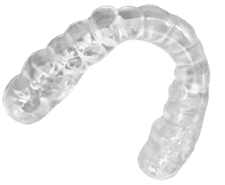
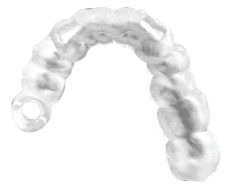
Among Whip Mix’s 3D print resins is VeriSplint OS, the first FDA-cleared 3D printable hard splint material, which provides an efficient and economical way to achieve accurate, high-quality splints. Leveraging additive manufacturing and this rigid, durable resin, splints can be produced with a high level of efficiency and without several lengthy steps, which lowers material costs. This also enhances digital design flexibility, which improves the lab and patient experience.

VERIMODEL OS
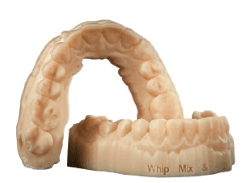
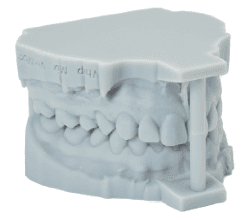
Whip Mix’s VeriModel resins include VeriModel OS Ivory, offering a high-quality surface finish and extreme precision for models. It can be used in any open-source 385- or 405-nm printer.
Methacrylate-based, VeriModel OS Golden Brown is specially made for dental models and removable discs and works with most open-system DLP, LCD, and SLA printers. Highly stable with low shrinkage and long-lasting toughness, VeriModel OS Grey Resin provides great visual contrast to waxes and can be used to fabricate full-study models, ortho models, or models with removable dies.

VERIGUIDE OS
Whip Mix’s VeriGuide is a Class I resin material developed for the production of high-precision surgical guides for use in dental implant surgery. VeriGuide OS has been successfully tested for biocompatibility and meets all mechanical properties requirements. The resin features an easy post-processing method and produces highly accurate surgical guides with high-quality surfaces.
Gypsums
ResinRock is a resin-fortified die stone that produces high-quality models. The unique blend of synthetic resin and alpha gypsum results in improved surface smoothness and increased resistance to abrasion. Its low setting expansion and dimensional stability make it ideal for implant and complex restorative cases where precision and accuracy are required.