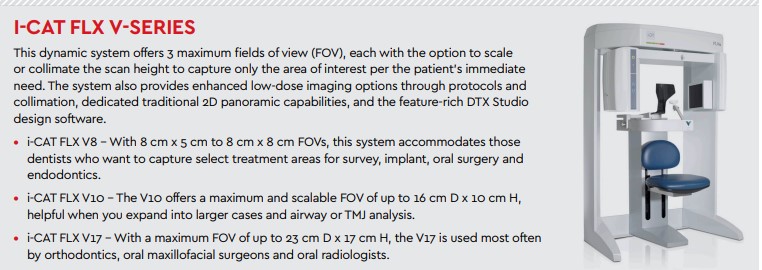
,With over 15 years of practice experience, Dr. Jordan C. Luna operates Stone Canyon Dental in
Sunnyvale, TX, where he makes it a point to conduct a thorough examination of teeth and surrounding tissue with the aid of an i-CATTM FLX-V-Series. Here, he explains how and why this CBCT imaging system has transformed his practice and, in many cases, his patients’ lives, ,When I was a young dentist just out of dental school, I joined a practice as an associate dentist, and the plan was for the practice owner to mentor me for 5 years. He would then retire and sell me the practice. For the first 2 months, we would look at x-rays and panos together and talk through cases, but then he went on vacation and left me with an established practice for an entire month. Practicing alone, I quickly realized there was a lot I did not know. Sadly, when he returned, he informed me that his cancer had returned, and he passed away months later., ,I wound up purchasing the practice from his estate, but I was without my mentor, and I needed to learn to walk without my crutch. Soon enough, I realized what I needed to do just that—3D imaging. After learning about the i-CAT, I realized it would not only become my crutch, but also a practice builder. As a young dentist, I wanted to make sure my practice was healthy and growing, and I felt that in order to do that, I would need to see everything with the clarity and detail of cone-beam imaging., ,The i-CAT was a big investment, but it’s been amazing. I haven’t skipped a step and I’ve never looked back. In fact, in the last 6 years, I’ve tripled production in this office, and a lot of that is because of that machine allowing me to do so much more. Not only does it give me the confidence that I can tackle a wide variety of cases, I’m also helping patients solve mysteries on a regular basis., ,Here are a few of the areas where the i-CAT has made a huge difference:,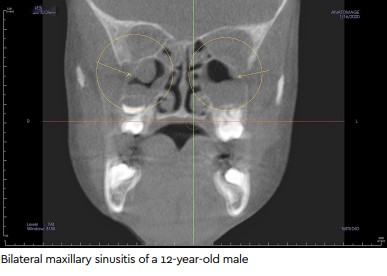 ,In my practice, we choose to take CBCT scans on all new patients, and we’ve started seeing that a lot of people here in Dallas suffer from allergies. In one case, we had a 12-year-old boy with bags under his eyes. He had delayed eruption of his baby teeth, because at 12 he should have most of his permanent teeth in. He’d been undergoing braces treatment. He doesn’t sleep well. He snores. He’s this tall 12-year-old about 5’ 10”, and we’re just trying to figure out: Why aren’t his teeth coming in? What’s happening?, ,So we take a cone beam, and we see that his sinuses are completely full. He is suffering from allergies and has restricted air. He’s always breathing out of his mouth because he cannot breathe out of his nose. So, I refer him to an ENT, who had him undergo 3 months of treatment with steroids and generally flushing out the sinuses. He comes back, we take another CBCT scan, and he’s completely cleared. The bags under his eyes are gone. Now, he’s running cross-country and is the starting quarterback on his high school football team. It’s an unbelievable transformation. Now, he comes in, and he’s about 6’ 2”. I say, “How are you feeling?” He says, “I feel like a new person.”, ,The i-CAT makes it easy to see if a tooth is infected. If there’s a radiolucency at the nerve in the bone, you can see that really well. You can see how many little canals are in each tooth before you do a root canal, and precisely measure how long that tooth is. It allows you to see if there are any cracks within the root. These are things that we cannot do with 2D film., ,When I do a root canal, I go in with full knowledge of the canal and the infection by taking a single scan. I know whether it’s something I can tackle or if a specialist is needed, and that’s a wonderful thing when you’re a clinician on your own., ,I have 2 female patients in their early 60s, and both have beautiful dentition and have had some crown work. They come in every 6 months, and they were both having issues around the same time—TMJ, headaches—so they went to their primary doctor, who then sent them to a specialist. Ultimately, they wound up in a neurosurgeon’s office, still trying to figure out what was going on., ,When they came to my office for their routine cleanings, we did a medical history breakdown and learned what was going on. So, I decide to take CBCT scan and look closely at their back molars, because I had a strong suspicion that the problem would have something to do with the teeth. Sure enough, both of them had infected upper-right back molars—just on one of the roots. We could see it plain as day, although you would not be able to see it on a 2D x-ray image. I sent them for root canal treatment. They already had crowns on these teeth, and the endodontist went straight through the crowns, and all their pain went away. They had been spending money on various doctor visits and were about to be placed on medication, but it all had to do with a sick tooth—clearly visible on the CBCT scan., ,With pediatric patients, I’m able to take a quick, low-dose CBCT scan when medically necessary and easily decide with the parents about whether the wisdom teeth need to come out. In general, one of the best things I do for my patients—especially the younger ones—is look at that scan and explain the things that we are looking for, whether it’s delayed permanent teeth, crowding, breathing issues, or something else., ,After taking a quick scan, I’m able to have a very thorough conversation with their parents about their child, who may be having sleeping problems, snoring, having issues at school, or getting sick frequently or experiencing allergies. I always think, “There may be more to this.” And the scan answers that question. I can then refer them back to their pediatrician, to an ENT for allergies, or whomever is needed based on what we detect., ,One thing that’s really nice about the i-CAT is you are able to take a scan and use the software to digitally plan whether this implant can fit in a given space. You can measure all different ways and check different anatomy as far as sinuses. You can check the density of the bone to know that the implant is going to be in a solid position, which is important because everybody’s bone is different., ,I use the i-CAT for guided surgery. We send out the scan and an impression so a guide can be 3D printed, which allows me to place implants with amazing accuracy., ,Gum disease is very prevalent in our community. By taking a scan, you can really see in 3D how much bone loss a patient might have around a tooth. We blow up the image and show it to them on the big screen. It is quite a visual for the patient and much more helpful than us trying to talk to the patient in terms that we understand but they do not. The cone-beam scan is an amazing tool for patients’ case acceptance., ,Because our practice sees the value of capturing CBCT scans when necessary, my team is trained on how to speak with patients and help them understand the reason for taking the image. They show the patients what we’re looking for—growth and development, sinuses, airway, alignment, and so many other things. If we see something out of the ordinary, we refer them to a specialist or I’ll take care of it myself, but this has become a very important part of what we do and has made an impact both on patients’ lives an the growth of our business.,