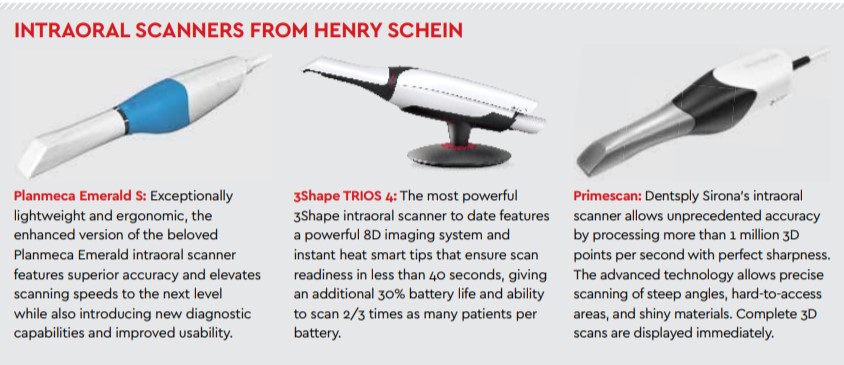
,Stepping into digital dentistry with an intraoral scanner can have a profound impact on the patient experience and the practice as a whole, ,It’s a tale of two patients: Patient No. 1 went to the dentist for a crown, had an impression taken, and later told family and friends how awful it was to spend 5 minutes gagging on a mouthful of thick goop. Patient No. 2 also needed a crown and an impression, but went home and shared, “I went to my dentist, and you wouldn’t believe what happened. They scanned my mouth instead of putting that rubber material in it, and the next thing I knew, I could see my entire mouth in color right there in front of me.”, ,The difference, of course, is the use of an intraoral scanner, which is making its way into more and more dental practices for reasons such as accuracy, speed, and to serve as the starting point of the digital workflow for restorations, implants, orthodontics, and more. However, for Dr. Wally Renne, the primary reason every practice should consider an intraoral scanner is simple—the patient., ,“Oftentimes, we as clinicians approach an investment as, ‘What is it going to do for me?’ I think the proper question is, ‘What is it going to do for my patients?’ We have so much evidence that patients unanimously prefer digital impressions over physical impressions,” said Dr. Renne, a professor and Assistant Dean of Innovation and Digital Dentistry at the Medical University of South Carolina. “While we are numb to it because it’s part of our daily practice, patients really do struggle with the physical impression. It’s a negative experience, and it’s something that’s often talked about after their dental appointment. But we could totally fl ip that whole entire negative conversation around to a positive one by incorporating digital dentistry—specifically, intraoral scanners—into the practice.”, , , ,“It’s one of the biggest things that we can do for our patients to eliminate their stress and anxiety.” ,– Wolly Renne, DMD, , ,Intraoral scanners have improved dramatically in the decades since their arrival. Cutting-edge systems such as the Planmeca Emerald S, Dentsply Sirona’s Primescan, and 3Shape TRIOS 4 present the opportunity to improve the patient experience, increase treatment acceptance, and reduce chair time as well as the number of patient visits per procedure., ,“Most scanners have become more compact and user-friendly, coupled with gains in both speed and accuracy,” said Michael Molloy, Henry Schein Director of Equipment and Technology – East. “These innovations have led to accelerated adoption of the technology.”, ,Dr. Renne, who began using digital scanners in his practice 13 years ago, likens their evolution to that of a cellphone. “The scanners we had back then were very difficult to use and they took a lot longer. Using a scanner was a hard conversation to have with the team back then. Now, it’s the reverse. Anytime I have to take a physical impression, my team members essentially shake their heads out of disgust, because they know it could be done much faster and easier.”, ,The Planmeca Emerald S, for example, is exceptionally small and lightweight, and capable of scanning an entire arch in under a minute—all of which benefits the user as well as the patient. Scanning contacts is significantly easier than before, and features from enhanced motion detection to tooth shade detection help streamline the workflow., ,Dr. Renne lauded the advancements being seen in intraoral scanners, including the ability to track wear and aid in caries detection. “We’re able to do things with scanners that we never would’ve thought were achievable 5 years ago. It’s amazing.”, ,
 , ,“Most scanners have become more compact and user friendly, coupled with gains in both speed and accuracy.” ,– Michael Malloy, Director of Equipment and Technology – East, henry Schein, , ,Intraoral scanners have a wide range of purchase prices depending on the system and an ongoing cost of ownership that includes the occasional replacement of autoclavable tips. In Dr. Renne’s experience, the cost of ownership is offset by the near elimination of impression material. ROI is achieved through many means, including the time saved by using a scanner, said Dr. Renne, citing a recent hybrid restoration he performed without an intraoral scanner, requiring a series of physical impressions that consumed 35 minutes, as opposed to 10 minutes with a scanner., ,ROI also comes in the form of treatment acceptance. When patients see their full-color scans blown up on the screen, they can better understand the need for treatment. A patient who grinds, for example, may not wish to act until seeing scans from two appointments overlaid with the wear color-coded in red., ,“It makes it personal for them. When they see their teeth, all chipped, jagged, and worn, with their malocclusion on the screen, and you’re able to open the bite and rotate the model in 3D with full color, they’re just in disbelief, and they want to fix it,” Dr. Renne said. “I think treatment acceptance has gone through the roof.”, ,Production is greatly increased when an intraoral scanner is paired with other technologies, such as 3D printing., ,“Without an intraoral scanner, a dental practice would not be able to 3D print models, splints, or night guards,” Molloy said. “By combining intraoral scanning and 3D printing, in-office 3D fabrication becomes a very efficient and profitable combination of technology. Each investment in new digital technology, when combined with the power of intraoral scanning, unlocks more digital workflows and thus more opportunities for return on the investment in these technologies.”, ,Patients value technology, particularly when it increases their quality of care and convenience. “It’s one of the biggest things that we can do for our patients to eliminate their stress and anxiety,” said Dr. Renne., ,”We can’t, right now, get rid of the injection as we know it, but we can totally get rid of the impression as we know it, and replace it with something that’s comfortable, faster, and that flips the whole script on the negative conversation to a positive one.”,