
 Prevent more disease by combining caries risk assessment with regular fluoride varnish treatment
 ,So often, we simply tell patients what they need—without really explaining why. When it comes to fluoride varnish treatment as a preventive measure for patients at risk of decay, the “why” is essential so that the patient understands the value and accepts treatment, especially for patients who lack insurance coverage for preventive care. However, because many hygienists don’t think they have a lot of time or simply don’t have an easy-to-use caries assessment tool, we fail to get them engaged in their own oral healthcare. When this is the case, we fail to do our job, which is to prevent disease.,In the early stages of demineralization we can reverse it, and later we can prevent it by eliminating bacteria. We need to educate patients and clear up the misconception that decay is caused by sugar, when in reality it’s caused by acid created when bacteria break down carbohydrates. If we don’t convince patients of this reality, it is unlikely they will see the value in paying an extra fee for preventive treatment.,For example, I had a male patient who was diabetic but told me he was not at risk because he didn’t consume sugar. I said, “It really isn’t just sugar. Any time you eat a carbohydrate, the bacteria in your mouth will feed on the carbohydrates, forming acid attacks on your teeth for hours. But there are ways to prevent that.” And he replied, “Oh, my God, I didn’t know that.” That’s when I realized I hadn’t been teaching patients, I was just telling them what they needed to do, and they didn’t see the value.,As part of my clinical assessment, I use an easy caries risk
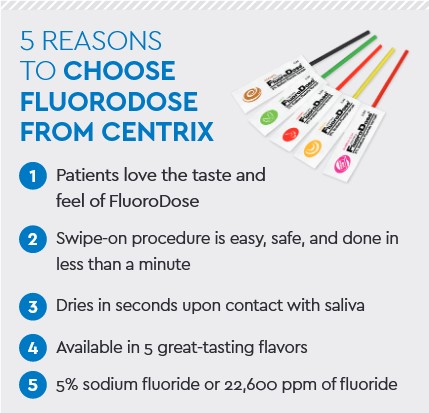 assessment tool from Centrix that helps categorize clinical, systemic, and environmental risks. This makes it easy to review my diagnosis and treatment plan with any patient and obtain treatment approval. If a patient is at low risk with no clinical issues or dry mouth, I won’t apply varnish. But if the patient’s risk assessment shows medium or high risk of caries, we will apply fluoride varnish—for example, if there is crown and bridge work and bacteria that they can’t seem to get out. I need that patient to understand that they are at a higher risk of caries, and if we don’t do something preventive, they may eventually lose that crown or bridge due to decay.,There is no patient who would choose to have a filling or a crown if they can avoid it. If they understood their risk level and that applying a fluoride varnish such as FluoroDose 4 times a year can help to prevent decay, who wouldn’t want it? For the dental team, it’s about doing risk assessment for present and future disease, and teaching our patients a little bit more so that we can prevent disease. Then, your patient can make an educated decision.,To learn more about FluoroDose and the Prevention for Life movement, visit cariesprevention.com


