Correct malocclusion with the Carriere MOTION 3D Appliance before treatment with Reveal Clear Aligners to deliver the most efficient and predictable outcomes for your patients,Dental innovations come in many shapes and sizes—from front-office software to imaging systems and restorative materials. The most impactful ones share a few common functions, serving to improve patient care, streamline processes, and offer the ability to increase practice production and stimulate growth. When it comes to orthodontic treatment, general practitioners and specialists alike now have access to a revolutionary system that checks all of those boxes., , “Start with a Motion 3D Appliance to solve the problem of sagittal, convert your case into Class I, and then jump into a short treatment of aligners.”,– Dr. Luis Carrière, ,By using the Motion 3D Appliance to correct malocclusion, dentists can simplify and streamline their clear aligner treatment. The self-managed appliance enables easy and predictable conversion to Class I occlusion as a lead-in to a shorter treatment with Reveal Clear Aligners, the crystal-clear, precision-fit aligners from Henry Schein Orthodontics that provide exceptional tooth-specific control and comfort.,“With these innovations, we are able to diminish—exponentially—the complexity of the orthodontic procedure,” says Dr. Luis Carrière, inventor of the appliance, who has been working with Henry Schein Orthodontics on innovations that effectively simplify orthodontic treatment protocols for any dental team.,The Motion 3D Appliance is a case opener that incorporates fast, natural, and gentle forces to correct Class II and Class III malocclusions at the beginning of treatment before transitioning to clear aligners or brackets. This innovative approach ensures that you address not only the patient’s occlusion, but their total-facial harmony. The appliance can be bonded immediately after patient consultation and takes under 15 minutes to place and educate the patient. It can be expected to establish a Class I platform in 3 to 6 months, with 4 months being most common timeframe.,Dr. Carrière describes it as both simple and safe, because the appliance has self-engineered collision points that enable all the corrections needed while preventing any chance of over-correction.“The doctor places one appliance on top of the tooth, and we tell the patient to use the elastics, which can be likened to placing gasoline in a car. We give the patient the car and
 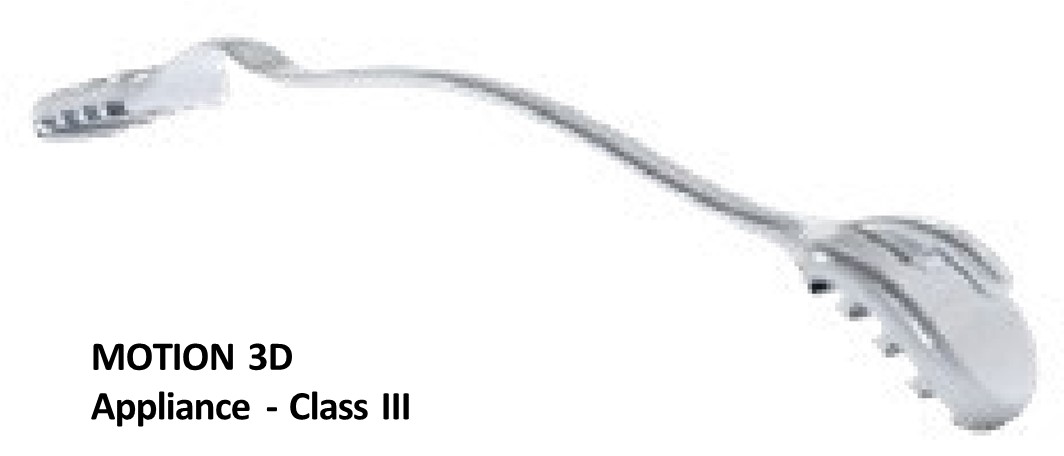 say, ‘OK, you are now in charge of the gasoline. The more gasoline you use, the faster you will go. The less you put in, the slower you will go. Or if you don’t put any in, nothing will move.’ So, they use their rubber bands, and boom! We’ve accomplished the perfect Class I. Normally, this happens in the fourth month.” Achieving proper occlusion reduces case complexity while addressing an area where clear aligner treatment falls short in terms of predictability. With the appliance, doctors turn a problem into a solution.,“Aligners are not designed for correcting sagittal,” Dr. Carrière notes. “They are super-efficient for correcting rotations, for correcting torque, for correcting transversal. But since sagittal is the weakest point of aligners, we address that with hybridization—start with a motion appliance to solve the problem of sagittal, convert your case into Class I, and then jump into a short treatment of aligners.”,The theme of reduced complexity also holds true during clear aligner treatment with Reveal, which offers a simplified workflow. Dentists submit cases via an intuitive web portal—an open-source platform that accepts STL digital impressions from all leading intraoral scanners, with direct connections available to users of scanners from both 3Shape and Planmeca. Conventional impressions also are accepted. From there, experienced technicians facilitate fast and accurate case setups for the dentist’s review. Treatment options are flexible, with the Standard of 21 to 30 sets; or Lite and Express packages of less than 20 and 10 sets, respectively. Because of the trays’ truly intimate fit to the tooth that produces higher retention, most cases have no need for attachments, unlike other aligner brands. This helps increase comfort and esthetics while reducing chair time and case complexity. Because the aligners are thermoformed using a proprietary material, they don’t have the lines often seen in a 3D-printed tray. According to Dr. Carrière, they are both clearer and better-fitting than other aligners.,“A Chevy is a car, and a Rolls Royce is a car, but they’re not the same. Both have four wheels, both have an engine, both have four seats, but they’re not the same. One is just better, and Reveal, in my opinion, is the Rolls Royce of clear aligner.,For doctors looking to begin using the appliance to correct malocclusion in advance of clear aligner treatment, Dr. Carrière has good news. There is no learning curve. They can accomplish Class I occlusion easily, resolving the most unpredictable aspect of clear aligner treatment.“A case that was super difficult,” he says, “becomes an easy case to solve., ,To learn more about the MOTION 3D Appliance and Reveal Clear Aligners, visit Henry Schein Orthodontics here.


