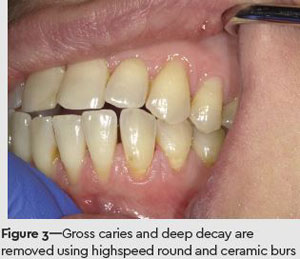
CASE PRESENTATION,A 38-year-old man presented for a routine dental examination. His chief complaint was, in his words, “I have a lot of cavities.” In fact, he had caries in all 4 quadrants and requested that his teeth be restored without metal fillings. His medical history was normal, so we obtained radiographs to determine the extent of the caries (Tuxedo intraoral sensor and XrayVision 4 software, Apteryx). In addition to radiographs, the caries diagnosis and extent of the decay was confirmed visually under surgical loupe magnification (EyeZoom, Orascoptic) (Figure 1).,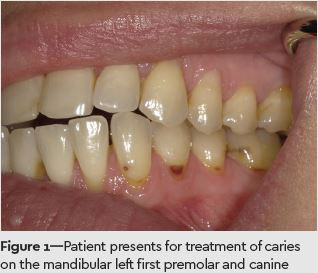 ,Fortunately, the diagnostics revealed no caries into the pulp, so the only treatment required for the patient’s affected teeth were composite restorations. We obtained intraoral photographs (EyeSpecial C-III, Shofu) and discussed the proposed treatment plan with the patient. He was delighted that he would not have to receive unsightly metal fillings to restore his teeth, and quickly scheduled the necessary appointments to receive his tooth-colored restorations.,The patient was anesthetized via a PDL injection (Septocaine, Septodont), and a mouth prop (DryShield) was placed into his mouth to ensure a dry field environment (Figure 2). Caries was removed using an LED micromotor attached to an electric handpiece controller (iOptima, Bien Air), which allowed me to precisely adjust the bur speed. The gross caries was removed using highspeed round burs at 200,000 RPMs and ceramic burs running at 1,500 RPMs were used to remove the deeper decay (Figure 3).,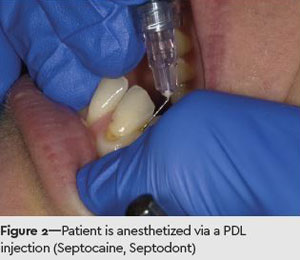
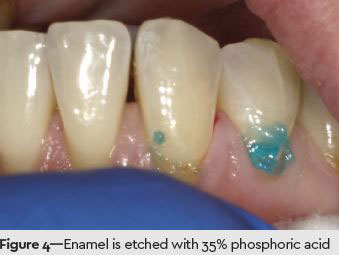
 ,Following caries removal, the enamel was etched with 35% phosphoric acid, and a universal bonding adhesive (Futurabond M+, VOCO) was placed on the enamel and dentin (Figure 4). The preparation was rubbed for 20 seconds, and then air dried for 5 seconds. The bonding adhesive was then light-cured for 20 seconds (Demi Plus, KaVo Kerr). The light output and material curing times were verified using a wireless smart radiometer (checkUP, BlueLight Analytics).,
 ,A single-shade, all-ceramic-based restorative material (Admira Fusion x-tra, VOCO) was selected for the restorations. This omni-chromatic material provides low polymerization shrinkage and is very easy to polish. Due to its nano-particle filler technology, Admira Fusion x-tra draws color from surrounding tooth structure to match any patient’s dentition with a single shade.,The material was placed into the preparations using a heated composite gun (Phasor, Vista) to improve the flow. The restorations were then cured and polished with finishing burs and polishers (Figure 5).,
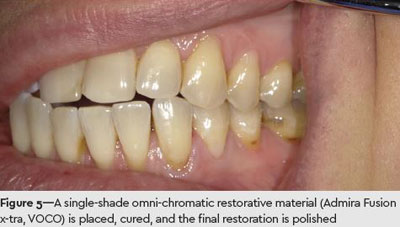 ,Postoperative instructions were given to the patient, who was pleased with the restoration and very happy to see the dark areas around his gums looking much better. He shared that he was enthusiastic about completing his remaining caries treatment. I feel enthusiastic, too, because I know that by using Admira Fusion x-tra to restore his smile, these future restorations will blend seamlessly into his existing dentition and create long-term esthetic results.,Admira Fusion x-tra,
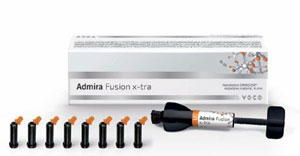 An all-ceramic-based omni-chromatic restorative material, Admira Fusion x-tra uses a single shade to match the entire range of human dentition by drawing color from surrounding tooth structure. The material uses innovative nano-ORMOCER technology to offer a low polymerization shrinkage rate of 1.25% and can be reliably cured in 4-mm increments. Because it is 84% filled by weight, it increases the longevity of the restoration while offering high shade stability and excellent wear resistance. A simple, high-luster polishing procedure and surface hardness ensure long-term results that are resistant to discoloration.,Dr. Jablow, a Dental Product Shopper Editorial Advisory Board member, is a clinician, speaker, and author. He presents and publishes worldwide on many topics, including state-of-the-art dental technology and dental materials. Dr. Jablow is president of Dental Technology Solutions, a lecture and consulting company. He is an active member of the ADA, New Jersey Dental Association, Middlesex County (NJ) Dental Association, and has achieved fellowships in the Academy of General Dentistry and International Academy of Dental Facial Esthetics.


