


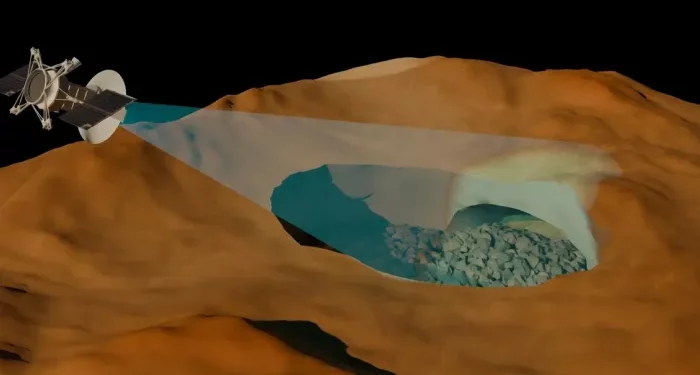
A team of scientists has identified a huge underground cavity beneath Venus, marking the first confirmed discovery of an underground lava tube on the planet. This finding, detailed in research published in Nature Communications, was made by carefully analyzing radar data from NASA’s Magellan spacecraft, which mapped Venus in the early 1990s. The study was supported by the Italian Space Agency and led by Professor Lorenzo Bruzzone from the University of Trento in Italy.
Unlike Earth, Venus is hidden beneath thick clouds that block normal cameras, making the planet’s surface and underground features hard to study. To get around this, the Magellan spacecraft used radar imaging, which can see through Venus’s dense atmosphere. By focusing on images where the ground appeared to have collapsed, the researchers identified a massive, hollow tunnel thought to be created by flowing lava long ago. This tunnel, known as a lava tube, runs beneath the Nyx Mons region, a giant volcano in Venus’s northern hemisphere.
The newly discovered lava tube measures about one kilometer in diameter, has a roof at least 150 meters thick, and forms an empty space at least 375 meters deep. Such features are sometimes found on Earth and have also been suspected to exist on the moon and Mars. However, this is the first time one has been clearly detected on Venus.
The study’s authors say these lava tubes are very hard to find because they are underground and only become visible if the surface collapses, creating pits. On Venus, radar is the only way to spot such structures since the planet’s thick clouds prevent seeing the surface directly. The special imaging techniques used by the research team enabled them to confirm that the identified structure is part of an empty lava tube underneath the side of the Nyx Mons volcano.
Venus’s unique conditions, such as its thick atmosphere and lower gravity compared to Earth, may make it easier for large lava tubes to form and stay intact. The size of the newly found tube is much greater than similar features found on Earth or even predicted on Mars, putting Venus at the upper limit for this kind of geological structure.
While only a section of the cavity near the surface was confirmed, there are hints that the underground channels could stretch as far as 45 kilometers. Researchers believe new missions with more advanced radar systems, like the European Space Agency’s Envision and NASA’s Veritas, will be able to find more of these tubes and gather clearer images. Both missions are expected to launch in the future and will carry powerful radar instruments able to study Venus from deep below the surface up to the top of its thick cloud cover.
The discovery marks a major step forward in understanding Venus’s volcanic activity and geological history. Scientists say these findings are important, not only for understanding how Venus compared to other planets, but also for helping guide future exploration missions that aim to investigate Venus’s hidden underground world.
Read More