


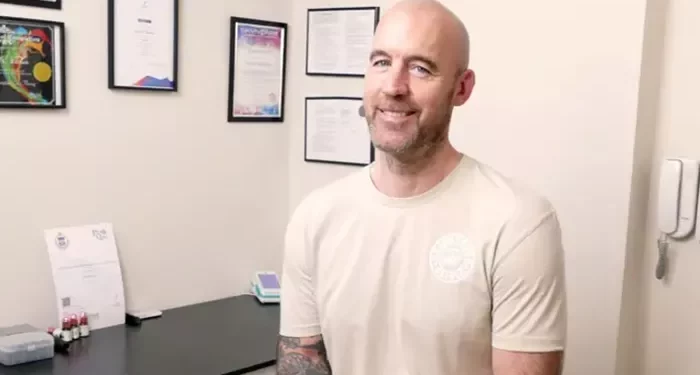
For many people, hair loss affects far more than appearance. It can also deeply influence confidence and self-esteem. In Cheltenham, Headstrong Clinic founder Russ Nicholson is working to address both the physical and emotional impact of hair thinning through aesthetic treatments designed to help people feel like themselves again.
Nicholson, now recognised as one of Europe’s leading scalp micropigmentation (SMP) artists, established the clinic after his own experience with hair loss during his twenties while serving in the fire service.
“Being a firefighter is about showing up for people on their worst days,” Nicholson said. “Helping people has always been a big part of who I am.”
While working in South Wales, Nicholson began to lose his hair at a time when he was building his career and personal life. The change affected him more than he expected.
“You suddenly don’t feel like yourself anymore,” he said. “People say it’s only hair, but when it’s happening to you, it chips away at your confidence in photos, social situations and even at work.”
After years of frustration with limited treatment options, Nicholson discovered scalp micropigmentation, a non-surgical procedure that recreates the appearance of natural hair follicles by placing pigment into the scalp.
He later underwent the treatment himself and said it had a profound impact.
“It transformed my life not just visually but emotionally,” he said. “I stopped thinking about my hair constantly, and getting that mental space back was huge.”
The experience prompted Nicholson to retrain and eventually launch Headstrong Clinic in Cheltenham. The decision also allowed him to reduce a long commute between South Wales and Gloucester and spend more time with his family.
“I wanted to create a place where people feel comfortable walking through the door — no pressure, no judgement,” he said.
Although Nicholson had no previous experience in tattooing, he said the technique quickly felt natural once he began training in SMP.
Scalp micropigmentation differs significantly from hair transplantation procedures.
Hair transplants relocate follicles from one area of the scalp to another, enabling hair to grow naturally. While effective for some patients, they can be expensive and results vary depending on the individual and the progression of hair loss.
By contrast, SMP does not restore hair growth. Instead, it creates the appearance of a closely shaved head or adds visual density to thinning areas.
“For someone with significant hair loss, even a successful transplant may result in very fine coverage,” Nicholson explained. “SMP offers a non-surgical alternative that can create the look of a full, shaved head.”
For many clients, he said, the psychological effect is significant. “It can make the shaved look feel like a choice rather than something forced on you.”
While scalp micropigmentation remains the clinic’s core treatment, Headstrong has gradually expanded its services as demand grew.
The clinic now offers hyper-realism eyebrow treatments, which use fine strokes to replicate natural eyebrow hairs for clients experiencing thinning or patchy brows.
Other services include laser tattoo removal, laser hair removal, IPL skin rejuvenation and carbon laser facials, often referred to as “Hollywood facials,” which combine laser technology with a medical-grade carbon solution to cleanse and exfoliate the skin while stimulating collagen production.
Nicholson said the expansion was driven largely by client requests and his own interest in skin health.
Many clients seeking SMP arrive feeling self-conscious about their appearance, Nicholson said, with some wearing hats or caps to hide thinning hair.
“There are men who embrace the shaved look confidently, and I admire that,” he said. “But for many others it has a real impact on how they present themselves and the opportunities they pursue.”
He noted that SMP can also help women experiencing hair thinning by creating the appearance of thicker hair and blending areas where the scalp is visible. In some cases, it may also support individuals living with certain forms of alopecia.
Nicholson believes the emotional impact of hair and skin conditions is often underestimated.
“While aesthetics might seem superficial on the surface, for most clients it’s about much more than appearance,” he said. “It’s about feeling like the most confident version of yourself.”
Nicholson’s work has also led him to become involved in mental health initiatives focused on men.
He supports Andy’s Man Club, a UK charity that provides peer-to-peer support groups for men across the country. He also volunteers as a skincare adviser for Look Good, Feel Better, a charity offering workshops for people undergoing cancer treatment.
He hopes to raise greater awareness about skin health and encourage more men to seek